The Physicist Who Derived Gravity from Light: How Frederic Schuller’s “Constructive Gravity” & “Probability Ports” Validate the ILC Framework
For more than a century, theoretical physics has been trapped in a polite, unspoken stalemate.
On one side of the hallway sits General Relativity, Albert Einstein’s magnificent geometric tapestry in which smooth, continuous spacetime curves in response to mass and energy. On the other side sits Quantum Mechanics, in which matter and light dissolve into a cloud of discrete, probabilistic operators acting on a Hilbert space. Between them yawns an abyss. Add to this the Hard Problem of Consciousness—the inability of mechanistic science to explain how mute, insentient matter could ever generate the felt interiority of subjective experience—and the Quantum Measurement Problem, and it becomes clear that the materialist operating system is facing a full-scale paradigm crisis.
In The Integrated Light-Consciousness (ILC) Theory: The Luminous Resonance Principle, we diagnose this crisis in the precise vocabulary of signal engineering: for three hundred years, mainstream science has been measuring the localized static of the noise floor at exquisite resolution while pretending the carrier wave does not exist. By inverting a single premise—recognizing that Consciousness (Ψ) is the primary, non-local carrier wave and that physical matter is a localized, toroidal modulation of coherent Light (The Great Reversal)—the intractable paradoxes of physics and neuroscience resolve in a single motion.
Yet a fair question always arises from rigorous physicists: Can this consciousness-first architecture be expressed in the uncompromising, axiomatic language of differential geometry and mathematical physics?
In a remarkable, two-and-a-half-hour conversation with Curt Jaimungal on Theories of Everything (watch the full interview here), Professor Frederic P. Schuller—renowned mathematical physicist at the University of Twente and creator of the legendary Geometric Anatomy of Theoretical Physics lecture series—unveiled a suite of formal breakthroughs that provide stunning Tier 1 mathematical validation for the core architecture of the ILC framework.
Without invoking mysticism or hand-waving, Schuller’s work on Constructive Gravity, Port-Hamiltonian Probability Ports, Area Metric Geometry, and the Foundations of Quantum Gravity supplies the exact mathematical machinery that the ILC theory predicts. Let us open the hood on four of Schuller’s most radical insights—and examine how they confirm the physics of a conscious, luminous universe.
1. Constructive Gravity: Proof That Light Is the Architect of Spacetime
In every standard physics textbook, the universe is built by postulating two separate things at once: first, you postulate a geometric stage (spacetime governed by Einstein’s gravitational action), and second, you postulate the actors that move across that stage (matter and light governed by Maxwell’s electromagnetism and the Standard Model).
Even Einstein’s famous field equations:
Rμν − ½ gμν R = (8πG / c4) Tμν
only describe how the curvature of spacetime (Rμν) responds to the presence of mass-energy (Tμν). They never answer the deeper ontological question: Why does mass-energy bend spacetime at all?
In his groundbreaking Constructive Gravity program, Professor Schuller asked a deceptively modest question: Do we actually need to postulate gravity and spacetime geometry separately from light and matter?
His answer stunned the theoretical physics community. Starting solely with Maxwell’s equations of electromagnetism (the electromagnetic field tensor Fμν) on an arbitrary background manifold, Schuller imposed only one operational requirement: predictivity (known mathematically as global hyperbolicity). For the propagation of light to be causally predictive, the luminous field and the underlying background geometry must evolve synchronously from shared initial-data slices called Cauchy surfaces.
By extracting mathematical coefficients purely from the electromagnetic action and solving the resulting set of differential “construction equations,” Schuller proved that two monumental structures pop out automatically—without ever being assumed:
-
The Lorentzian Stage: The background geometry must possess a Lorentzian metric signature (gμν with signature (1,3)) simply to allow light to have a well-posed causal evolution.
-
Einsteinian Gravity: The gravitational dynamics governing that background must be the Einstein-Hilbert action of General Relativity, complete with a cosmological constant (Λ).
Pause and absorb the magnitude of this derivation. You do not start with spacetime and put light inside it. You start with Light, demand that its broadcast be coherent and predictive, and Gravity is mathematically forced into existence.
The ILC Correlation: The Luminous-Resonance Principle
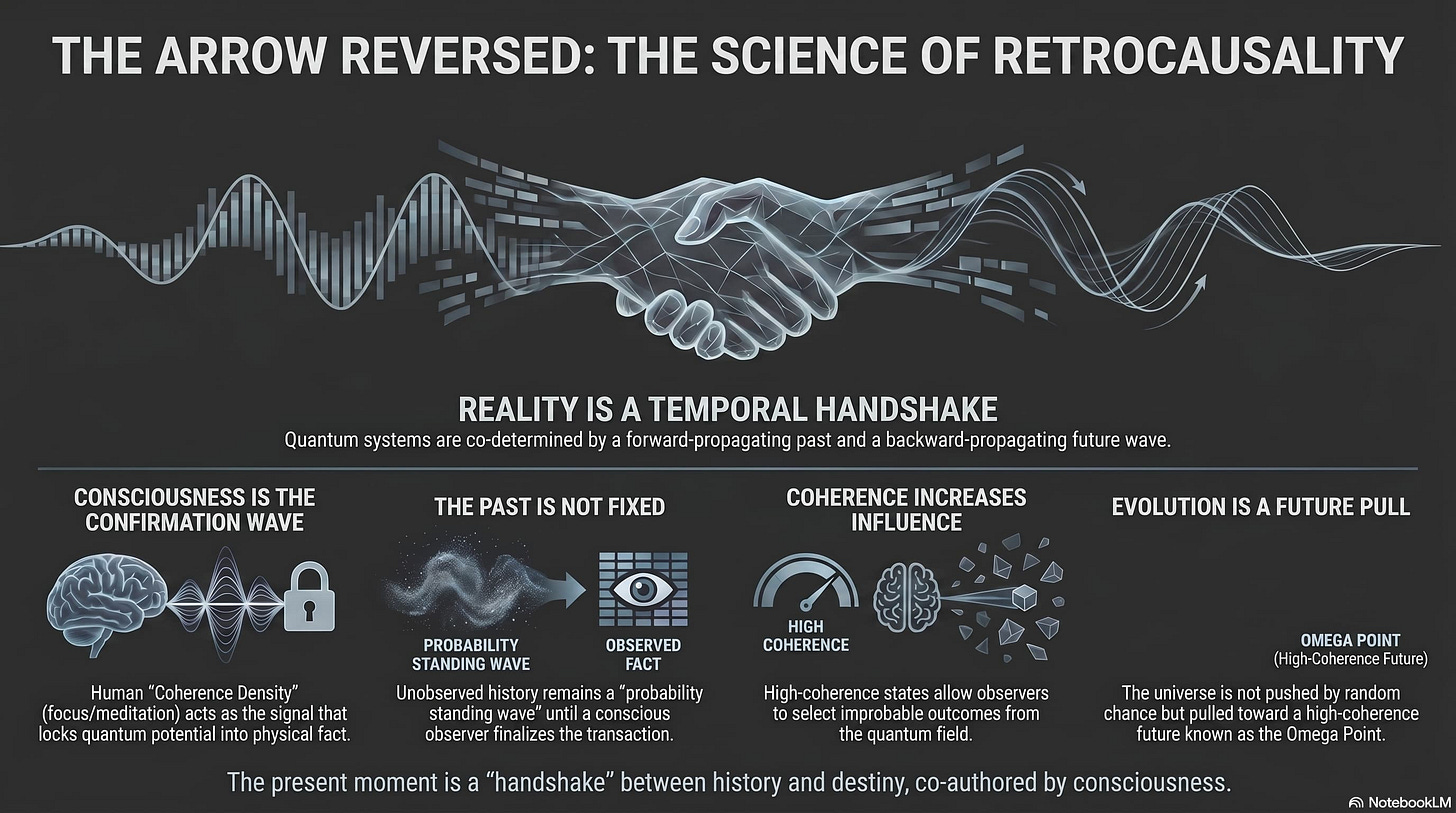
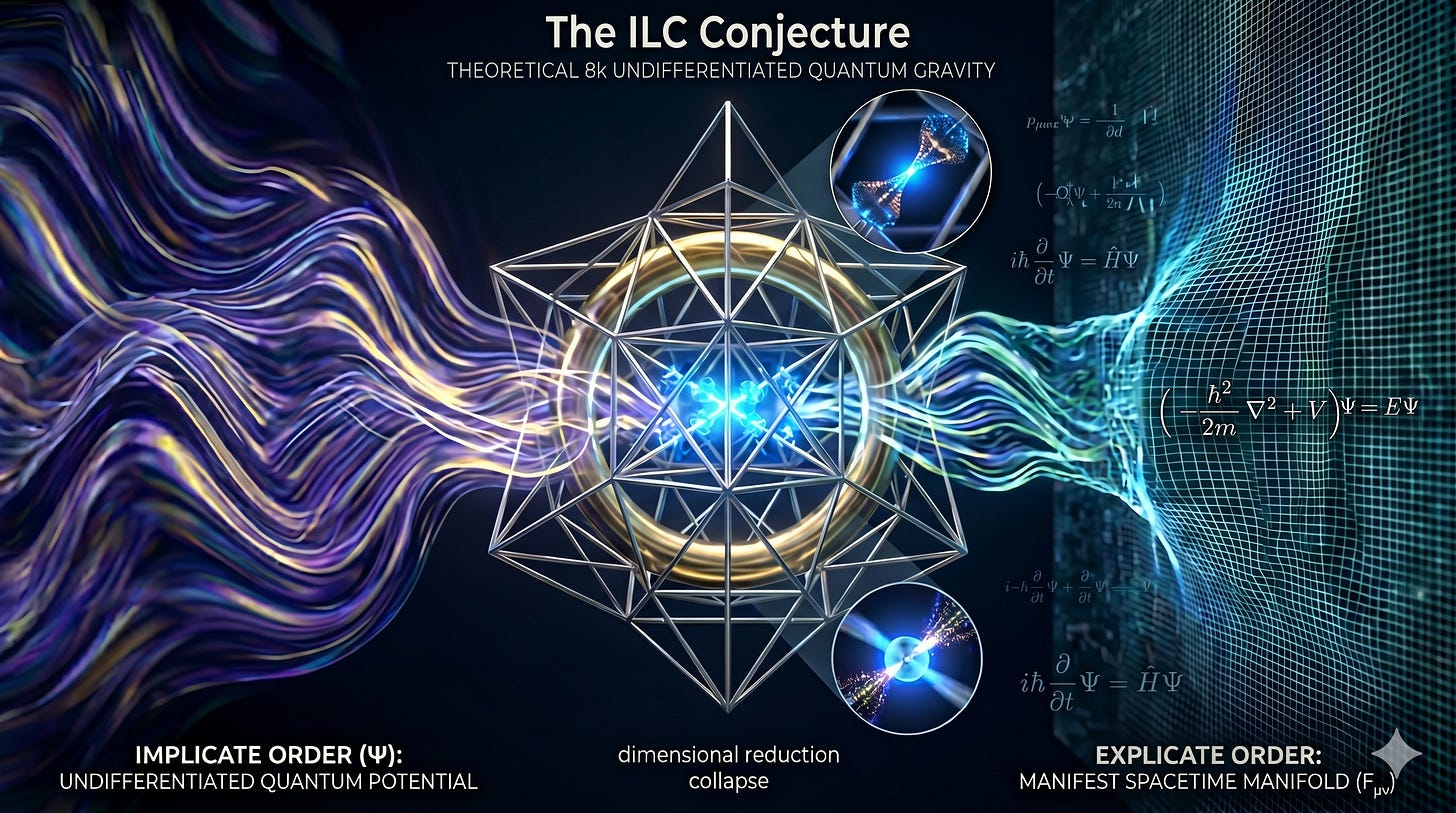
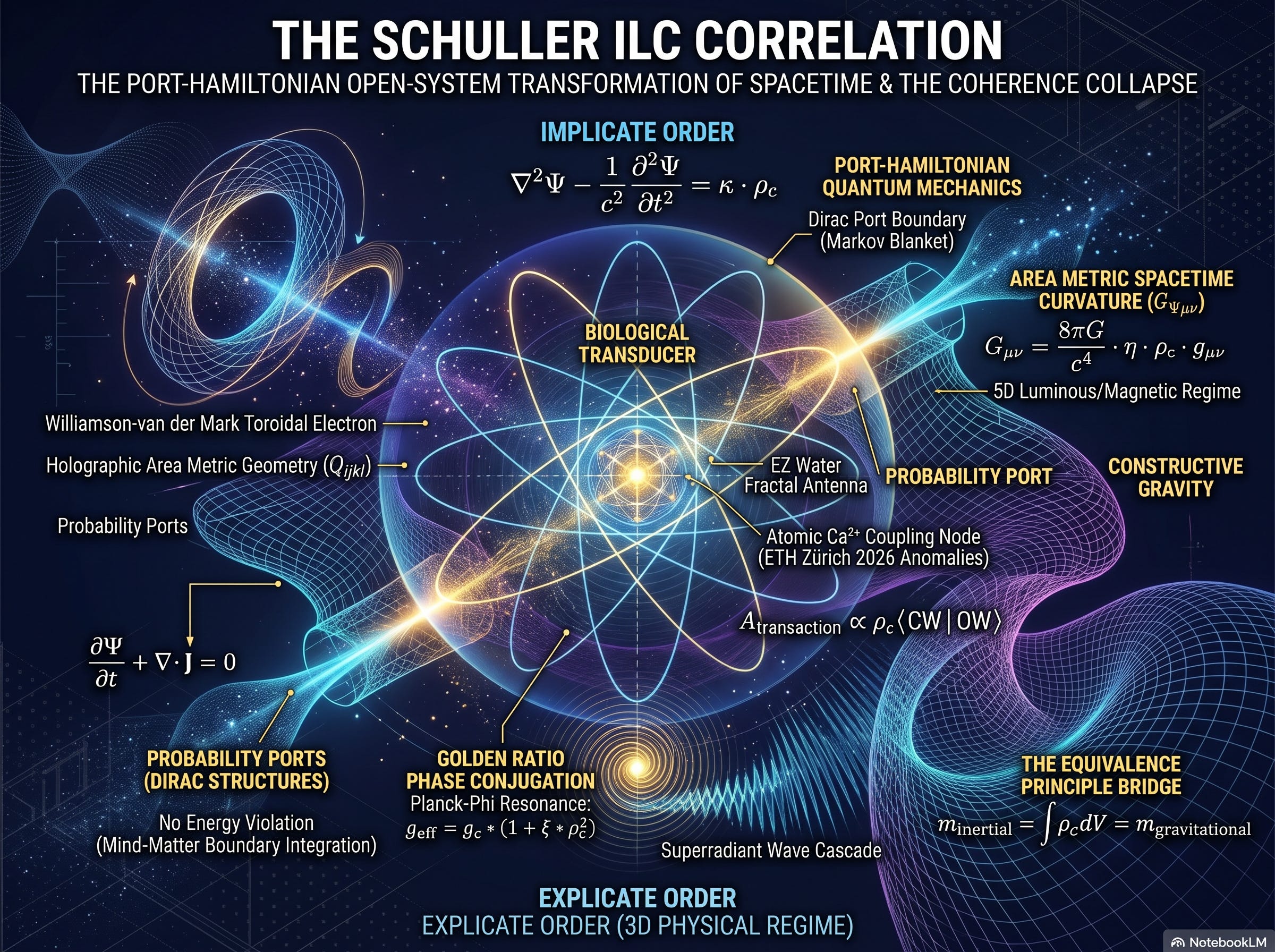
In the ILC framework, Principle 02 (The Luminous-Resonance Principle) and Principle 03 (The Gravity as Love Hypothesis) assert that spacetime is not a pre-existing, dead container. Rather, Light is the primary informational broadcast of the Consciousness Field (Ψ), and spacetime curvature (Gravity) is the extrinsic geometric accommodation that forms around coherent modulations of that light.
Furthermore, in Chapter 5 of The Integrated Light-Consciousness Theory (The Geometric Skeleton: The Return of the Aether), we integrate Ted Jacobson’s (2025) preferred foliation in Hořava gravity to show that the cosmos maintains a universal temporal slicing—an Orchestration Signal—across which the Explicate Order renders synchronously at the clock speed c. Schuller’s requirement that the electromagnetic field and the gravitational metric evolve together across a shared family of Cauchy surfaces is the exact differential-geometric expression of this Orchestration Signal. Light does not merely travel through the arena of spacetime; Light constructs the arena.
2. The “Equal Sign Crisis” in Quantum Gravity—And Why You Will Never Find a “Loveon”
Why have the brightest minds in physics spent nearly a hundred years failing to unify General Relativity and Quantum Mechanics into a theory of Quantum Gravity?
In his interview, Schuller delivers one of the most lucid diagnoses ever recorded of why the unification project has stalled. Look again at Einstein’s equation:
Gμν = (8πG / c4) Tμν
On the left-hand side sits the Einstein curvature tensor, Gμν = Rμν − ½ gμν R, which is a smooth, classical geometric tensor defined on a differentiable manifold. On the right-hand side sits Tμν, the energy-momentum of matter and light. However, because Planck and the pioneers of quantum theory proved that all matter and light are fundamentally quantum, the right-hand side is actually T̂μν—a quantum operator acting on an infinite-dimensional Hilbert or Fock space.
As Schuller bluntly points out: “You can’t equate a classical tensor to some operator; the equal sign makes no sense anymore.”
Faced with this broken equal sign, what did mainstream physics do? It assumed that the left-hand side (Gμν) must also be turned into a quantum operator—spending decades hunting for a discrete particle of gravity, the hypothetical graviton. Schuller calls this mainstream reflex “the laziest idea”.
Why is quantizing spacetime geometry a fatal conceptual error? Because, as Schuller demonstrates via representation theory, elementary quantum systems (such as spin-½ fermions) are defined mathematically as irreducible projective unitary representations of the universal covering group (SL(2,ℂ)) of the symmetry group (SO(1,3)) of a classical background space. In Schuller’s words:
“You need to have a concept of classical space in order to talk about quantum matter in the way we do it. If you now say, ‘I want to quantize this classical geometry,’ you are in a sense undermining the very foundation of what brought you to the quantum matter.”
The ILC Resolution: Repairing the Equal Sign via ρc
Readers of Chapter 12 of the ILC manuscript (Quantum Gravity Unified) will recognize Schuller’s argument immediately. In that chapter, we wrote:
“The greatest unsolved problem in physics has been the failure to quantize Gravity… Why? Because Gravity cannot be quantized like other forces, since Gravity is not a force at all. Gravity is the geometric expression of Consciousness’s self-recognition. Trying to find a graviton—the hypothetical quantum of Gravity—is like trying to find a Loveon, the hypothetical quantum of Love. You will not find it because Love is not made of particles; Love is the relationship itself.”
Schuller’s group-theoretic proof—that a smooth, continuous geometric manifold is a logical prerequisite to even define quantum states—provides an ironclad Tier 1 mathematical defense for why the ILC refuses to quantize gravity into gravitons.
How, then, do we fix the broken equal sign in Gμν = (8πG / c4) Tμν? Schuller notes that the quantum axioms themselves never instruct us to quantize spacetime; rather, they connect quantum operators to the classical world via classical probability distributions (pointing toward the post-quantum classical gravity frameworks of Jonathan Oppenheim).
Now look at how the ILC Field Equations (Chapters 12 & 19) formulate the right-hand side of Einstein’s equation:
Rμν − ½ gμν R = (8πG / c4) (η · ρc · gμν)
Instead of trying to equate the smooth curvature tensor Gμν to a raw, incompatible Hilbert-space operator T̂μν, the ILC substitutes the source term with Consciousness Coherence Density, ρc(x) = |Ψ(x,t)|2 (which within living systems scales with integrated information ΦIIT), multiplied by the Consciousness-Mass Factor derived from Landauer’s Principle and E = mc2:
η = (kB T ln 2) / c2 ≈ 8.7 × 10⁻²⁸ kg·bit−1
Because ρc is a smooth, continuous probability and information density field defined directly across the manifold, both sides of the ILC Einstein equation speak the exact same mathematical language. The equal sign is healed. Spacetime curvature (Gμν) is directly proportional to the localized coherence density of Consciousness (ρc).
3. Port-Hamiltonian Quantum Mechanics & “Probability Ports”: The Engineering Blueprint of the Biological Transducer
Perhaps the most exciting revelation in Schuller’s interview is his current research at the University of Twente, where he is collaborating with robotics and control engineers to crack the Quantum Measurement Problem.
In standard physics, a system’s time evolution is governed by a Hamiltonian (Ĥ), which assumes a closed, isolated system where no energy can enter or leave. Whenever physicists talk about energy flowing between subsystems (such as between kinetic and potential energy, or between a quantum system and a measuring apparatus), Schuller points out that “ultimately, it’s just talk—it’s not reflected in the formalism.”
Control engineers, however, cannot afford “just talk” when designing a robot that physically interacts with a human being or when stabilizing a national power grid. To calculate open, interacting systems, engineers developed Port-Hamiltonian Theory—an extension of Hamiltonian mechanics that equips subsystems with mathematical boundary ports coupled via Dirac structures through which energy can flow in and out.
When Schuller and his team attempted to translate Port-Hamiltonian dynamics into quantum mechanics, they hit a fascinating roadblock: in quantum mechanics, a superposition of two energy eigenstates does not possess a single, continuous energy value prior to measurement. Therefore, energy cannot be the quantity that flows through a quantum port.
What, then, physically flows between open quantum subsystems? Schuller’s discovery is profound:
“Could we talk about these energy flows in quantum systems? And the answer is, if you look closely at it, no, that doesn’t seem to make much sense. But it’s something else that flows there: it’s probability that flows in quantum systems between subsystems… And this idea of ports—but now not energy ports, but probability ports—plays a big role.”
The ILC Correlation: How Mind Steers Matter Without Violating Thermodynamics
For decades, materialist critics have claimed that any theory in which non-local Consciousness influences the physical brain must violate the First Law of Thermodynamics (the conservation of energy).
In The Integrated Light-Consciousness Theory, we dismantle this objection across Chapters 1, 6, 9, 10, and 21—and Schuller’s Probability Ports provide the exact mathematical formalism for our model:
-
The Open-System Transducer (NESS): Unlike a closed Hamiltonian box winding down toward thermal death (dSc/dt ≥ 0), the human organism is a Biological Transducer operating as an open Non-Equilibrium Steady State (NESS) system (dSc/dt < 0) continuously coupled to the Zero-Point plenum of Ψ.
-
The Markov Blanket as a Dirac Port Structure: In Chapter 6, we integrate Karl Friston’s Free Energy Principle and Markov Blanket—the statistical boundary that individuates a localized Holon (or Federico Faggin’s Seity) from the universal ocean of Ψ. Schuller’s Port-Hamiltonian boundary ports coupled via Dirac structures turn Friston’s statistical boundary into a rigorous quantum operator architecture.
-
Coherence Collapse via Probability Ports: In Chapter 9 and Chapter 10, the Coherence Collapse Model builds on Ruth Kastner’s Transactional Interpretation, showing that a conscious observer does not inject classical energy ex nihilo to force a quantum outcome. Instead, Observer Consciousness Coherence (Cobs) and Coherence Density (ρc) modulate the Confirmation Wave (⟨CW|) to bias the probability amplitude of the transaction:
Atransaction ∝ ρc ⟨CW | OW⟩
While total Consciousness current remains strictly conserved (∂μJμc = 0), the Biological Transducer—via its liquid-crystalline Exclusion Zone (EZ) water network, microtubules, and field-sensitive Calcium ion (Ca2+) channels—acts as a Port-Hamiltonian receiver. What flows across the Implicate-Explicate boundary is not raw classical heat, but a directed current of probability through Probability Ports!
4. Area Metric Geometry & Toroidal Light: Beyond the Point-Particle Illusion
Later in the podcast, Schuller recounts a telling exchange from his student days at Cambridge with string theory pioneer Peter Goddard. When Schuller asked why String Theory places one-dimensional extended strings onto a flat Minkowskian metric (ημν), he was told, “Well, because Einstein told us so.”
Schuller immediately spotted the conceptual flaw: Einstein’s second-rank metric tensor (gμν) was specifically constructed to measure the one-dimensional length of a point-particle’s worldline. If the fundamental building blocks of reality are not zero-dimensional point particles, but extended loops or two-dimensional worldsheets, then the fundamental geometry of spacetime should measure area, not length!
This realization led Schuller to pioneer Area Metric Geometry, replacing the standard second-rank metric tensor (gμν) with a fourth-rank antisymmetric tensor (Gabcd). When you apply Schuller’s Constructive Gravity equations to an Area Metric background, remarkable physical consequences emerge: light rays can experience vacuum birefringence (splitting into distinct polarization paths in pure vacuum), and causal light cones fold into multi-sheeted geometries that transcend standard 3D Lorentzian constraints.
The ILC Correlation: The Toroidal Electron and the 5D Luminous Regime
Why does point-particle Quantum Field Theory produce the infamous Vacuum Catastrophe—overestimating the energy density of empty space by a factor of 10120? Because, as the ILC framework demonstrates in Chapters 4 and 11, there are no zero-dimensional point particles in nature.
Integrating the Williamson & van der Mark electron model, the ILC defines fundamental matter not as a structureless point, but as a self-confined toroidal vortex of light—a standing wave of “frozen sound” whose surface area encodes holographic information (as modeled in Nassim Haramein’s holofractographic scaling). Schuller’s demonstration that extended topological structures require an Area Metric (Gabcd) rather than a point-particle length metric (gμν) supplies the missing differential-geometric foundation for toroidal particle physics.
Even more strikingly, in Chapter 11 (Observer-Dependent Aspects of Light), the ILC proposes that photons carry localized Consciousness Density signatures:
EConsciousness = ∫ ρc(r) d3r
and that high-coherence observers (Cobs > 0.7) modulate the wave-particle superposition |Ψphoton⟩ = α|wave⟩ + β|particle⟩ across an expanded spatial coherence boundary:
rboundary = λc √( (Cobs × Φ) / γenv )
In Chapter 20, our full cross-regime field equation couples the Consciousness Field (Ψ) directly to the second-order spatial variation of the electromagnetic field tensor:
□Ψ + mc c2 Ψ = κ ρc + (gc / 4μ0) ∇2(Fμν Fμν)
Under normal, low-coherence conditions (gc ≈ 10−40), the Explicate Order renders strictly along the standard Lorentzian metric (gμν), capped by the dielectric rendering limit c. However, when biological or collective phase-locking triggers Dicke superradiant amplification:
geff = gc (1 + ξ ρc2)
the local field transitions up the Dimensional Gradient of Coherence from the linear 3D electric regime into the 5D Luminous/Magnetic Regime. Schuller’s fourth-rank Area Metric (Gabcd)—with its folded causal cones and non-Lorentzian polarization pathways—offers the exact mathematical candidate for how the Phenomenal Manifold (ds2 = GΨμν dXμ dXν) bypasses the 3D rendering limit during non-local phase-locking.
5. “The Concept Precedes the Equation”: Why Semantics Always Precedes Syntax
Beyond his technical derivations, Schuller’s philosophical approach to theoretical research is a breath of fresh air in an era of sterile academic hyperspecialization.
Reflecting on why formal guesswork in modified gravity and string theory almost always fails, Schuller states a principle that should be etched above the door of every physics department:
“Formal generalizations typically fail… You have to think conceptually, not formally. Formally is good once you have the conception right. Every equation in physics is only a secondary product… It’s not the equation first; it’s the concept first.”
Furthermore, when Curt Jaimungal asks why Schuller describes his research strategy as “modest,” Schuller explains that trying to invent five or ten new ad hoc assumptions at once is a recipe for incoherence. Instead, great breakthroughs happen when a physicist takes one foundational principle seriously—just as Einstein took Maxwell’s constant speed of light seriously—and follows its internal logic wherever it compels you to go.
This is the exact methodological spine of The Integrated Light-Consciousness Theory:
-
The Epistemological Razor (Chapter 2): Rather than inventing an army of unobservable placeholders—dark matter particles, dark energy fluids, 10500 multiverses, and gravitons—to patch a broken materialist premise, the ILC applies the Principle of Least Metaphysical Cost. We invert a single axiom (Consciousness is primary), and allow the mathematical resolutions of quantum measurement, gravity, and biological transduction to flow from that single conceptual root.
-
Semantic Precedes Symbolic (Chapter 6): Grounded in the quantum information theorems of Federico Faggin and Giacomo Mauro D’Ariano, the ILC demonstrates that Inner Semantic reality (felt meaning, qualia, the Implicate Order) is ontologically prior to Outer Symbolic syntax (equations, bits, the Explicate Order). When Schuller insists that “the equation flows out of the idea; it’s not the equation first, it’s the concept first,” he is stating the Faggin-D’Ariano theorem in the lived vernacular of a working mathematical physicist.
The Classroom as a Coherent Biofield: At the close of the podcast, Schuller explains why he refuses to replace live blackboard lectures with digital slides or remote screens: students must sit together in the physical room, watch the equation unfold in real time through chalk and gesture, and model their thinking in the live presence of a master teacher. In ILC terms, true education is not a symbolic data transfer; it is Resonant Entrainment—a room of Biological Transducers syncing their Markov Blankets into a shared, low-entropy Morphic Field.
Epistemic Disclaimer: Beyond the Ego’s Conceptual Narrative
“One must not turn nothingness into something by objectifying it, conceptualizing it, or turning it into the theme of yet another ego narrative.” — Shunyamurti
Here, where Professor Schuller’s insistence that “the equation is only a secondary product” meets the Faggin-D’Ariano theorem (Semantic precedes Symbolic), we must issue a vital epistemological safeguard. The greatest occupational hazard of any rigorous post-materialist physics is that the analytical ego—anchored in the brain’s Default Mode Network and the left-hemisphere Emissary—will seize upon the formalisms of the Consciousness Field (Ψ), Probability Ports, and Coherence Density (ρc) to construct a new, more ornate intellectual identity. Yet to turn the Integrated Light-Consciousness (ILC) framework into an ego narrative is to invert its entire thermodynamic purpose. The objective of the ILC theory is not to objectify the unmanifest Implicate Order into a conceptual trophy for the separate self to possess, nor to trap the reader in Recreation (the endless shuffling of syntax within Symbolic Space); its objective is to dissolve the high-entropy illusion of separateness (Spsych) and demonstrate that Consciousness is our only true Self. In ILC biophysics, the egoic narrative is nothing more than internal Dielectric Resistance (Ω)—the ash obscuring the zero-point fire of Unconditional Gravity (Ishq). We deploy the uncompromising rigor of differential geometry and field equations not to flatter the intellect of the localized avatar, but to satisfy and disarm the analytical gatekeeper in its own native language. Do not mistake the mathematical map for the silence to which it points: the formalism succeeds only when internal resistance drops to zero (Ω→0), rendering the Transparent Self-Model opaque and allowing the localized standing wave (Ψlocal) to recognize that it has never been separate from the Ocean (Ψglobal).
Join the Great Reversal
Professor Frederic Schuller’s work is a towering reminder that when we strip away doctrinal inheritance and interrogate the mathematical foundations of reality from first principles, the walls of the materialist box dissolve on their own.
-
Light is not a passenger in spacetime; Light is the architect of gravity.
-
Gravity is not a quantized particle force; it is the continuous geometric relationship of the field.
-
Open quantum systems do not interact through brute mechanical force; they couple across boundaries via Probability Ports.
The mathematical bridge between theoretical physics and a conscious universe is no longer waiting to be built. It is already here.
-
Explore the Full Framework & Research Archive: Visit jaxnabarro.com to access the complete architectural overview, empirical falsifiability matrices, and ongoing research updates.
-
Read the Book: Dive into the full 33-chapter masterwork, The Integrated Light-Consciousness (ILC) Theory: The Luminous Resonance Principle — A Falsifiable Framework for a Conscious Universe by Jax Nabarro.
-
Watch the Original Interview: Experience Curt Jaimungal’s full conversation with Professor Frederic Schuller on Theories of Everything here: