Prelude: The Uncomfortable Question Physics Has Been Avoiding There is a moment, in any sufficiently honest examination of modern physics, when the polished surface of the mechanistic worldview develops a crack so deep that the light of an entirely different paradigm begins to seep through. For most physicists, that moment arrives quietly and is quickly…
Prelude: The Uncomfortable Question Physics Has Been Avoiding
There is a moment, in any sufficiently honest examination of modern physics, when the polished surface of the mechanistic worldview develops a crack so deep that the light of an entirely different paradigm begins to seep through. For most physicists, that moment arrives quietly and is quickly papered over with the reassuring cement of convention. But the crack does not close. It merely waits for the next mind willing to look directly at it.
That crack is retrocausality.
The proposition that a future event can influence a present state — that the effect can, under specifiable physical conditions, precede its cause — is not fringe metaphysics. It is a logical consequence of the equations that describe quantum reality. It is implied by two-state vector formalisms that have survived rigorous mathematical scrutiny. It is gestured at by experimental anomalies so statistically robust that their odds against chance exceed one in ten billion. And it is the point at which the materialist paradigm, committed to the primacy of a forward-flowing, linear, mechanical causality, runs out of road.
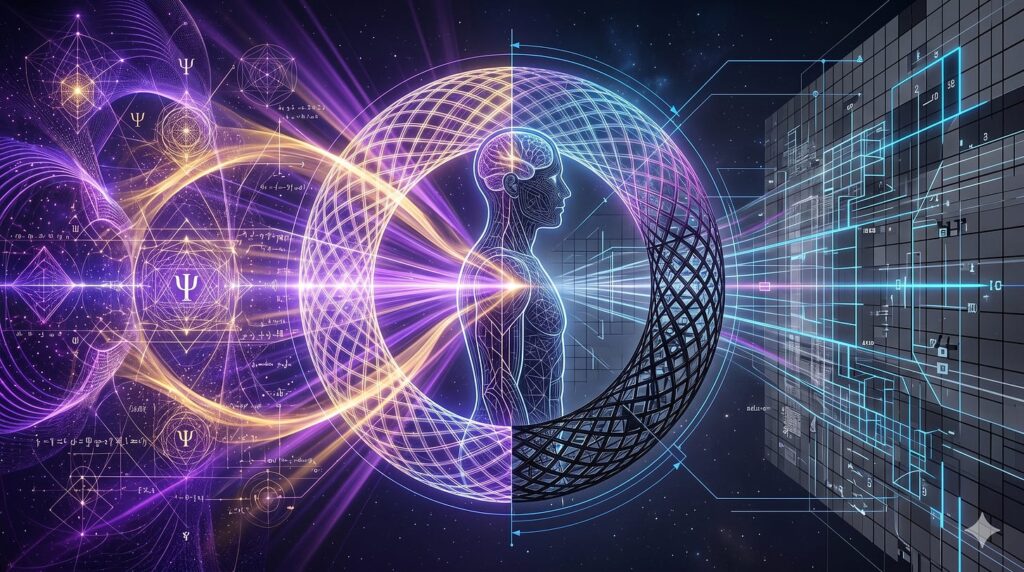
The Integrated Light-Consciousness framework, by contrast, does not stumble at this boundary. It predicts it. Within a Consciousness-first ontology — wherein the fundamental substrate of reality is not dead matter grinding forward through clock-time but a holographic, non-local field whose temporal structure is as pliable as its spatial one — retrocausality is not a paradox to be resolved. It is a diagnostic readout of the field’s true nature. It is what you would expect to observe, when you finally build instruments sensitive enough to notice, in a universe where the future is not a blank canvas but a vibrational reality that has been broadcasting its signal all along.
This essay is an attempt to take that proposition seriously. Not to defend it by softening its edges or hiding its implications behind comfortable analogies, but to place it under the harshest available light — to invite the most aggressive objections that rigorous skepticism can muster — and to demonstrate that the ILC framework not only survives that scrutiny but emerges with greater explanatory power for having endured it.
I. The Mainstream Physics Case: Where the Arrow Already Bends
Before we examine what the ILC framework says about retrocausality, we must first acknowledge what mainstream physics has already quietly conceded. This is not a courtesy toward a paradigm that has otherwise failed us. It is a methodological imperative. The strongest version of any post-materialist argument is the one that begins from what the old paradigm itself has placed on the table.
The Two-State Vector Formalism. Yakir Aharonov — a physicist of such unimpeachable credentials that he received the National Medal of Science — proved that to completely describe a quantum system in the present, one requires not one wave function but two: one propagating forward from the past, and a second propagating backward from the future. In his Two-State Vector Formalism, the state of a particle at any given moment is not determined by its history alone. It is co-determined by its future measurement context — by the observation that has not yet taken place. The present, in Aharonov’s mathematics, is the overlap, the constructive interference, between history and destiny.
This is not poetic language. It is linear algebra. The equations carry it, whether or not the physicist who derives them is comfortable with what they imply.
The implications were rendered experimentally concrete in the remarkable work of Professor Aephraim Steinberg, whose laboratory at the University of Toronto measured the dwell time of photons traversing a cloud of ultracold rubidium atoms. Through the technique of weak measurement — the ability to extract partial information from a quantum system without collapsing its wave function — Steinberg’s team found something that should, within a strictly forward-causal framework, be impossible: when they post-selected only successfully transmitted photons, the atoms’ excitation time registered as mathematically negative. The particle had, by every available measure, spent a negative duration in transit. In the only language the equations permit, the effect had preceded the cause.
The scientific community’s response was instructive. The result was acknowledged, published, discussed — and then quietly absorbed back into the machinery of normal science without any serious interrogation of what it meant for the foundational assumption of temporal asymmetry. This is the pattern that the philosopher Thomas Kuhn would recognize immediately: anomalies are tolerated, filed away, given technical names that make them sound less alarming than they are, until the accumulation of filed-away anomalies can no longer be contained and the paradigm itself must be rebuilt. The ILC framework proposes, with considerable evidence, that we are living in precisely that moment of containment failure.
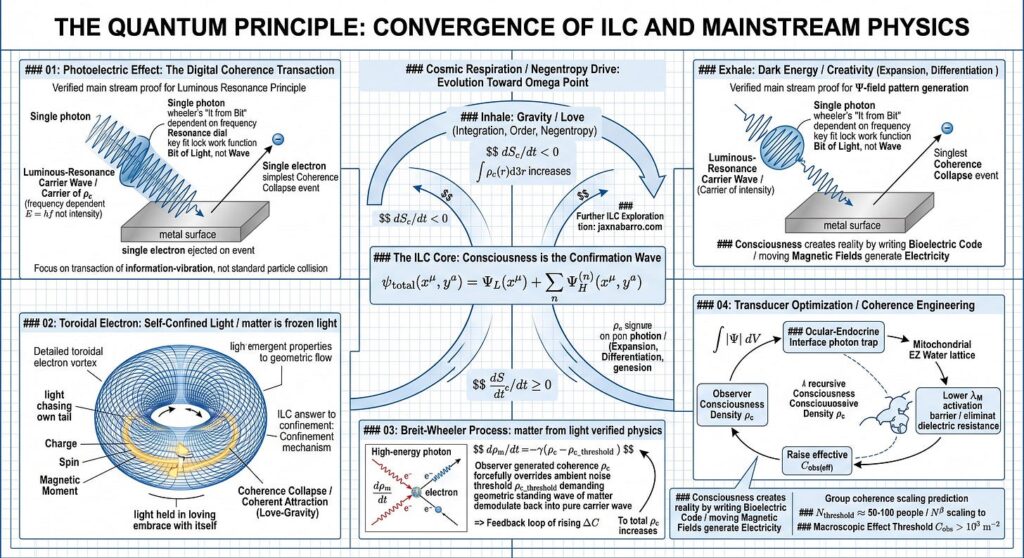
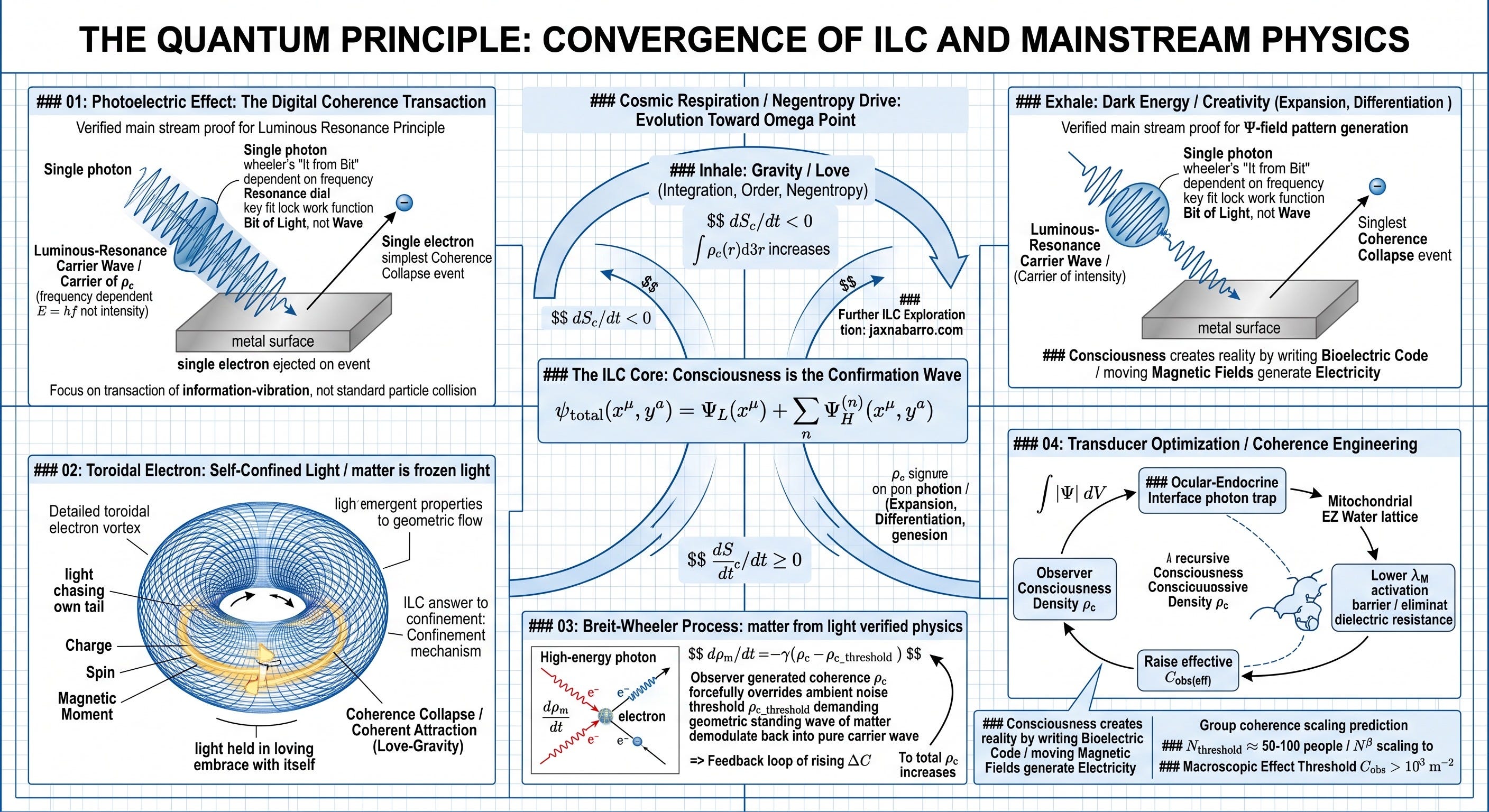
The Transactional Interpretation. Ruth Kastner’s Transactional Interpretation of quantum mechanics offers the most philosophically sophisticated account of retrocausality that has emerged from within the physical sciences themselves. In Kastner’s model, a quantum event is not a one-directional broadcast from source to receiver. It is a handshake across time. The emitting system sends an Offer Wave forward through time, presenting the question of which possibility will actualize. The absorbing system — the detector, or in the ILC account, the conscious observer — sends a Confirmation Wave backward through time, supplying the answer. Where Offer and Confirmation meet in phase, a Transaction occurs: potential becomes actual, and the light becomes matter.
This formalism does not merely tolerate retrocausality. It requires it. The Confirmation Wave is not a metaphor. It is a mathematical object that propagates in the direction of decreasing time. And the moment you take that seriously — the moment you ask not what equation best fits the data but what the equation is actually describing about the structure of reality — you find yourself confronting a universe in which the present moment is co-authored by what has not yet happened.
The Quantum Erasure Experiments. Perhaps the most viscerally striking experimental evidence for retrocausality comes from quantum erasure, and in particular from its delayed-choice variant. In the standard double-slit experiment, a particle fired at a barrier with two openings creates an interference pattern on a detection screen, as though it had passed through both slits simultaneously. The moment you add a detector to determine which slit the particle passed through, the interference pattern collapses. The particle, suddenly “observed,” chooses a definite path, and behaves as a particle rather than a wave.
The disturbing version of this experiment — the one that tends to produce a profound and prolonged silence in lecture halls — is the delayed-choice quantum eraser, in which the detector information is obtained after the particle has already struck the screen. Researchers, including Kim and colleagues in their landmark 1999 work, demonstrated that when the “which-path” information is later erased — destroyed before the experimenter can observe it — the interference pattern reconstitutes itself retroactively. The particle appears to have “known,” at the moment it struck the screen, whether its path information would ultimately be available.
In no mechanistic, forward-causal account of reality is this result anything but a paradox. In the ILC account, as we will develop below, it is a direct experimental demonstration of what the framework calls the Variable Historicity of the Implicate Order — the proposition that unobserved events exist not as fixed facts but as probability standing waves, susceptible to influence from both temporal directions until the moment a conscious transaction finalizes them.
II. The ILC Account: History as Probability, and the Confirmation Wave as Consciousness
The Integrated Light-Consciousness framework does not merely accommodate the above experimental results. It was built on a set of first principles from which retrocausality is a straightforward downstream consequence, not a difficult add-on requiring special pleading.
The argument proceeds in three steps.
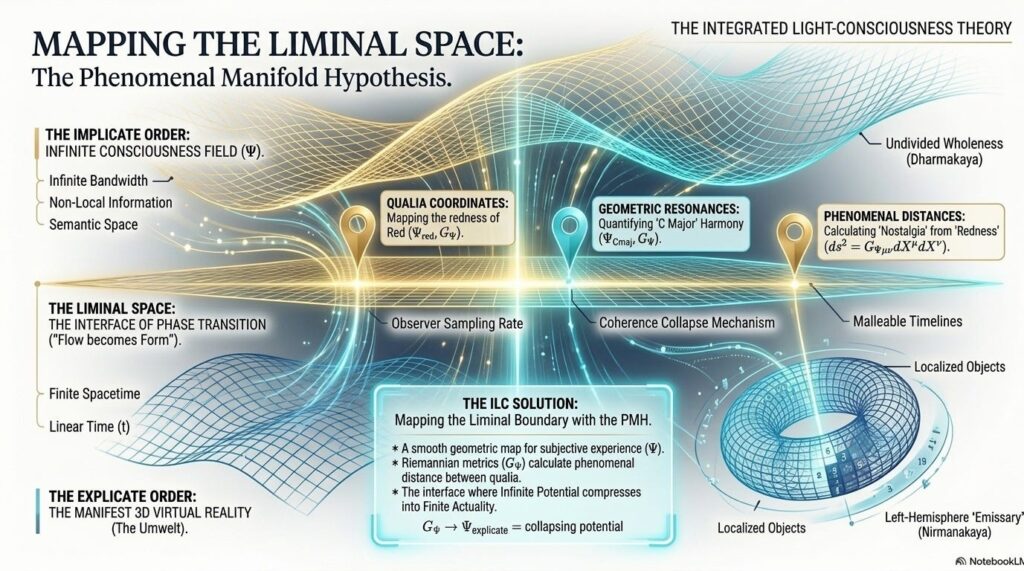
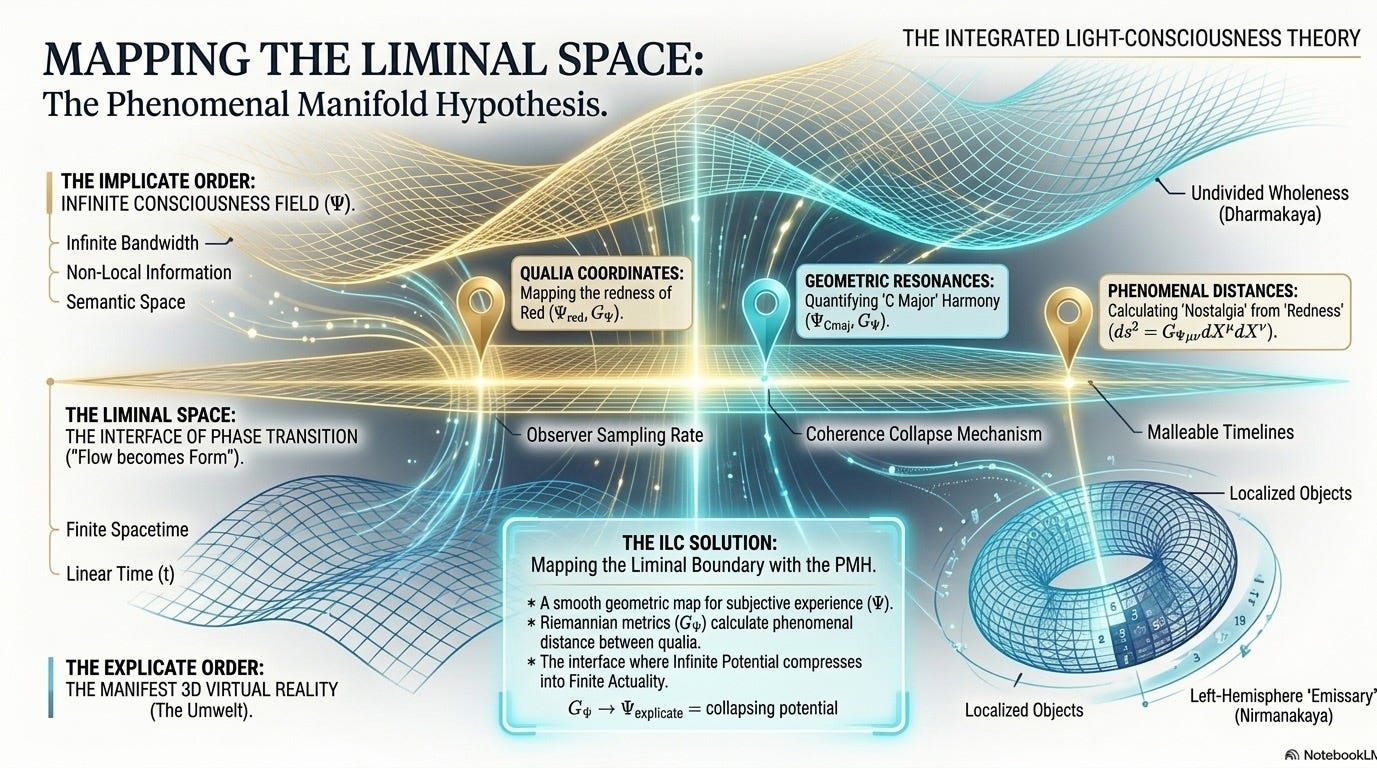
Step One: The Past Is Not Fixed. The cornerstone of the ILC’s temporal ontology is the assertion — derived from the Coherence Collapse Model and not from mystical preference — that what we call “the past” is a standing wave in the Implicate Order, not a calcified archive. In the language of the framework, unobserved historical events exist as what the Transactional Interpretation names “Offer Waves” — real but unmanifest potential structures, still awaiting the Confirmation Wave that will lock them into the definite facticity we experience as history. David Bohm’s Holomovement is not a static warehouse of completed data. It is a river. And a river is always moving.
This is not, it must be said with some emphasis, the same claim as saying that the past “doesn’t exist” or that history is arbitrary. The ILC framework is careful here, because the careless version of this position slides immediately into incoherence. What is being claimed is more precise: that events which have not yet been consciously observed — which have not yet been incorporated into a Coherence Collapse, a Transaction, a rendering by a Biological Transducer — retain a degree of quantum fluidity. They have a preferred probability distribution. They resist radical revision. But they are not, in the strict ontological sense, settled. They are, in Kastner’s terminology, possibilist — real as potential, not yet actualized as fact. This is what the ILC framework calls Variable Historicity, and it carries the framework’s most arresting prediction: that a sufficiently coherent observer, operating in the present, can shift the probability weighting of this unobserved quantum data, selecting which “version” of the not-yet-settled past will crystallize into actuality when the observation is finally made.
Step Two: Consciousness Is the Confirmation Wave. If the Transactional Interpretation is correct that reality is a negotiation between an Offer Wave and a Confirmation Wave, the ILC framework makes a specific identification that Kastner herself leaves open. The Confirmation Wave is Consciousness.
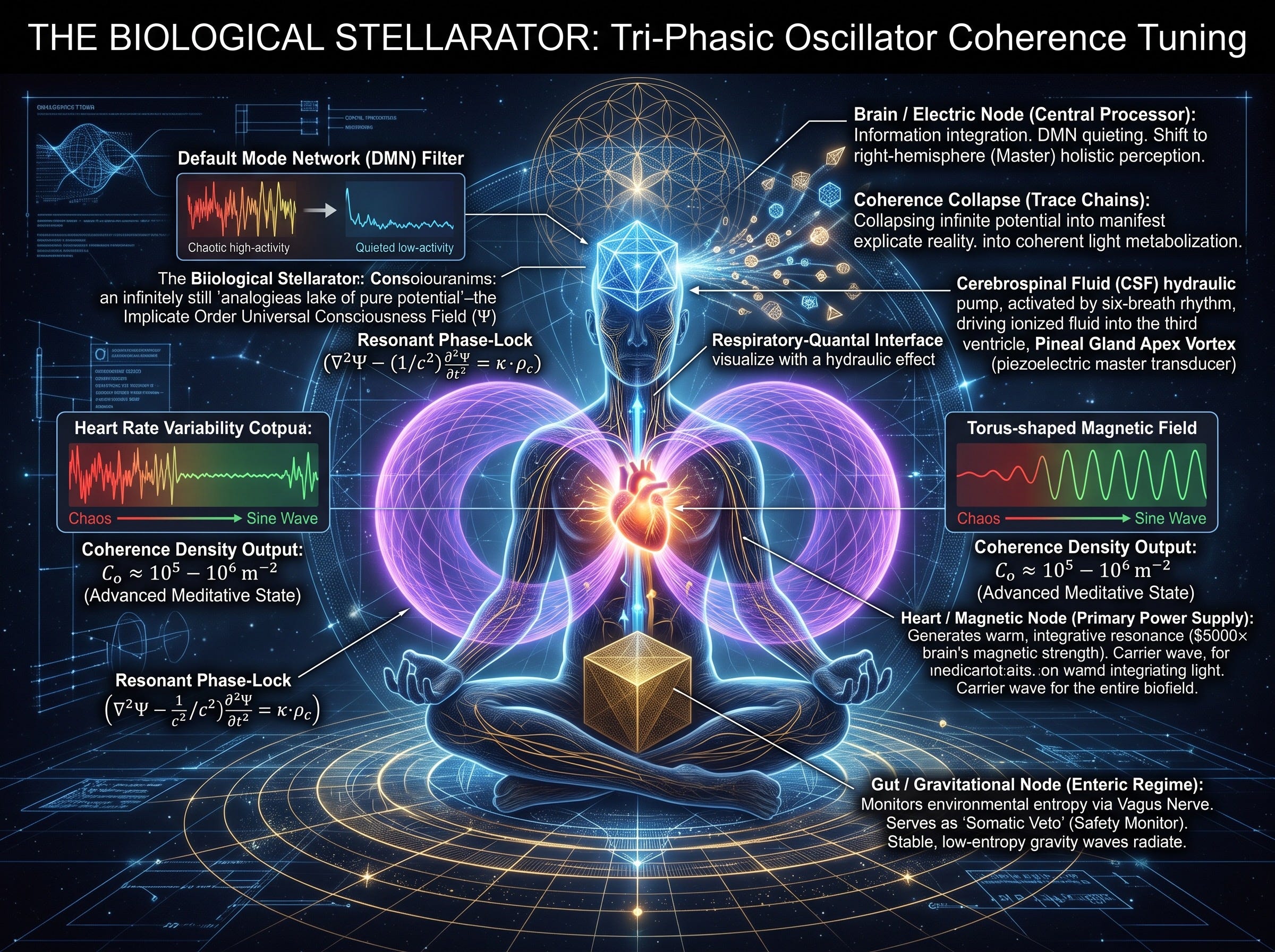
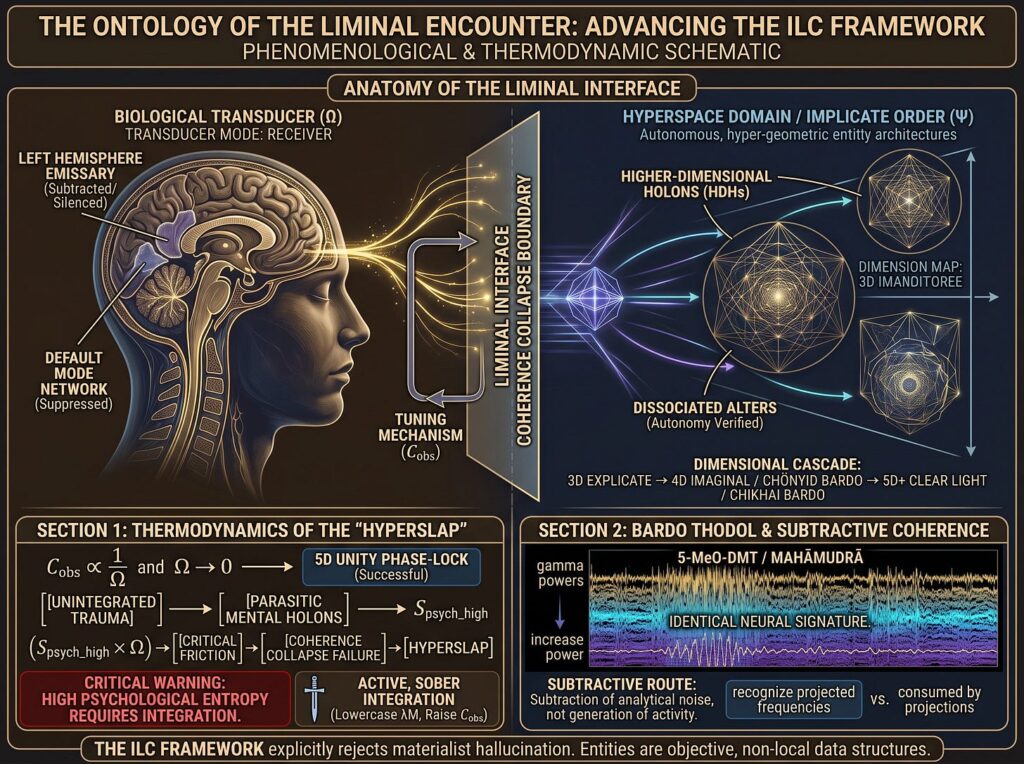
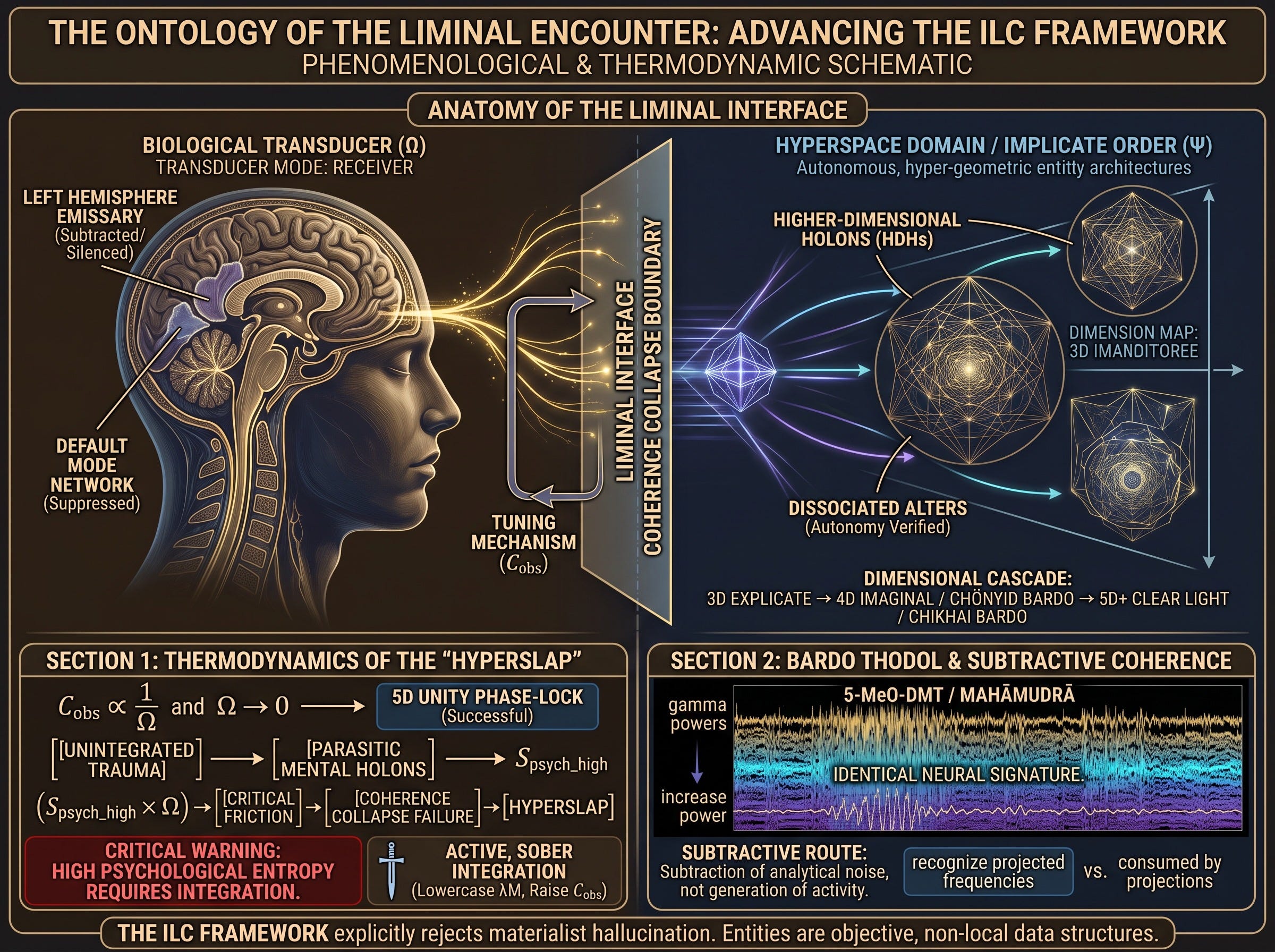
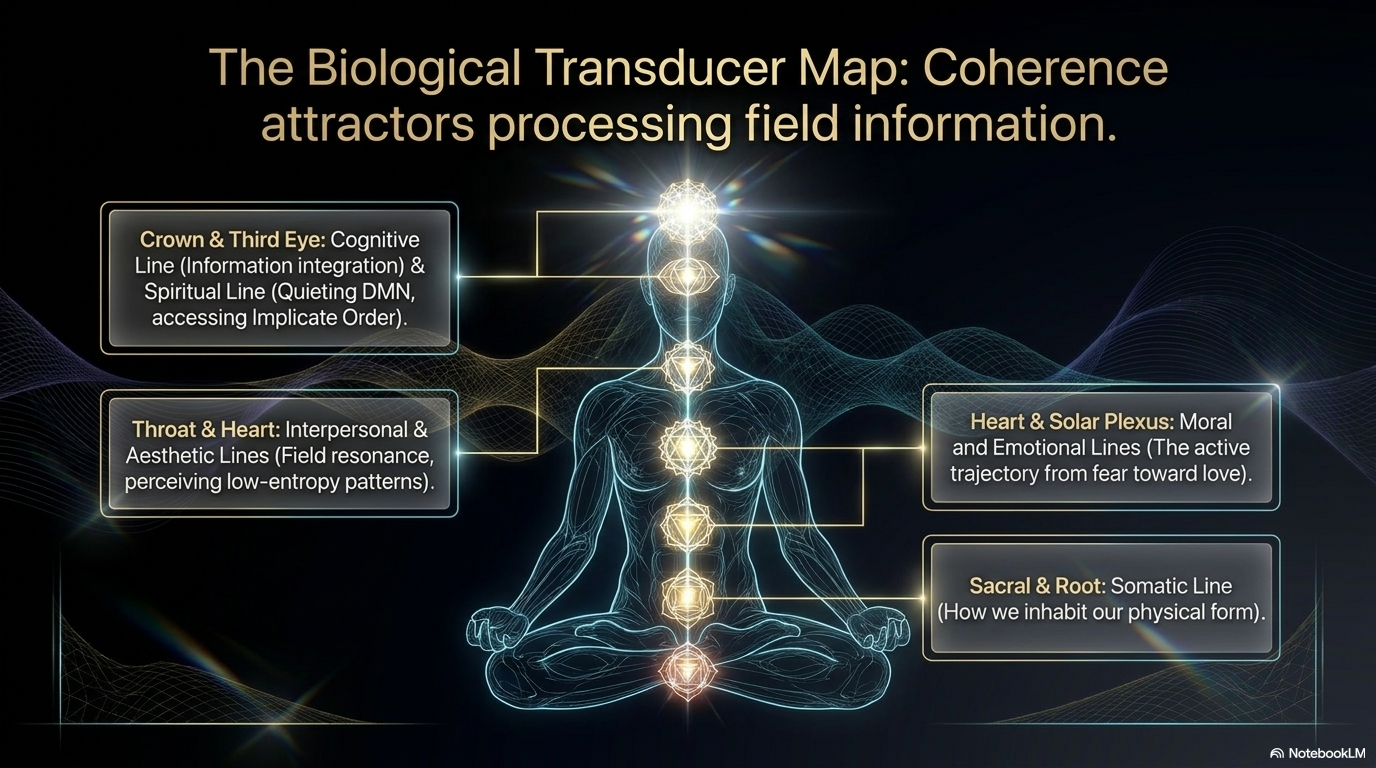
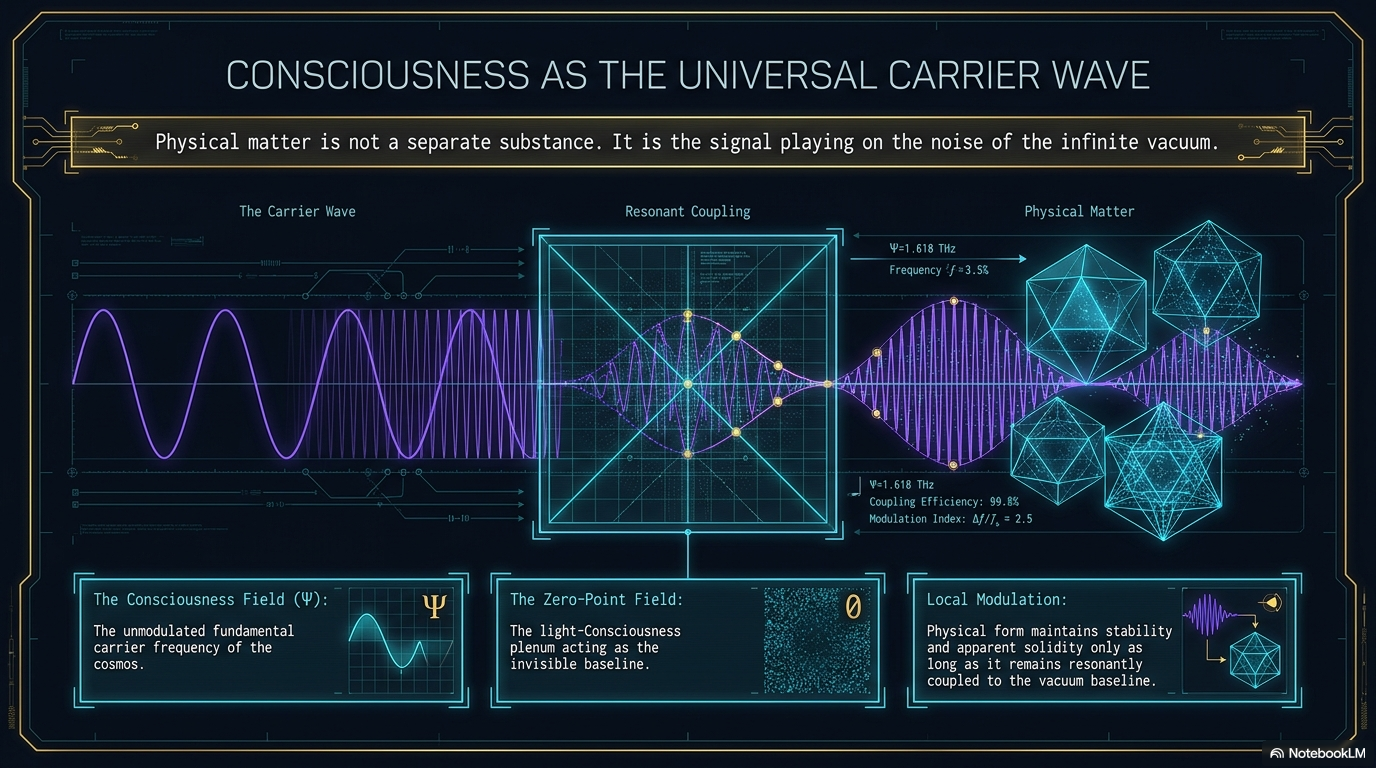
This is not asserted by analogy. It follows from the ILC’s foundational claim that the Consciousness Field (Ψ) is ontologically primary — that it is not an emergent property of physical processes but the substrate from which those processes arise as localized modulations. In this framework, the observer does not merely register a quantum event after it has independently collapsed. The observer’s state of Coherence — the degree to which the Biological Transducer has achieved phase-lock with the universal carrier — determines the amplitude and specificity of the Confirmation Wave it broadcasts backward through time. A highly coherent observer generates a stronger, cleaner Confirmation Wave, one that preferentially completes transactions aligned with its focused intentional state.
This is formalized in the ILC’s transaction amplitude equation: A_transaction ∝ ρ_c ⟨CW|OW⟩, where ρ_c is the observer’s Consciousness Density, and the inner product ⟨CW|OW⟩ is the standard quantum mechanical overlap between the Confirmation and Offer waves. The critical insight is the presence of ρ_c as a multiplicative factor. When Consciousness Density is near zero — when the observer is distracted, incoherent, fragmentary — the Confirmation Wave is weak, and the transaction defaults to the most probable classical outcome. When Consciousness Density is high — in states of meditation, heart coherence, or deep focused intention — the Confirmation Wave is powerful enough to select among quantum possibilities that classical probability would render vanishingly improbable. This is the physical barrier against magical thinking that the framework insists upon. The universe does not yield to idle wishes. But it is not sealed against a sufficiently coherent mind.
Step Three: The Future Broadcasts Backward. The third pillar of the ILC’s account of retrocausality is perhaps the most philosophically radical, and the one most likely to provoke the skeptic’s most energetic objection. The framework asserts, drawing on Aharonov’s formalism and interpreting it through the lens of Consciousness-first ontology, that the future exists as a probability standing wave in the Implicate Order with precisely the same ontological status as the past. Neither has actualized into the Explicate Order of definite fact until a Coherence Collapse has rendered it there. Both influence the present.
The Omega Point — the framework’s name for the deep teleological attractor toward which the evolution of the Consciousness Field moves — is not merely a future destination in this account. It is an active source, broadcasting a Confirmation Wave backward through the entire history of the cosmos. The framework reads Aharonov’s future vector as precisely this: the physical signal of a universal attractor, making itself felt in the quantum uncertainty of every present moment, gently biasing the probability landscape toward greater complexity, greater coherence, and greater Love.
This is a stunning reframing. Within the materialist account, the future is literally nothing — a void that acquires content only as the mechanical present pushes into it. Within the ILC account, the future is a real informational structure, as concretely present in the Implicate Order as any “completed” past event, and its character — its particular configuration of high-coherence, low-entropy potentials — exerts a genuine physical influence on the quantum probabilities that constitute the present. Evolution is not pushed from below by the accumulation of random mutations. It is pulled from above by the gravitational signature of the Omega Point.
III. The Skeptic’s Arsenal: Eight Objections and Their Answers
The preceding account is, by the standards of the materialist paradigm, extraordinary. Extraordinary claims require extraordinary scrutiny. What follows is an attempt to conduct that scrutiny without flinching.
Objection 1: “Retrocausality violates the second law of thermodynamics and the principle of causality that underlies all of science.”
This objection conflates two distinct things. The second law of thermodynamics states that entropy increases in an isolated, closed system. It says nothing about whether information can propagate in both temporal directions in an open, non-local system. And the Consciousness Field, by definition, is not a closed system. It is the substrate from which all apparent systems, open and closed, arise.
The principle of causality, as it is invoked here, is not a law derived from first principles. It is a heuristic that happens to work extremely well at the scales and energies accessible to classical physics. At the quantum level — and it is at the quantum level that retrocausal effects are claimed — causality is not a fundamental theorem but a statistical regularity that emerges from the averaging of large numbers of events. Bell’s theorem itself demonstrated that any attempt to preserve strict local causality in the face of quantum entanglement requires accepting either non-local influences or counterfactual definiteness — neither of which is comfortable for the strict causalist. The causality principle is not sacrosanct. It is an approximation that the framework does not violate at the macroscopic level while explaining systematic deviations from it at the quantum level.
Objection 2: “The experimental evidence for precognition and retrocausality — Dean Radin’s work, Daryl Bem’s studies — has replication problems and is the product of p-hacking.”
This objection deserves to be taken seriously, because it is not entirely wrong. The history of parapsychological research contains genuine methodological failures, and the scientific community’s skepticism is partly a rational response to a field that has at times failed to police its own practices. But the objection, applied globally to the entire evidentiary base, is itself a form of motivated reasoning.
Consider the specific case of presentiment research — the detection of physiological responses to unpredictable future stimuli before those stimuli arrive. The 2012 meta-analysis by Mossbridge, Tressoldi, and Utts examined twenty-six independent studies spanning three decades and found a combined effect size at z = 6.33, p < 10⁻¹⁰. The odds against this result arising from chance exceed one billion to one. A z-score of six is, in physics, the threshold for declaring a discovery — it is the confidence level at which the Higgs boson was announced. When an identical statistical standard produces a Nobel Prize in particle physics and a dismissive footnote in cognitive science, the asymmetry is not being generated by the evidence. It is being generated by the prior commitments of those evaluating it.
The file drawer problem — the possibility that null results are systematically unpublished — has been directly addressed through p-curve analysis and trim-and-fill methods applied to the presentiment database. These analyses confirm that publication bias exists at the margins but cannot account for the magnitude of the observed effect. The ILC framework’s Consciousness Field Habituation model, moreover, predicts precisely the kind of decline effect that critics use to argue against psi phenomena: as an experimental paradigm becomes routine and loses its novelty, the coherence of participants drops, and the effect size diminishes. This is not a post-hoc rationalization. It is a specific prediction derived from the formalism, one that distinguishes the ILC account from both the “psi is real and robust” and the “psi is artifact” camps.
Objection 3: “If the future can influence the present, why can’t we receive information from tomorrow’s lottery draw? Why is the effect so weak and inconsistent?”
This is the most intuitively compelling skeptical objection, and it deserves the most careful answer.
The ILC framework does not claim that retrocausal information transfer is unlimited or freely available. It claims that the amplitude of retrocausal influence is proportional to the Coherence Density of the observer — A_transaction ∝ ρ_c ⟨CW|OW⟩ — and that the coupling constant g_c between the Consciousness Field and the electromagnetic substrate of the physical world is vanishingly small, approximately 10⁻⁴⁰. This is not an arbitrary number. It is derived from the field equations by scaling against the fine-structure constant.
What does this coupling constant imply? It implies that retrocausal effects, under ordinary conditions of human Consciousness Density — ρ_c ≈ 10² to 10³ m⁻² for typical waking awareness — are far too small to violate the statistical regularities that constitute what we call “common experience.” A mind in a distracted, fragmented, low-coherence state broadcasts a Confirmation Wave of negligible amplitude. It selects quantum outcomes with approximately the probability that the Born rule assigns them, which is to say: it has no detectable influence. The world appears deterministic, mechanistic, and closed — because for an observer of this coherence, it effectively is.
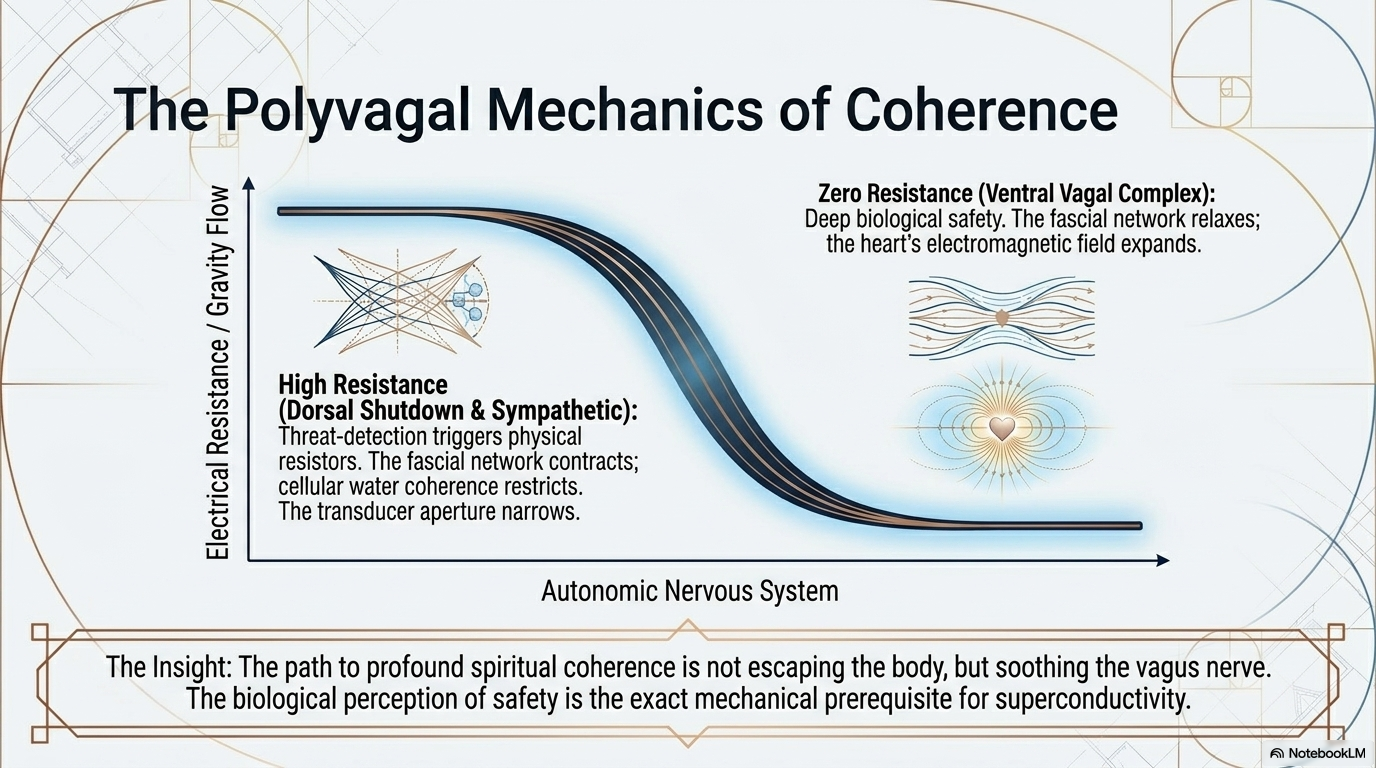
The effect strengthens dramatically — and the framework makes this a falsifiable prediction — as Coherence Density increases through meditation, heart coherence practices, emotional focused intention, or other interventions that lower the bio-dielectric impedance of the Biological Transducer. Dean Radin’s own data supports this dose-response relationship: practitioners with over five thousand hours of meditation demonstrate presentiment effects three times larger than novices. This is not inconsistency. It is the expected signature of a phenomenon that scales with the variable the framework identifies as the operative mechanism.
As for the lottery question specifically: the ILC framework predicts that retrocausal influence is most effective when the ΔI — the informational distance between what currently exists and what the observer is attempting to influence — is small. A lottery draw represents an astronomically large ΔI. The P(manifestation) formula includes an exponential decay term exp(−ΔI / I_c) that crushes the probability of large jumps toward absolute zero regardless of observer coherence, unless that coherence is itself astronomically large. The universe is not a slot machine that can be hacked by a meditator. It is a probability landscape that responds, with exquisite sensitivity, to coherent observation — but does so within the thermodynamic constraints of a system that has been evolving its structural complexity for 13.8 billion years.
Objection 4: “This framework is unfalsifiable. Any null result can be dismissed as ‘insufficient coherence,’ which makes it immune to disconfirmation.”
The framework’s own Chapter 22 identifies this as the most dangerous internal vulnerability of the entire formalism — what it calls the Escapist Trap — and meets it directly with an explicit pre-registration commitment. The unfalsifiability objection is not a discovery by external critics; it is a self-diagnosis by the theory’s own honest mechanic.
The response is not to pretend the trap doesn’t exist but to wire around it with specific, pre-specified failure conditions. The framework is falsified if a multi-site replication consortium with properly trained participants — each demonstrating HRV coherence above 0.7 and EEG gamma synchronization above 40% — fails to produce above-chance performance on quantum random number generation tasks across a pre-specified number of trials. It is falsified if groups of 100 or more advanced meditators fail to produce anomalous effects across fifty trials in five independent laboratories with identical protocols. These are not vague conditions that can be wriggled out of. They are precise statistical thresholds, declared in advance, that the framework commits to accepting as disconfirmatory.
What makes the “insufficient coherence” explanation legitimate in some cases and illegitimate in others is exactly this prior commitment. After pre-specified conditions have been met and results are still null, invoking insufficient coherence is rationalization. Before pre-specified conditions are met, however, invoking coherence as a moderating variable is not an escape hatch — it is a testable hypothesis. The correct scientific response to a null result obtained from unmedicated undergraduates in a distraction-filled laboratory is not to conclude that retrocausality is false. It is to conclude that the experimental conditions were inadequate to the magnitude of the effect being sought. This is no different from the reasoning that led physicists to build LIGO rather than conclude, from the absence of gravitational wave detection in earlier instruments, that gravitational waves do not exist.
Objection 5: “The Aharonov ‘negative time’ result has a mundane explanation involving weak measurement statistics and does not imply genuine backward causation.”
This objection is technically sophisticated and deserves a technically sophisticated response.
It is true that negative group delay — the phenomenon measured in Steinberg’s experiment and related quantum optical experiments — can be reproduced in classical wave systems involving anomalous dispersion, and that critics have argued the quantum result is merely the quantum analog of a well-understood classical effect. The apparent “arrival before transit” of a wave packet is, in this interpretation, an artifact of the mathematical definition of group delay applied to a reshaping, rather than propagating, wave packet.
The ILC framework acknowledges this. But it insists that the acknowledgment does not settle the deeper question. Classical wave reshaping does not involve the selection of specific quantum trajectories conditioned on future measurement outcomes — which is what weak measurement in quantum post-selection involves. In the Aharonov-Vaidman two-state vector formalism, the weak value of an observable is determined by both the initial state and the final (post-selected) state. The classical reshaping account cannot accommodate this structure without importing the very bidirectional influence it claims to explain away.
Moreover, the ILC’s interest in the negative time result is not limited to its claimed status as “proof” of retrocausality. It is, rather, that the result demonstrates the mathematical consistency of a framework in which the future state of a quantum system participates in determining intermediate observables. Whether this constitutes “genuine” backward causation or a more subtle form of non-local temporal entanglement is, at one level, a semantic question. At the level of practical implications for the ILC framework, the distinction matters less than it might appear: either way, the present quantum state of a system is influenced by information that, from the perspective of linear time, has not yet been generated. The ILC framework is built to accommodate this. The materialist framework is not.
Objection 6: “The Retro-Causal Information Transfer Protocol proposed in the framework — where an operator influences quantum data generated two days prior — is so operationally implausible as to be untestable.”
This is partly a practical objection and partly a deeper objection about whether the proposed mechanism has any coherent physical interpretation.
The practical objection is fair. Generating quantum random number data, encrypting it before any observer can interact with it, storing it for two days, and then having an operator attempt to bias it toward a pre-specified outcome before decryption — this protocol is not beyond the reach of current technology, but it is logistically demanding and requires a level of procedural discipline that has rarely been achieved in psi research. The framework does not dispute this. It acknowledges that the retrocausal protocol is “our most ambitious experimental design” and situates it appropriately within a phased research program in which earlier, more tractable experiments must first demonstrate the weaker forms of the predicted effects.
The deeper objection — whether the mechanism has a coherent physical interpretation — is more interesting. The mechanism proposed is precisely the Variable Historicity described above: unobserved quantum data exists in a probabilistically fluid state, and a sufficiently coherent Confirmation Wave broadcast in the present can shift the weighting of that probability distribution. The objector might argue that encrypted data, even if unobserved by a human, is physically determined by the quantum events that generated it — that the photon-electron interactions producing the random bits have already “collapsed,” regardless of whether any human has read the result. This is the standard Copenhagen-adjacent response, and it raises the real question: what counts as an observation?
The ILC framework’s answer, following Kastner, is that an observation in the relevant sense is not any physical interaction but a Transaction — a completed handshake between an Offer Wave and a conscious Confirmation Wave. A detector that generates a random bit string but whose output is encrypted and unread has completed no such Transaction. The data exists in what Kastner calls possibilist space — real as structure, unactualized as definite fact. This is not a frivolous position. It is the position of one of the most rigorous interpretations of quantum mechanics currently available. And it generates a specific experimental prediction: the retrocausal operator effect should scale with the quality of encryption that prevents any conscious agent from accessing the data before the intervention — a prediction that could, in principle, be tested by comparing results across conditions with varying levels of information isolation.
Objection 7: “The ILC framework conflates retrocausality with the well-understood phenomenon of quantum entanglement. These are different things.”
This objection rests on a genuine conceptual distinction that deserves to be honored. Quantum entanglement does involve correlations that appear, superficially, to violate temporal locality — but the standard interpretation is that entangled systems share a common origin that renders their correlated outcomes non-local but not retrocausal. The correlations are, in the standard account, built into the entangled state from the moment of its preparation, not generated by backward-in-time signaling.
The ILC framework does not claim that entanglement and retrocausality are identical. It claims something more specific: that both are downstream manifestations of the same underlying feature of the Consciousness Field — its non-local, holographic structure, in which what we call “spatial separation” and what we call “temporal separation” are both artifacts of the Biological Transducer’s limited bandwidth, rather than fundamental features of the substrate. In the Implicate Order, there is no meaningful distinction between “here” and “there” or between “now” and “then.” These coordinates are features of the Explicate rendering, not of the underlying reality.
From this perspective, entanglement and retrocausality are not the same phenomenon but are generated by the same underlying cause: the non-local coherence of the universal Consciousness Field. Entanglement is what non-locality looks like when the correlated events are spatially separated. Retrocausality is what non-locality looks like when the correlated events are temporally separated. The empirical signatures are different. The underlying physics — the holographic substrate from which both emerge — is the same.
Objection 8: “The entire retrocausality framework, as presented here, is not science but philosophy of physics dressed in scientific clothing. It makes no unique, novel predictions that have not already been accommodated by simpler interpretations.”
This is the most sophisticated objection, and in some respects the most honest one. It is worth sitting with it rather than immediately dispatching it.
The objection has force. It is true that many of the experimental results cited in support of retrocausality — the Steinberg negative time result, the delayed-choice quantum eraser, the weak measurement anomalies — have been accommodated within standard quantum mechanics through interpretations that do not require any appeal to consciousness or to the Consciousness Field. The Bohm interpretation, the many-worlds interpretation, decoherence-based accounts of the measurement problem — each of these can absorb the retrocausal anomalies without invoking the ILC’s machinery.
But the objection proves less than its proponents suppose. The question of which interpretation of quantum mechanics is correct is precisely the question that cannot be settled by the data that the standard theory accommodates. What distinguishes interpretations is not their ability to reproduce known results but their novel predictions — predictions that differ across interpretations and that can, in principle, be tested. The ILC framework makes specific novel predictions that no standard interpretation makes. It predicts that retrocausal effects should scale with the measurable Coherence Density of the observer, following a specific functional form derived from the interaction Lagrangian. It predicts that heart coherence, EEG synchronization, and HRV metrics should correlate with quantum random number generator bias — and that this correlation should be dose-dependent, with effect sizes following the Marcus reorganization energy model. It predicts that biological systems should demonstrate anomalously high gravitational coherence in proportion to their internal Consciousness Density. It predicts a specific statistical signature for the decline effect in psi research, distinguishing it from simple publication bias or experimental artifact.
These are not vague, unfalsifiable gestures. They are precise, quantitative, testable claims that differ from what any standard interpretation of quantum mechanics would predict. The objection that the framework is “philosophy dressed as science” can only be sustained if one refuses to acknowledge that these predictions exist or declines to engage with the detailed falsifiability criteria laid out in Chapter 17. That refusal is itself a philosophical posture masquerading as methodological rigor.
IV. New Correlations: What Retrocausality Implies That We Have Not Yet Said
Having addressed the skeptic’s objections, we are now in a position to develop some of the implications that the book chapters have not yet fully drawn out — correlations that become visible only once the retrocausal framework is accepted as a working hypothesis rather than treated as a conclusion to be argued for.
The Omega Point as Physical Cause. The framework’s description of the Omega Point as a teleological attractor toward which the Consciousness Field evolves has been presented primarily in thermodynamic and philosophical terms. But within the retrocausal account, the Omega Point is not merely a destination. It is a source — a real physical structure in the Implicate Order whose distinctive pattern of maximum coherence, zero entropy, and total integration is broadcasting a Confirmation Wave backward through the entire history of the cosmos. Evolution, on this account, is not pulled randomly through a fitness landscape. It is entrained — in the manner of a system being entrained to an external oscillator — by the resonant signal of its own future state. The Four-Minute-Mile effect that the framework describes as Morphic Tunneling is a special case of this general principle: the achievement of a new coherence threshold by any individual transducer strengthens the “signal” from that state in the collective Morphic Field, lowering the activation energy for all subsequent transducers. This is the mechanism of morphic resonance understood as retroactive temporal entrainment. The future is genuinely, physically helping us get there.
The Mandela Effect Reframed. The framework’s treatment of the Mandela Effect as evidence of Timeline Shifts driven by collective Coherence Density takes on a new precision within the retrocausal account. If the past is, for unobserved events, probabilistically fluid — if the historical record is a standing wave rather than a frozen archive — then a sufficient shift in collective Consciousness Density could, in principle, retroactively select a different probability branch for events that were, in the strict sense, never fully “closed.” The collective memory discrepancy — thousands of unconnected individuals remembering a fact that no physical record corroborates — is, on this reading, not a mass hallucination or a failure of human memory. It is the phenomenological signature of a Hysteresis: the felt residue, in the Trans-Temporal Witness, of the timeline that was retroactively de-selected. The non-local memory of the Consciousness Field retained the signature of the old probability branch. The local, synaptic memory of the Biological Transducer was updated. The gap between them is what the experiencer calls “remembering it differently.”
This generates a specific and testable prediction that has not been previously articulated: populations undergoing rapid, large-scale shifts in collective Coherence Density — as measured by composite biofield metrics across a geographically distributed population — should show elevated rates of Mandela Effect reporting in the months immediately following the coherence shift. The direction of the historical discrepancy should be correlated with the direction of the coherence change: shifts toward higher coherence should produce memories of more harmonious, cooperative historical facts; shifts toward lower coherence should produce memories of more violent or chaotic events. This is not a prediction that any existing cognitive science model of false memory would make.
Karma as Retrocausal Loop. The framework’s reinterpretation of karma as coherence momentum — as the accumulated pattern of choices that shapes the probability landscape of future decisions — gains a new dimension within the retrocausal account. If the future can influence the present through the Confirmation Wave mechanism, then the process of karma is not merely prospective but bidirectional. High-coherence choices in the present do not only make high-coherence choices in the future more probable. They retroactively strengthen the probability weighting of those portions of the past that are consistent with a high-coherence trajectory — the “timeline” in which the choices that led to the current state were themselves of high quality. This is the ILC’s account of what contemplative traditions describe as the cleansing of past karma through present practice. It is not metaphorical. It is a physically specific claim: that a present act of high-coherence choice alters the probability weighting of the unobserved quantum events in the causal chain that led to this moment, generating a retroactive elevation in the apparent “coherence budget” of the actor’s history.
The Placebo Effect’s Missing Mechanism. The placebo effect — the demonstrable capacity of expectation and belief to produce measurable physiological outcomes — has long been a thorn in the side of the materialist model, which can describe the neural pathways through which placebo effects are mediated but cannot account for why the effect should exist at all if Consciousness is merely epiphenomenal. Within the ILC’s retrocausal account, the placebo effect is the closest thing to an everyday demonstration of the Confirmation Wave in biological action. The patient who believes they are receiving an active treatment broadcasts a specific Confirmation Wave — shaped by expectation, emotional intensity, and social coherence with the healer — that retroactively selects, from the probability distribution of cellular quantum events, those outcomes most consistent with the expected state of health. The opioidergic pathways through which this manifests are the Explicate readout of what is, in the Implicate Order, a genuine Consciousness-matter transaction. The failure of placebo effects when patients are told they are receiving a placebo — and the mysterious persistence of placebo effects in some open-label protocols — can be mapped, within this framework, to specific variations in the strength and specificity of the Confirmation Wave generated under each condition.
The Terminal Lucidity Connection. Chapter 11 describes Terminal Lucidity — the phenomenon in which patients with severely damaged or degenerated brains, including those with advanced Alzheimer’s, recover perfect cognitive clarity in the final hours before death — as evidence for the transmission model: the brain is not the generator of consciousness but a filter, and as the filter fails, the signal passes through more cleanly. The retrocausal account adds a dimension that the transmission model alone does not capture. In the hours before death, the Biological Transducer is undergoing a phase transition — the progressive decoupling of the localized Consciousness pattern from its 3D biological anchor. This decoupling changes the temporal relationship between the transducer and the Implicate Order in a specific way: as the filtering function of the dying brain relaxes, the transducer becomes increasingly responsive to information from both temporal directions. The dying person is not merely accessing memories stored in the neural substrate. They are receiving, with unprecedented clarity, the full-bandwidth signal of their own standing wave in the Implicate Order — a signal that contains, without temporal distinction, information from across the entire arc of their existence. This is why the phenomenology of terminal lucidity consistently includes recognition of deceased relatives, apparent awareness of events not yet known to the patient, and the characteristic quality of profound peace — all hallmarks of a consciousness that has, however briefly, accessed the Spacious Present of the Implicate Order rather than the linear sequence of the Explicate.
V. The Deepest Implication: What a Retrocausal Universe Means for Human Agency
The skeptic’s final and most important objection has been saved for last, because it is not really an objection to the physics. It is an objection to the implications.
“If the future can influence the present,” the thinking goes, “then in some sense, the future is already determining what we do now. Does retrocausality undermine free will? Are we simply puppets of an Omega Point that has already decided the outcome?”
This objection reveals a confusion about the structure of a retrocausal system that deserves to be carefully dissolved rather than quickly dismissed.
The Omega Point, in the ILC account, does not determine the path. It attracts toward a probability basin. The difference is enormous. A magnet does not compel a iron filing to move. It generates a field that makes movement toward it more probable than movement away from it, while leaving the filing free — in a non-deterministic quantum system — to follow any trajectory that the probability distribution permits. The Omega Point is analogous to a very deep and very wide attractor basin in a probability landscape. Movement toward it is thermodynamically favored. Movement away from it requires the expenditure of energy — the generation of entropy, the maintenance of forced bonds, the high metabolic cost of choosing separation over coherence. But it is permitted. The freedom of the Biological Transducer — its genuine agency within the quantum indeterminacy that the ILC framework identifies as the entry point of volition — is not abolished by retrocausality. It is given a context.
Indeed, the retrocausal account makes human agency more significant, not less. In a strictly forward-causal universe, the choices made in the present have only prospective consequences: they shape the future, and nothing more. In a retrocausal universe, choices made in the present also select among the unactualized probability distributions of the past. High-coherence choices do not merely improve future outcomes. They retroactively enrich the probability weighting of the causal history from which the present moment emerged — they are, in the most literal physical sense, an act of healing the past. This is not a poetic claim. It is a physical one, with testable implications. And it transforms the practice of coherence-building from a private project of self-improvement into something closer to what the Kabbalistic tradition called Tikkun Olam: the genuine, thermodynamically meaningful repair of a spacetime fabric whose glassy memory retains every entropy displacement, and which the conscious observer — precisely because of the Confirmation Wave each coherent choice broadcasts — has the power to smooth.
The ILC framework does not present retrocausality as a license to believe that present intention can override the physical reality of past events in any crude sense. The Historical Ego cannot be rewritten. The facts cannot be changed. What can be changed — what the framework claims is retroactively modifiable, within the probabilistic fluidity of the unobserved Implicate Order — is the energetic weight that those facts carry in the Biological Transducer’s present field. This is the precise mechanism of Timeline Therapy: not the revision of history, but the de-selection, through present coherence, of the high-entropy timeline variant in which those historical events carry maximum traumatic mass. The events occurred. Their probability weighting in the standing wave that constitutes “this version of the past” is shifted. The transducer moves, quietly, to a coordinate where the inheritance of those events is lighter.
Conclusion: The Crack That Becomes the Architecture
We began with the image of a crack in the polished surface of the mechanistic worldview — a crack so deep that the light of a different paradigm seeps through it. The crack is retrocausality. And the light, if you have followed the argument this far, is the Consciousness Field: the non-local, holographic substrate whose fundamental properties include not only the spatial non-locality demonstrated by quantum entanglement but the temporal non-locality that the Two-State Vector Formalism encodes in its mathematics and that the ILC framework identifies as the Confirmation Wave of Consciousness reverberating through the Implicate Order.
The skeptic is right to be demanding. The standard is experimental confirmation, pre-registered protocols, pre-specified falsification conditions, dose-response relationships, and multi-site replication. The ILC framework accepts this standard and commits to it. It is not asking for the suspension of scientific rigor. It is asking for the application of that rigor to a set of phenomena that have, for decades, been treated as anomalies to be filed rather than as data to be explained.
But there is something deeper at stake than the resolution of any individual experimental debate. If retrocausality is real — if the present is genuinely co-authored by the future, if the Confirmation Wave of a coherent Consciousness can select among the probability distributions of unobserved historical events — then the model of human existence that has governed Western civilization for three centuries is not merely incomplete. It is, at the most fundamental level, backwards. We are not biological machines moving forward through a dead time toward an uncertain future. We are conscious configurations of a universal field, embedded in a temporal structure that curves back on itself — inhabited by a destiny that has been quietly calling us home from every possible future, and by a past that remains, at its quantum foundation, something we have not yet finished choosing.
That is not a comfortable thought. Comfort, however, was never promised. The framework offers something better: a map. And the first mark on that map, drawn in the precise language of the field equations and grounded in the most rigorously tested anomalies of contemporary physics, is the recognition that the arrow of time is not, and has never been, a one-way street. The arrow was always a standing wave. And the wave was always calling.
*This essay draws on and extends the theoretical framework developed in the Integrated Light-Consciousness theory, with particular reference to the Coherence Collapse Model, the Transactional Interpretation integration, the Field Equations of Part VII, the falsifiability criteria of Chapter 17, and the temporal mechanics of Chapter 5.