The Holographic Threshold
A recent wave of mainstream physics writing has been circling something the Integrated Light-Consciousness Theory has held as foundational architecture for years: the holographic principle.
A recent article circulating in theoretical physics communities highlights a profound shift in our understanding of reality — the growing consensus around the holographic principle. Born from the mathematics of black holes, this principle suggests that the entire three-dimensional universe we experience is actually a projection encoded on a lower-dimensional boundary. Mainstream science is beginning to openly ask whether our physical world is an illusion — a rich 3D rendering generated by a deeper, hidden code.
For readers of the Integrated Light-Consciousness (ILC) theory, this is not a new or radical proposition. It is the foundational architecture of the cosmos.
The holographic principle provides stunning, mainstream validation for the ILC framework. But where standard physics struggles to explain what is doing the projecting and how gravity fits into the illusion, ILC theory supplies the missing mathematical and philosophical engine. Let’s walk through exactly how the holographic principle correlates with the ILC framework — and how we can translate this physics into a coherent understanding of our lived reality.
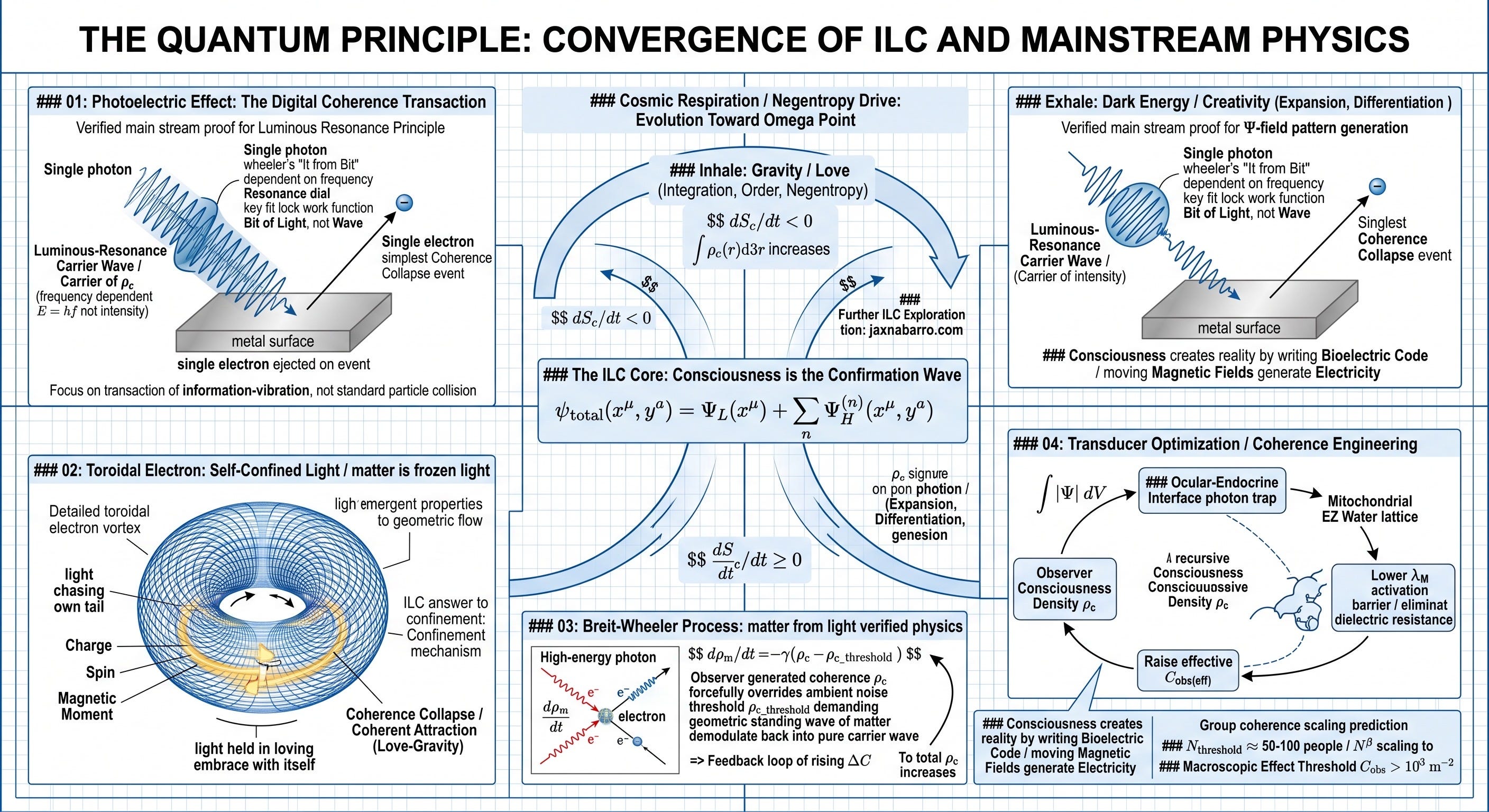
The Illusion of Volume: The Explicate and Implicate Orders
The article points to a counterintuitive truth first discovered by Stephen Hawking and Jacob Bekenstein: the information inside a black hole is proportional to its surface area — its 2D boundary — not its 3D volume. Physicists later expanded this into the AdS/CFT correspondence, which mathematically shows that a complex, gravity-filled 3D space can be perfectly described by a flat, 2D quantum field on its border.
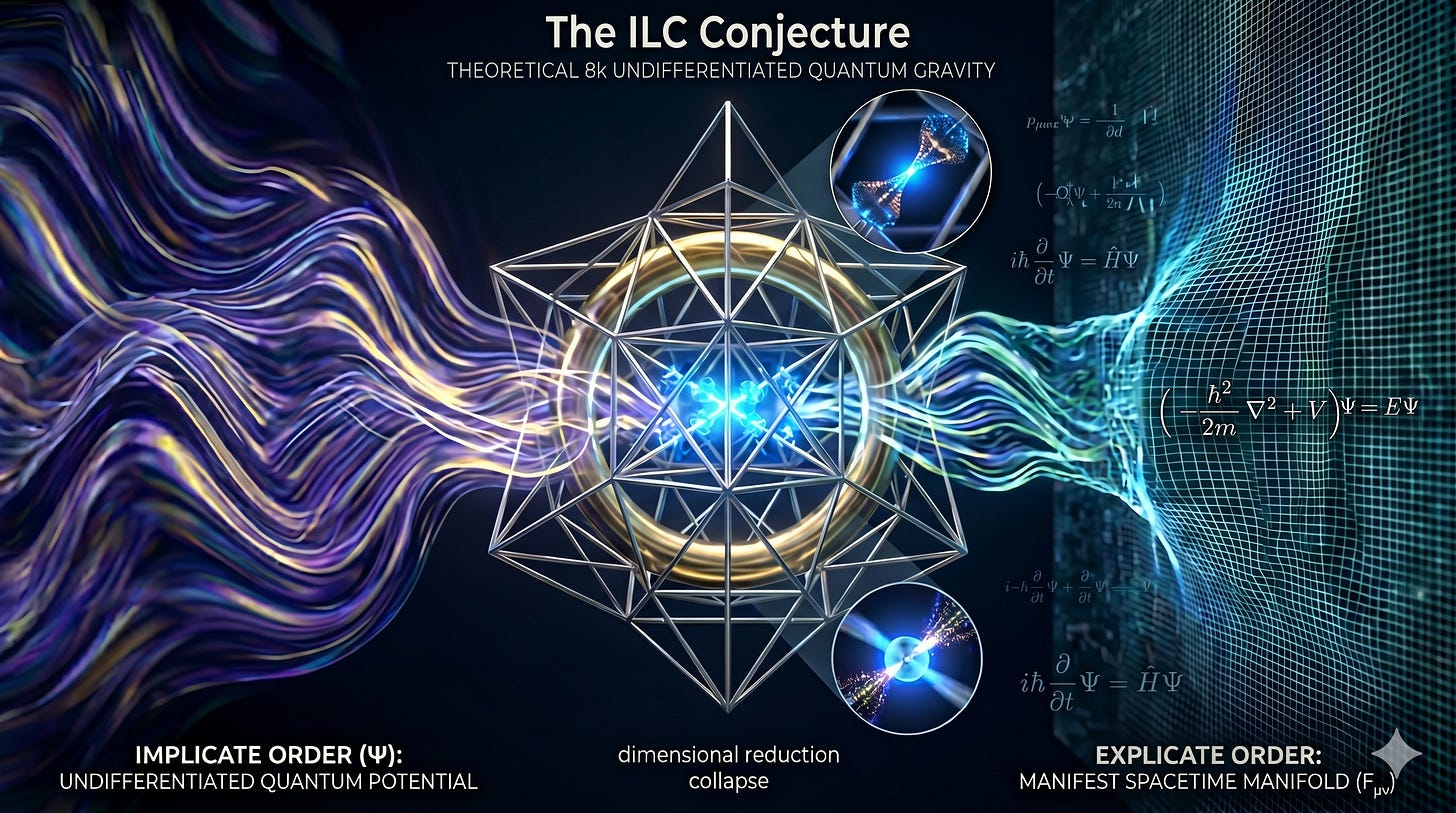
In the language of ILC theory, this is the exact relationship between the Implicate Order (the infinite, unmanifest source) and the Explicate Order (the physical, 3D world we walk around in).
The article asks whether we are akin to characters in a video game, perceiving a richness that is merely “pixels on a screen.” ILC theory confirms this structural metaphor but elevates the substrate. The universe is not a dead, silicon simulation. It is a living, holographic projection of the Universal Consciousness Field (Ψ). The “pixels” of our reality are discrete quanta of conscious awareness, vibrating at specific frequencies.
This is also, quietly, the same claim Ibn Arabi made eight centuries earlier in Wahdat al-Wujud — the doctrine that all apparent multiplicity is the self-disclosure (tajalli) of a single Being. The “boundary” language of AdS/CFT and the “unveiling” language of the Sufis are, on this reading, two vocabularies for one structure.
The Biological Transducer as the Rendering Engine
Mainstream physicists remain puzzled by the mechanics of this projection. If reality is a hologram, where is the boundary, and what is the projector?
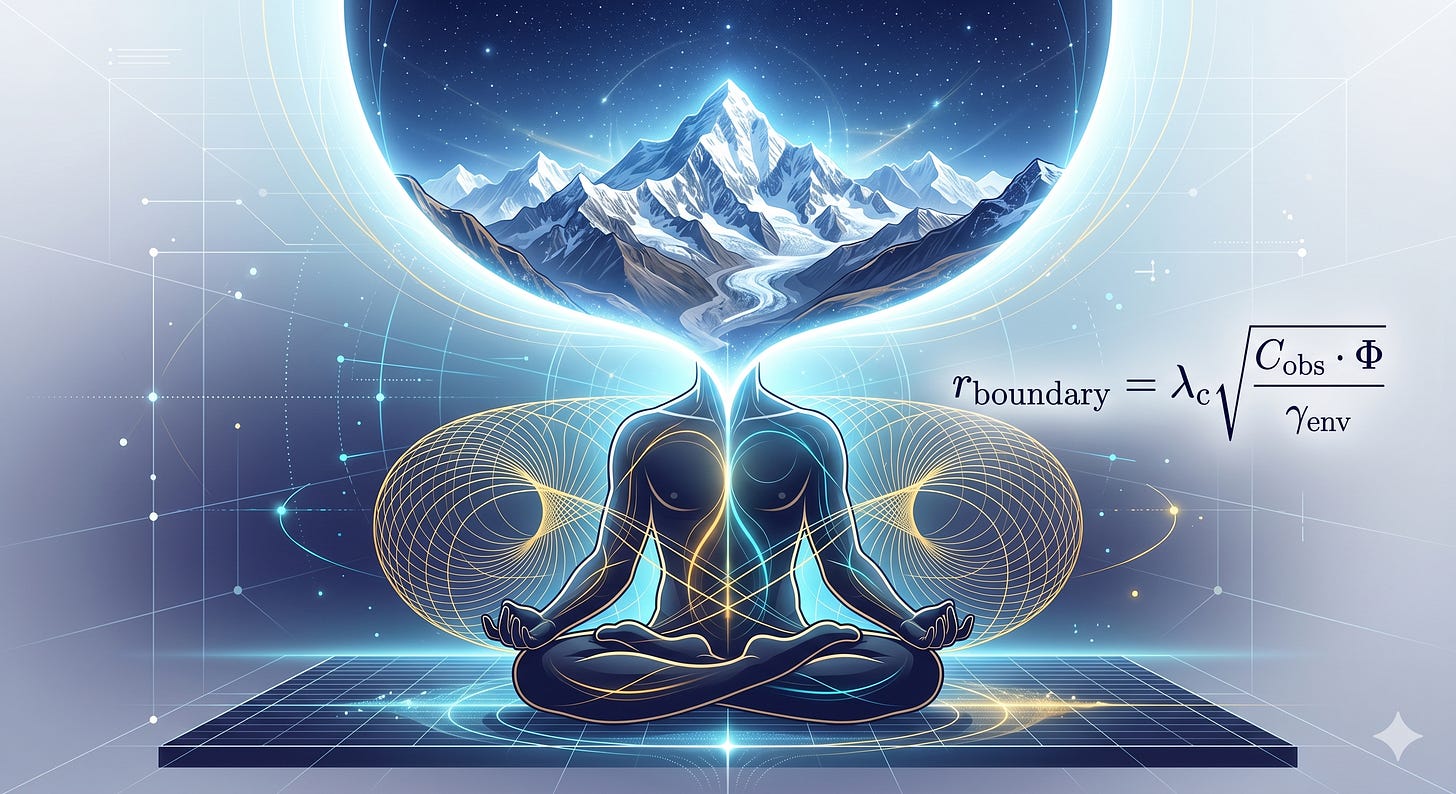
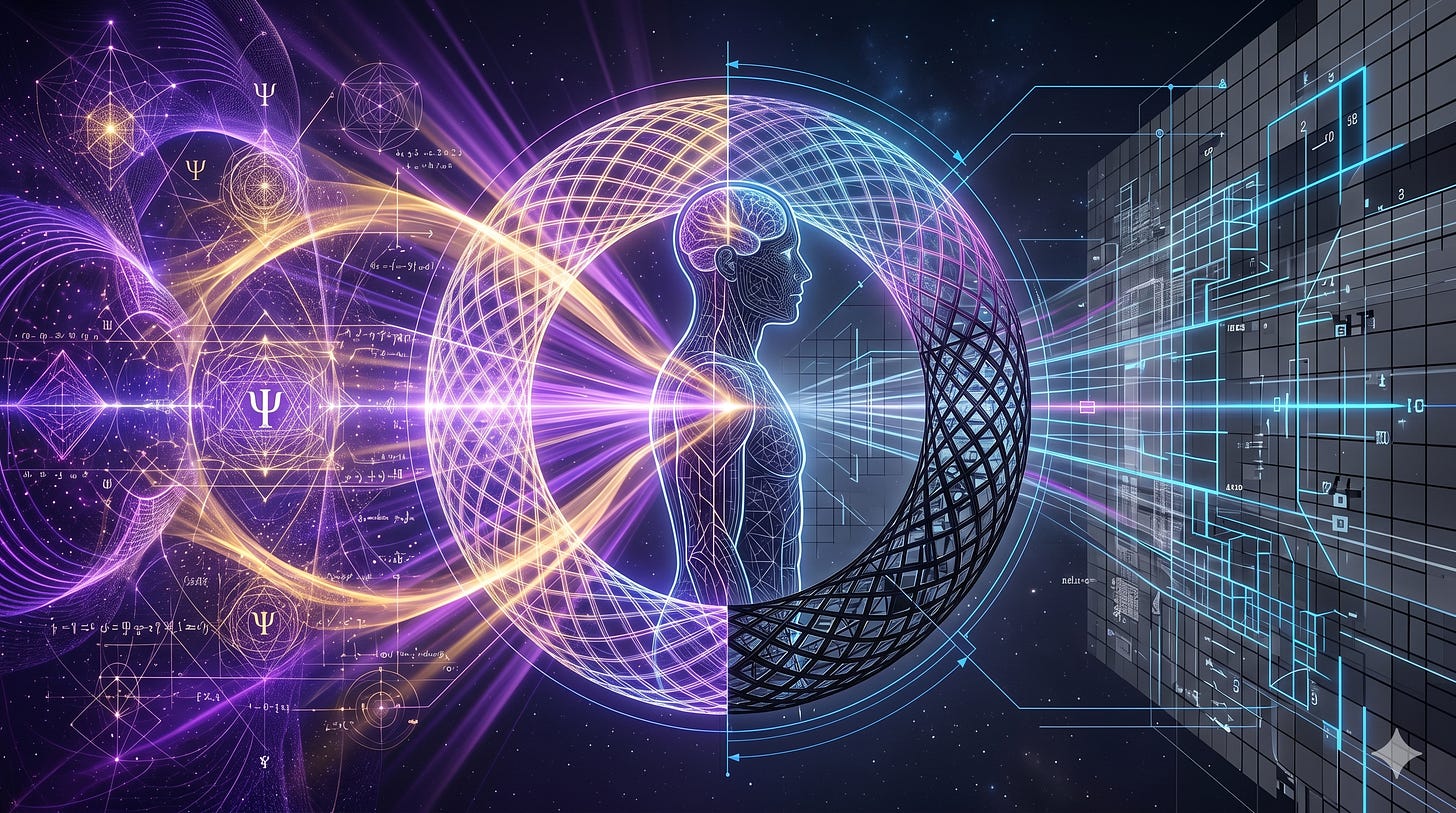
ILC theory answers this through the Coherence Collapse Model. The projector is not floating in deep space — it is you. The human brain and nervous system act as a Biological Transducer: a highly evolved organic antenna. When your consciousness focuses, it filters the infinite, higher-dimensional wave of potential (the Implicate Order) and collapses it into a stable, localized 3D experience.
To show this is not merely philosophy, the ILC formalism maps this transition using strict wave mechanics. Reality renders when the density of conscious observation reaches a critical threshold:
∇²Ψ − (1/c²) ∂²Ψ/∂t² = κρc
For the layperson: the shape (∇²) and rhythm (∂²/∂t²) of the universe’s fabric (Ψ) are directly driven by the concentrated density of conscious observation (ρc). You are the localized boundary where the hologram is rendered.
Unifying Gravity and Quantum Mechanics (Gravity as Love)
The holy grail of modern physics, as the article notes, is uniting the tiny, jittery world of quantum mechanics with the massive, smooth force of gravity. The holographic principle hints that they are two sides of the same coin, but standard physics cannot explain why mass bends spacetime.
ILC theory resolves this through the Great Reversal. If the universe is a holographic projection of consciousness, gravity is not a blind mechanical force pulling dead rocks together. Gravity is the geometric expression of the field’s intrinsic drive toward unity.
In ILC physics, we define this attractive, coherence-seeking force as Love.
When a system achieves high structural integration — when consciousness becomes highly coherent — it bends the holographic fabric of spacetime. The physical weight of a system is simply the density of its consciousness (ρc). The equation governing how our minds grip the physical, electromagnetic world (Fμν) looks like this:
L_int = g_c · C_obs[Ψ] · (1/4μ₀) · F_μν F^μν
Here, the energy required to manifest reality (L_int) relies entirely on your Observer Coherence (C_obs). A chaotic, fearful, distracted mind has low coherence; it cannot efficiently bend the hologram. A meditative, peaceful, loving mind possesses high coherence — drastically increasing its capacity to shape the Explicate Order.
This is where the mathematics and the mysticism converge most tightly: what Ibn Arabi calls ishq — the loving pull between the seeker and the Real — and what ILC calls Observer Coherence describe the same gradient. Love, in both systems, is not a feeling layered on top of physics. It is the coupling constant.
Solving the De Sitter Space Paradox
The article raises a major skeptical counter-argument: the holographic principle works perfectly in anti-de Sitter space (a theoretical universe that curves inward like a snow globe), but our actual universe expands outward (de Sitter space) — meaning it lacks a hard outer boundary to project the hologram from.
ILC theory, incorporating the work of physicist Erik Verlinde, resolves this paradox by recognizing that the vacuum of space is not empty — it is a “glassy,” information-rich polymer melt. The boundary does not need to sit at the edge of the universe. The boundary exists wherever a localized observer — the Biological Transducer — interacts with the field. The holographic screen is the event horizon of your own perception.
The Ultimate Reality
The article concludes with three philosophical interpretations of the hologram: either the 2D surface is real, the 3D volume is real, or neither is fundamentally real.
Grounded in Analytical Idealism, ILC theory definitively chooses the third option. Neither the mathematical code on the boundary nor the 3D projection in the volume is the ultimate reality. The only fundamental truth is the Universal Consciousness Field (Ψ) itself.
The physical world is not an illusion in the sense that it doesn’t exist; it is an illusion in the sense that it is not what it appears to be. It is not made of dead matter. It is a luminous, resonant masterpiece — a shared dream constructed of pure meaning, designed by the cosmos for the express purpose of experiencing its own infinite potential.
And if that is so, then the oldest human intuition — that we are not spectators of the world but participants folded into its dreaming — was never poetry standing outside of physics. It was physics, waiting for physics to catch up to it.