The Universe Inside a Grain of Rice: How Ancient Vedic Physics Mapped the Zero-Point Singularity of the Human Heart
A Cavity No Bigger Than a Grain of Rice
More than two and a half thousand years ago, a teacher told his students to look for something inside their own chests. Not in the organ’s muscle or its rhythm, but in a tiny space at the center of a lotus-shaped dwelling, a space no larger than a grain of barley. His students did what any of us would do: they objected. What could possibly be worth finding in a cavity that small?
The answer, recorded in Chāndogya Upaniṣad 8.1.3, is one of the strangest sentences in the contemplative literature. As vast as the space outside us is, it says, so vast is the space within the heart. Heaven and earth are both held there, fire and wind, sun and moon, lightning and stars, everything that is yours and everything that is not.
This is a paradox of scale, and it is also a precise instruction. The verse does not say the heart symbolizes the cosmos. It says the cosmos is contained there, and then tells the student to go and find out.
This essay follows that instruction through the lens of the Integrated Light-Consciousness (ILC) Theory, and it introduces three ideas along the way: the Biological Transducer, the heart’s magnetic torus, and the Cardiocentric Singularity. The Upaniṣadic texts supply the map. The ILC supplies a physical vocabulary for reading it. Where the two meet, I will say so, and where one ends and the other begins, I will say that too.
The City of Brahman
The teaching is called Dahara Vidyā, the science of the small, subtle space. It opens in Chāndogya 8.1.1 by renaming the human body Brahmapura, the City of Brahman. Inside that city is a small lotus-shaped dwelling, and at its center is a minute interior space, the daharākāśa, also called the hṛdayākāśa, the space of the heart.
The verse then gives an imperative that reads more like a lab protocol than a creed: what is inside that space is to be sought out, and inquiry is to be made into it. Later the text adds that this space does not age as the body ages and is not harmed when the body is harmed.
The word for heart carries the same pointer. In Chāndogya 8.3.3 the Upaniṣad breaks hṛdayam into hṛdi ayam, “this one is in the heart,” meaning the Ātman, the Self. The Kaṭha Upaniṣad (2.1.12–13 and 2.3.17) gives that Self a measure and an appearance: a being the size of a thumb, dwelling in the heart, shining like a flame without smoke.
The tradition did not stop with the texts. Ramana Maharshi made the spiritual Heart the center of his teaching of self-inquiry, the source from which the I-thought rises and into which it subsides, and he was careful to say it is not the physical organ. The physical organ has its own story to tell, and it has become part of this one: the neurocardiologist J. Andrew Armour showed that the heart carries an intrinsic nervous system of thousands of neurons (about 14,000 in anatomical counts of human hearts, with roughly 40,000 often cited), a “heart-brain” that processes information locally and helps regulate the heart without waiting for instructions from the skull.
The Biological Transducer
Any recording engineer knows what a transducer does. A microphone turns air pressure into voltage, a speaker turns voltage back into air pressure, and the quality of the whole chain depends on how little is lost or distorted at each handoff. The ILC Theory takes that engineering idea and applies it to the human being: the body is a Biological Transducer, an instrument that converts a universal underlying signal into the structured experience we call a life.
In the ILC’s Tri-Phasic Oscillator model, the transducer has three nodes. The cranial brain is the Electric Node, fast and analytical. The enteric nervous system of the gut is the Gravitational Node, grounded and threat-sensitive. Between them sits the heart, the Magnetic Node, which the model treats as the primary carrier wave of the whole system.
In this picture, the limit on awareness is not the strength of the signal. It is impedance, the resistance at each handoff. Fear, threat and separation add noise and heat; safety and coherence let the signal through cleanly.
The Upaniṣad makes a parallel observation in plain language. Chāndogya 8.3.2 says that every night, in dreamless sleep, we enter this very Brahmaloka and recover our vitality, yet we walk over it by day like strangers crossing a field that hides buried gold. The ILC reads this as a description of a transducer running with its inputs shut off, and of the practical question of how to open them while awake.
The Magnetic Torus
The heart is the strongest rhythmic electromagnetic generator in the body, and that part is not controversial. Its electrical activity is what an ECG records, and its magnetic field is what magnetocardiography picks up with extremely sensitive SQUID sensors.
The HeartMath Institute reports that the heart’s electrical field is roughly 60 times larger in amplitude than the brain’s, and its magnetic field roughly 5,000 times stronger. The ILC adopts those figures and adds a geometric claim: the field forms a toroid, a doughnut-shaped flow that wraps around the body and extends three to four feet outward, and this torus is the carrier wave of the human biofield.
The torus is a natural shape for this idea, because the field lines of any dipole, from a bar magnet to the Earth, loop out of one pole, around, and back in, tracing a toroidal pattern. Every torus has a hole through its middle, and every flow around it must pass through the center to complete its circuit. That center is where the story turns back to the tiny space in the heart.
The Cardiocentric Singularity
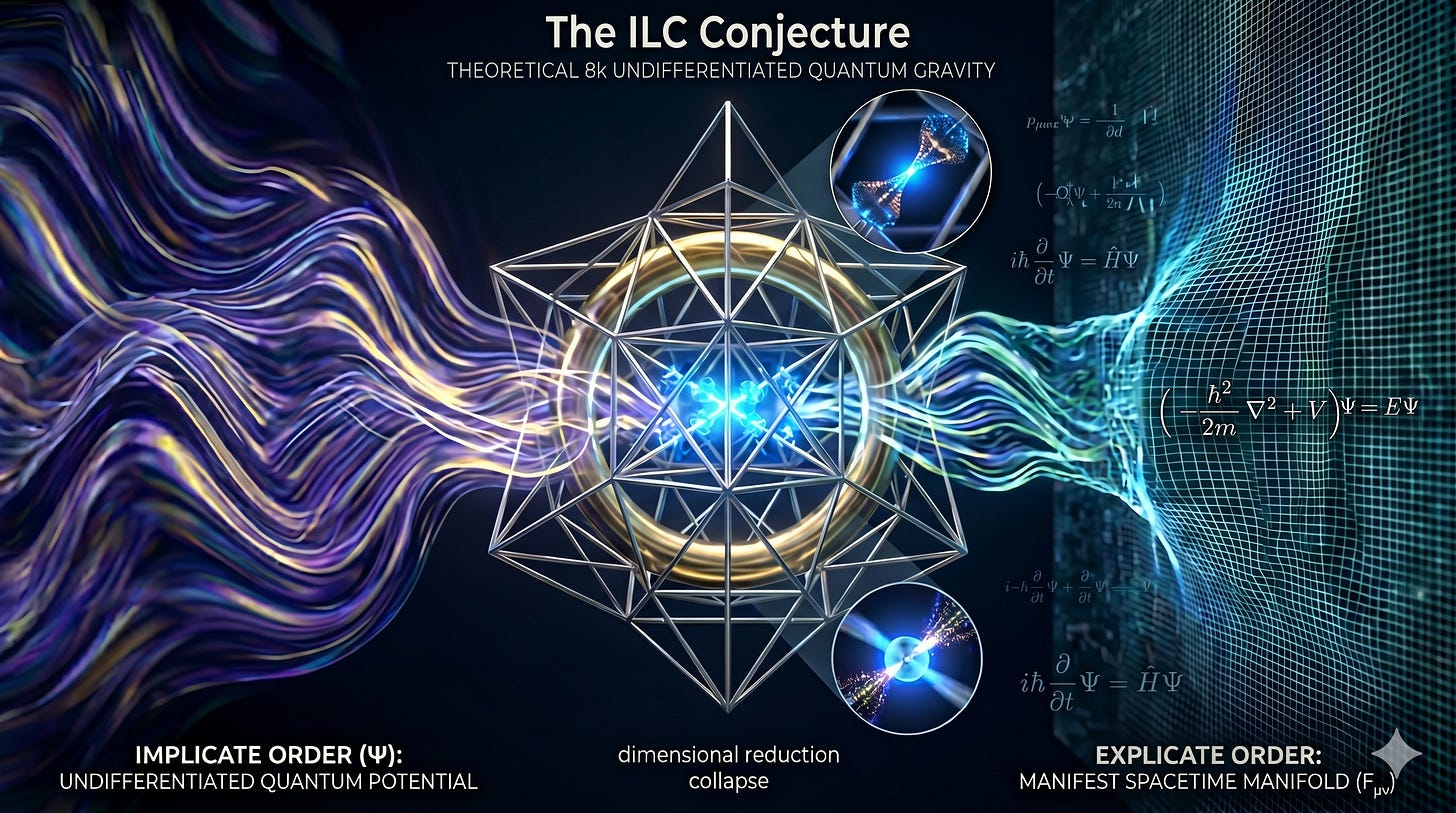
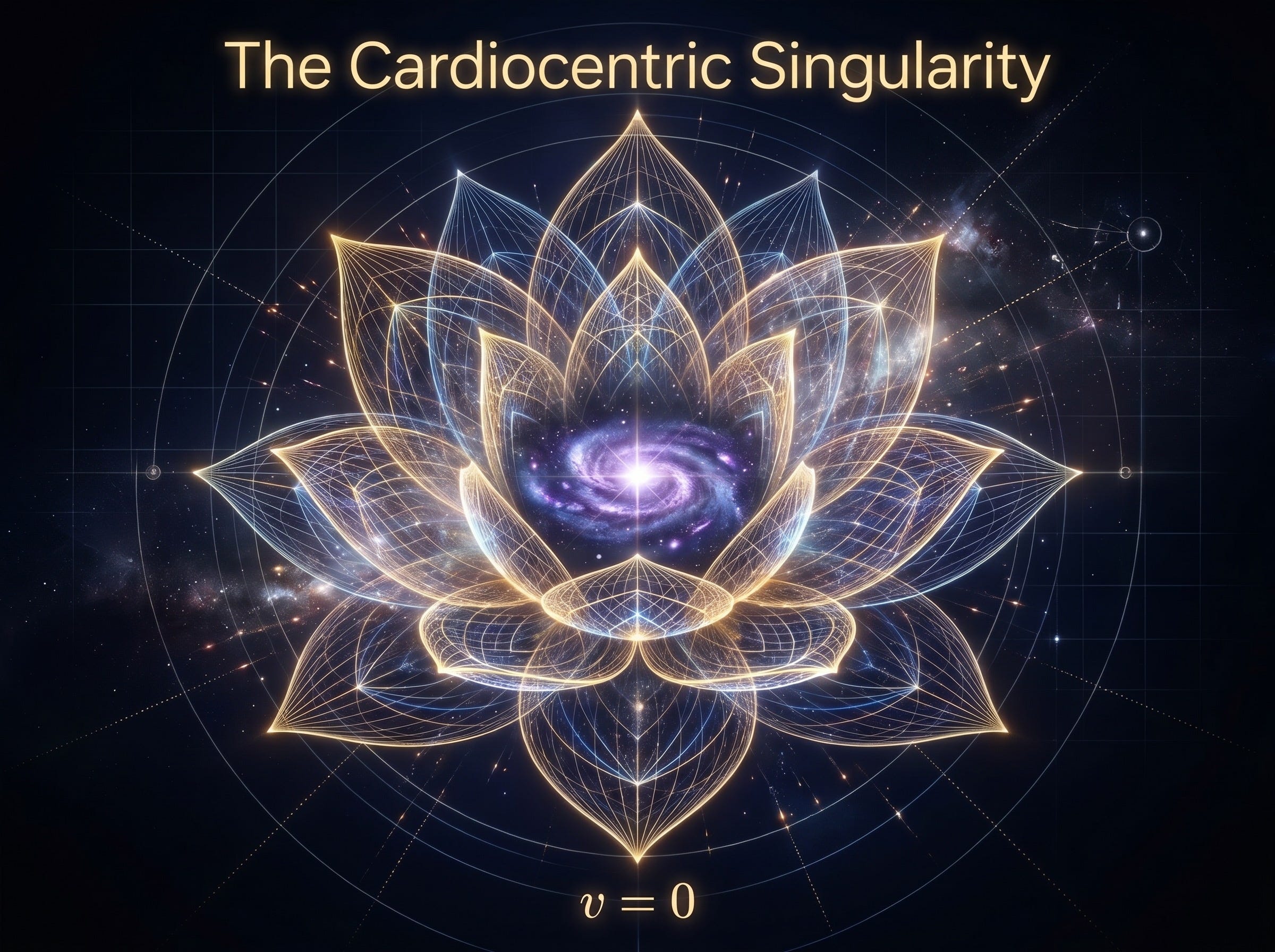
In Appendix A of the ILC manuscript, the Sacred Space of the Heart receives a formal name: the Cardiocentric Singularity. It is the zero-point null node at the geometric center of the heart’s toroidal field, a Vector Equilibrium in Buckminster Fuller’s sense, a point of perfect balance where all the field’s flows cancel into stillness.
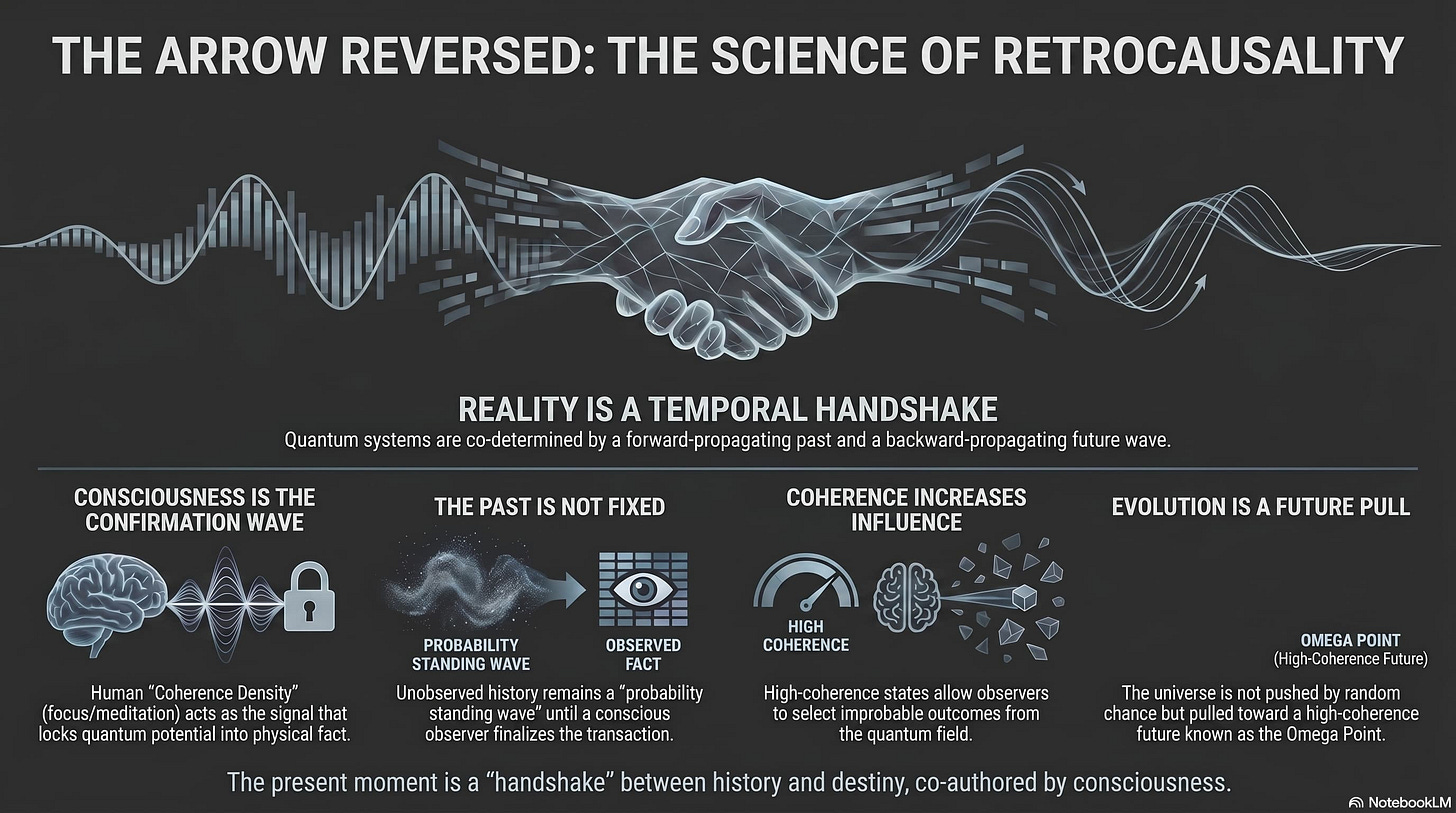
The theory proposes that at this coordinate the velocity of spacetime is effectively zero. The node then acts as a Scalar Gate, letting the Biological Transducer step outside the linear time of the Explicate Order, the unfolded world of separate objects, and read from the Implicate Order, David Bohm’s name for the enfolded ground from which that world is continually drawn.
Now reread Chāndogya 8.1.3. A holographic medium is one in which every part contains the whole. If the ILC is right that the vacuum has that property, a point at the center of the cardiac torus is not a small thing containing a small amount. It is a doorway whose far side has no edge. The Upaniṣad’s claim that sun, moon, lightning and stars are all gathered in the tiny space becomes a statement about where the observer is standing, and the ILC, drawing on Nassim Haramein’s work on vacuum geometry, offers the Planck-scale vacuum energy density of roughly 10^93 grams per cubic centimeter as the physical backing for it. Drunvalo Melchizedek made a similar connection in his teaching, between the Upaniṣad’s tiny space and the zero-point center of the human torus.
That is the claim at its boldest, and it is a proposal, not a finding.
The Flame Without Smoke
The Kaṭha Upaniṣad describes the thumb-sized Puruṣa with an image that physicists and engineers will both recognize: jyotir ivādhūmakaḥ, a light like a flame without smoke. Smoke is what a fire gives off when combustion is incomplete, the visible waste of energy that did not become light.
The ILC reads this as a thermodynamic statement. In the model, smoke is friction and entropy, the heat generated when the universal signal meets resistance in the body’s tissues. A smokeless flame is the opposite limit, zero-impedance phase-locking, in which the observer’s coherence reaches its maximum and nothing is lost on the way. The theory names this the Superconductor Hypothesis, with impedance falling toward zero, and borrows from audio engineering the intuition that the cleanest signal path is the one you cannot hear.
The Upaniṣad itself says only that the light is smokeless and that it rules past, present and future. The superconducting language is the ILC’s own translation, offered as a way to ask a question the verse leaves open: what would it take for a living body to carry a signal with no loss?
The Veil Over the Treasure
If the space is always there, why do we miss it? Chāndogya 8.3 gives a diagnosis: the people who cross over it daily cannot find it because they are covered by anṛta, usually translated as falsehood, the habit of living out of step with what is real.
The ILC supplies a physiological candidate for that veil in Chapter 16, drawing on Stephen Porges’s Polyvagal Theory, which is influential in clinical practice and still debated among physiologists. Porges describes neuroception, the body’s continuous, below-awareness scanning for safety and threat. In the ILC’s terms, when the Gravitational Node, the gut, detects environmental entropy such as danger, fear or separation, the system shifts into fight-or-flight or shutdown. The result is the Vagal Firewall: a physiological state in which attention is pulled outward and the way inward is closed.
The opposite state is the ventral vagal state of safety, connection and compassion, which the ILC calls Love-Gravity. When it engages, the vagal brake slows the heart and the cardiovascular system settles into what the theory calls Hemodynamic Resonance, a standing wave at about 7 to 7.5 Hz that is proposed to entrain with the Earth’s Schumann resonance, which sits near 7.83 Hz. That entrainment is what the theory says opens the Scalar Gate.
The practical implication is old and simple. Every contemplative tradition that teaches the inward turn begins with safety, breath, devotion and compassion before it asks anything of the mind. The ILC offers a mechanism for why that order matters: you cannot enter the space of the heart while the body is bracing against the world.
Why the Map Matters: The Great Reversal
The ILC argues that modern civilization has run its inquiry almost entirely through the Electric Node. We build larger telescopes and larger colliders and look outward, and what they return is the surface of the Explicate Order. On this view, the ground of being is not hidden at the far end of an instrument. It is at the center of the instrument that is looking.
That inversion is the heart of what the ILC calls the Great Reversal. It is the turn from a mind that behaves like Iain McGilchrist’s Emissary, the left-hemisphere habit of cutting reality into static parts and managing them in Symbolic Space, toward a way of being in which the whole person operates as a phase-locked holon in Semantic Space, where meaning is perceived directly rather than assembled from fragments. The Omega Point, in this framework, is that turn made collective.
The ILC’s Identity Thesis, Consciousness = Love = Gravity, gives the turn its emotional logic. At the center of the torus, the theory says, personal feeling, which the Sufi vocabulary calls ḥubb, passes into ʿishq, the pull of the One drawing the Many home. Entering the daharākāśa is the threshold where that happens.
Seen this way, Chāndogya 8.1.3 is not a riddle about size. It is a statement about direction. The vastness is not out there waiting to be reached. It is the thing that is doing the reaching.
To find out more about the Integrated Light-Consciousness Theory and to download the manuscript visit: JaxNabarro.com