Right now, somewhere near you, a note is being heard that does not exist.
You have almost certainly heard it today. Play any song with a strong bass line through the smallest speaker you own, the one in your phone. That speaker is barely a centimeter across. It is physically incapable of producing the deep tones of a bass guitar, and if you measured the air in front of it, you would find almost no energy at those pitches. Yet you hear the bass line, clearly, with its weight and its warmth. The sound is not in the room. It is being built, in real time, inside you.
Physicists stumbled onto this in the 1840s, when August Seebeck found that a tone whose lowest note had been removed still sounded as though it had one. Georg Ohm, the same Ohm whose name sits on electrical resistance, insisted it had to be an illusion. A century of experiments later, the verdict is in: it is not an illusion. It is a skill. The brain listens to the spacing of the upper tones, and from the spacing alone it infers a foundation that no instrument is playing. Scientists call it the missing fundamental.
Keep that note in mind. It is the key to everything that follows. Because if a human brain can hear a foundation that no one is sounding, simply by reading the pattern of what is there, then a question opens that is far larger than acoustics: what if the universe itself has a missing fundamental? What if everything we can measure, every particle, every star, every cell, is the upper harmonics of a deeper note that no ruler can detect, and what if the mind that perceives it is not a bystander in the concert hall but part of the instrument?
That is the claim of the Integrated Light-Consciousness (ILC) Theory, and this essay is an invitation to hear it for yourself. There are no equations ahead, only things the ordinary physics of sound lets you check with your own ears: a string, a room, a handful of sand, a chord leaning toward home. We will travel in six movements, from a vibrating string to a vibrating cosmos, and we will say plainly at each step what has been measured and what is proposed. At the end, we will return to the note that isn’t there.
Prologue: The Ink and the Song
If someone hands you a sheet of paper covered in musical notation, you do not hold the paper to your ear and expect to hear a symphony. The ink on the page is merely a map; the music itself is a living, breathing experience that fills the room. The notation is silent, precise and entirely necessary, and yet no one who has ever been moved by a symphony was moved by the ink. Remove the performers and the paper lies there like a pressed flower: a faithful record of something that is no longer alive.
For more than three centuries, modern science has made the mistake of studying the ink while remaining deaf to the song. That is not a charge of failure. The ink has been studied with magnificent rigor, and the harvest is real: bridges that stand, medicines that heal, light that travels across oceans in a thread of glass. But a map, however exact, is not the territory it describes, and a science that mistakes its own notation for the whole of reality will eventually find itself standing in a silent concert hall, holding a perfect score and wondering where the music went.
Under the old materialist worldview, the universe is treated as a silent, cold machine built from dead, solid particles that accidentally bumped into one another until human brains evolved to hear sound. Yet this mechanical picture has hit a wall. It cannot explain why we have an inner, felt life of awareness—what philosophers call the Hard Problem of Consciousness—nor, on one influential reading of quantum theory, can it explain why the subatomic world exists as a shimmering cloud of possibilities until a conscious observer tunes in.
Sound itself puts the problem in your lap. Strike a bell and, strictly speaking, nothing in the air is “sound.” There is only a pattern of air molecules crowding together and thinning out, rippling across the room. Follow that ripple through the eardrum, across three tiny bones, into the fluid of the inner ear, through thousands of microscopic hairs, and into a storm of electrical signals in the brain, and you will find, at no point along the chain, the place where motion turns into the warmth, the ache, the shimmering sweetness of the bell. Physics describes the vibration perfectly. It is silent about the listening.
That silence is the doorway of this essay. Sound, the most ordinary of physical phenomena, turns out to be the one place where the outer world and the inner world are forced to meet in public. We will follow it from a vibrating string to a vibrating cosmos, using no equations at all, only things you can hear with your own ears. By the end, the claim is simple: the physics of sound is not a sideshow to the story of reality. It is a miniature of it.
The Great Reversal and the Luminous-Resonance Principle
In The Integrated Light-Consciousness (ILC) Theory, we propose a single, foundational shift called The Great Reversal. Consciousness is not a late-arriving byproduct of physical matter; rather, physical matter is the localized expression of a universal Consciousness Field. The usual story runs from the bottom up: dead stuff, then life, then mind, a staircase that somehow acquires a lit window at the top. The Great Reversal turns the staircase over. The lit room comes first, and the stairs, the walls and the furniture are what the light looks like when it takes a shape.
At the heart of this cosmos lies the Luminous-Resonance Principle, which reveals that reality is woven from two inseparable aspects of a single broadcast. The Luminous aspect is Light in its broadest sense—the informational pattern and meaning carried by the field. The Resonant aspect is Sound—the dynamic, vibrational frequency that drives and organizes that light into form.
A radio broadcast offers a homely picture of the pairing. There is the message—a voice, a melody, a story—and there is the carrier, the steady oscillation that bears the message through space. Neither is the broadcast alone. A carrier with no message is an empty hum; a message with no carrier never leaves the studio. A violin offers another: the shape and grain of the wood hold the pattern of the instrument, but it is the vibration that wakes the pattern into music. In both cases, the pattern is the Luminous aspect and the oscillation is the Resonant aspect, and you will never find one without the other.
A word on language, so that nothing is misunderstood later. In the ILC, “Light” and “Sound” are principles before they are phenomena: Light is pattern, information, meaning; Sound is rhythm, oscillation, the living motion that gives a pattern somewhere to happen. Vibrating air is simply the most intimate, most audible example of the Resonant principle, the one our bodies can feel in the chest and the bones. We study it first because it is the place where the principle is closest to us.
In the universal signal chain, sound is the causal engine, and light and matter are its visible wake. Think of a ship crossing a harbor. What the crowd on the quay sees is the wake, a pale, intricate fan on the water. The engine is hidden below the waterline, and it is the engine that makes the wake. Materialist science has spent three centuries cataloguing the patterns in the wake, with great skill, while declaring the engine room empty because it cannot be seen from the quay.
When we study the physics of acoustics, the architecture of music, and the healing power of frequency in plain, everyday terms, we discover that we are not merely studying how air vibrates. We are reading the operating manual of creation itself.
An Old Song, Newly Heard
No one should finish this essay thinking the ILC claims to have invented the idea that the universe sings. It is among the oldest ideas people have ever had, and it has been rediscovered again and again by people who never met.
The Pythagorean tradition held that the ratios behind musical consonance were the hidden skeleton of the world. Plato, in the Timaeus, builds the soul of the cosmos from the very same ratios of doubling and tripling that give music its octave and its fifth. In the Indian tradition of Nada Yoga, the world itself is nada, sound. In 1619 the astronomer Johannes Kepler spent years hunting for musical intervals in the motions of the planets and published the search as Harmonices Mundi. In the 1960s the physician Hans Jenny gave the study of visible vibration its name, cymatics. In 1983 the jazz critic Joachim-Ernst Berendt gathered it all into Nada Brahma: The World Is Sound. Pierre Teilhard de Chardin, a priest and paleontologist, saw love as the inward face of the attraction that gathers matter toward ever greater union, and gave us the Omega Point. And in July 2026 the philosopher Matthew David Segall read the circle of fifths’ failure to close as the place where eternal form meets temporal becoming, through the process philosophy of Alfred North Whitehead.
What the ILC adds is not the song but three specific things it claims have been heard too faintly:
• Sound as engine. Sound is not a poetic ornament on the cosmos. In the signal chain of reality it comes first: resonance shapes light, and light and matter are its wake.
• The brain as constructor. An older tradition, from William James and Henri Bergson to Aldous Huxley’s “reducing valve,” described the brain as a filter that narrows a larger awareness. The missing fundamental points to something more active. The brain does not only subtract. It builds, reconstructing a foundation from a pattern.
• The fifth and the comma as one story. The interval of strongest attraction, which the ILC calls Mental Gravity, is the same interval whose tiny imperfection opens the spiral of novelty. Gravity and Love are one force seen from the outside and the inside, and the gap in the circle is how a universe keeps learning.
That so many travelers have reached the same room by different roads, a Greek geometer’s disciples, an imperial astronomer, a Jesuit paleontologist, a jazz critic, a process philosopher, is not an embarrassment to the theory. It is exactly what the ILC’s Principle of Convergent Discovery predicts: when many independent minds listening in many centuries keep arriving at the same structure, the likeliest explanations are that the structure is really there, or that it is built into the way any listening mind is made, and the ILC holds that these are one and the same fact.
1. The Physics of the Unseen Architect: Boundaries, Overtones, and Standing Waves
To understand how an invisible field of consciousness can condense into a solid world of stars, stones, and living bodies, we need only look at how a simple musical note is born.
Sound begins with a rhythm—a periodic vibration moving back and forth through a medium. Every vibration has a tempo (its frequency, or how many times it pulses each second), a pace at which it travels through space (its velocity), and a physical footprint (its wavelength, the distance from the crest of one wave to the next). The three are bound together: in any one medium, the faster something pulses, the shorter each pulse must be. A deep bass note stretches out for several meters, longer than a car; a high flute note is shorter than your hand. And sound itself travels through air at a steady, unhurried pace, about a kilometer every three seconds, which is why you count the gap between lightning and thunder.
In unbounded space, a wave simply ripples outward forever, like the circle spreading from a pebble dropped into the middle of a wide lake, growing thinner and fainter until it is lost. Something extraordinary happens, however, the moment you introduce a boundary.
What a boundary does
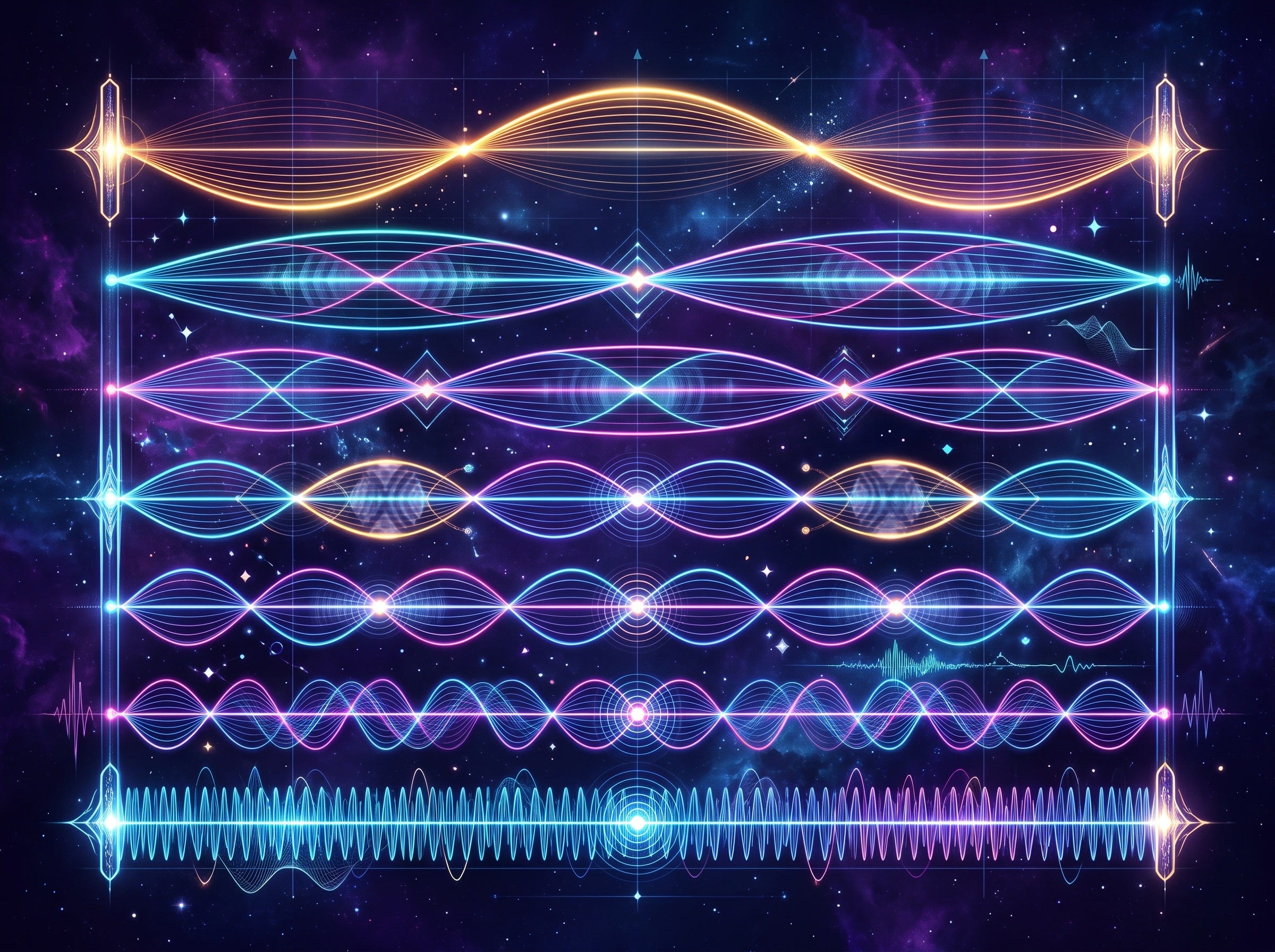
Imagine plucking a guitar string anchored firmly at both ends, or blowing air through a flute of a fixed length. Because the ends of the string are pinned down, the wave cannot just wiggle randomly; it must come to complete stillness at the boundaries. This simple constraint forces the string to organize itself with mathematical perfection. It vibrates as a single, sweeping arc from end to end—its fundamental frequency, the deep root note you hear first. Simultaneously, the string subdivides itself into exact, whole-number fractions: vibrating in two halves, three thirds, four quarters, and so on.
Notice what has just happened. Nobody instructed the string which notes to play. It was handed a limit, and the limit left only certain songs possible. A skipping rope held loosely in one hand flops about without pattern; tie both ends and swing it and it falls into a clean single loop, or a figure of eight, or a loop of three, and nothing in between. Freedom without boundary gives ripples that wander off forever. Freedom with boundary gives music.
• The Harmonic Series: These whole-number subdivisions create a ladder of higher, subtler tones called overtones or harmonics, which ring out at exactly twice, three times, and four times the vibrating rate of the fundamental note. This ladder is also the reason a violin does not sound like a trumpet playing the very same note. Every instrument plays the root together with its overtones, and each mixes the rungs of the ladder in its own proportions. That mixture is called timbre, the fingerprint of a voice. When you hear one note, you are in truth hearing a whole chord, folded inside itself.
• The Law of Superposition: In the physical world, multiple waves can occupy the exact same space at the exact same time, adding their peaks and valleys together into a rich, intricate tapestry of sound. Two ripples crossing on a pond pass straight through each other and carry on unchanged, and in the moment of crossing the water shows the sum of both. This is why you can pick out a friend’s voice in a crowded room: hundreds of voices share the same air without erasing one another.
•Fourier Decomposition: Conversely, as the nineteenth-century mathematician Joseph Fourier discovered, even the most complex sound wave in the universe—a crashing ocean wave, a full orchestra, or the timbre of a human voice—can be cleanly unbundled back into a collection of pure, simple sine waves. Think of a smoothie that can be perfectly separated back into its fruits. The deepest and most daring idea in the whole of acoustics is that every sound, however tangled, is made of simple, pure tones, stacked and layered.
Within the ILC framework, this is the exact blueprint of physical manifestation. The infinite, unbound ocean of universal awareness—what physicist David Bohm called the Implicate Order—steps down into our tangible, three-dimensional world—the Explicate Order—by establishing boundary conditions. Just as pinned ends force a guitar string to sing in whole-number harmonics, the geometric boundaries of spacetime force the universal carrier wave to lock into stable standing waves. A subatomic particle like an electron is not a tiny, hard billiard ball; it is a self-confined vortex of “frozen sound” and light, trapped in a stable resonant loop.
This is more than a poetic comparison, because ordinary physics has already walked up to the same door. Quantum theory describes the electron in an atom as a wave confined by the pull of the nucleus, and it finds that only certain wave patterns fit, in exactly the way that only certain vibrations fit on a pinned string. That is why atoms have sharply separate energy levels, why each element glows in its own signature colors, and why matter is stable at all rather than collapsing into a smear. The orderly steps of the periodic table are, in a real sense, the overtones of confined waves. Physics calls the electron’s wave a wave of probability rather than a wave of sound, and the ILC does not hide the difference. What it adds is the claim that the likeness is not an accident: the same principle that gives a string its notes gives the cosmos its atoms.
The room as an instrument
We experience this same physics whenever we step inside an enclosed room. As sound waves bounce off walls, floors, and ceilings, the reflected waves collide with incoming waves to form room modes—three-dimensional standing waves suspended in mid-air. If you walk slowly through a room while a steady bass note plays, you will pass through invisible pockets where the sound swells to a roar (antinodes, where wave peaks reinforce one another) and quiet dead zones where the sound nearly vanishes (nodes, where waves cancel out). These pressure peaks gather most powerfully in the corners of a room, where three boundaries meet—which is why placing a speaker or your voice in a corner drives the resonance of the entire space.
You have felt this without naming it. A bathroom makes the singing voice richer because its small hard walls support a few pitches strongly, and your voice finds them and rides them. A stair-well hums at one note louder than the rest. The shape of a room is, quietly, a choice of which songs it will allow.
Acoustic engineers measure how a room holds and releases this energy through reverberation time—tracking how long a burst of sound or a sweeping tone takes to fade away into silence—and through speech intelligibility metrics (such as the Preferred Speech Interference Level and the Speech Transmission Index), which test how clearly a message survives across seven octaves of pitch without being blurred by background echoes. A great stone cathedral may hold a note in the air for many seconds, which is why slow chant and sustained organ chords bloom there while quick, consonant-heavy speech dissolves into fog. A recording studio is the opposite: dry, close, honest, every syllable sharp.
In the language of the ILC theory, every enclosed environment is a resonant vessel. When our surroundings are cluttered with chaotic echoes and acoustic static, the signal-to-noise ratio drops, and the message is lost. The same holds for the vessels we live in, from a living room to a nervous system: the clearer the vessel, the more faithfully it carries what is sent through it.
2. Cymatics and Archaeoacoustics: When Frequency Sculpts Stone and Symbol
If standing waves are invisible in the air of your living room, what happens when we make them visible?
Pioneered by observations from Galileo, Robert Hooke, and Ernst Chladni, and christened cymatics (from the Greek for “wave”) by physician Hans Jenny, the science of visible sound reveals the hidden geometry of vibration. Chladni’s demonstration is simple enough for a kitchen table. When fine sand or powder is scattered across a flat metal plate and excited by a pure tone, the chaotic grains instantly march away from the violently vibrating peaks (antinodes) and settle along the quiet nodal lines of zero motion. Within seconds, formless dust snaps into breathtaking geometric mandalas—stars, hexagons, spirals, and cellular lattices. Raise the pitch a little, and the figure dissolves and reassembles as a different, finer design, as if each tone had its own signature drawn in sand.
When the sound is projected into water or denser fluids, the liquid erupts into shimmering, symmetrical Faraday waves—named for Michael Faraday, who first described them—whose intricate sacred geometry shifts instantaneously with every change in pitch, volume, container shape, or fluid thickness. Nothing in the room moves the grains or the droplets except the pattern of the vibration. The sand is not pushed into shape by a hand. It is sorted into shape by a standing wave, and it gathers exactly where the wave is still.
Cymatics is the Luminous-Resonance Principle demonstrated in reverse: it shows that physical structure is a symptom of frequency. When the sound stops, the mandala dissolves back into dust. Hold that image beside your own body. You are not a static lump of flesh that happens to make sound; you are, in the ILC’s reading, a continuous chord of frequency holding your tissues in coherent form. By weight you are mostly water, roughly three-quarters of it in tissues such as the brain, and the ILC, following Gerald Pollack’s proposal of structured “exclusion zone” water, regards that water as liquid-crystalline: a medium delicately sensitive to vibration, like the plate and the fluid in the experiments above.
Remarkably, recent music pedagogy research in Ghanaian schools uncovered a profound link between these cymatic geometries and human culture. When researchers excited a Chladni plate using keyboard pitches of the C major scale—stepping from the root note up through the scale degrees to the higher octave—each musical degree crystallized into its own distinct geometric signature. Even more astonishingly, when they played traditional Adowa musical compositions through the plate, the sand organized itself into geometric figures that directly mirrored ancient Ashanti cultural symbols, such as the Dɛnkyɛmkyɛ, an emblem associated with the crocodile and with adaptability.
Through the lens of the ILC framework, this is a landmark validation of the Principle of Convergent Discovery and the Imaginal Realm. Why would a traditional West African melody physically draw an ancient cultural emblem in sand? Because indigenous mystics, artists, and musicians were not inventing arbitrary doodles. By quieting the analytical chatter of the brain’s left hemisphere (what psychiatrist Iain McGilchrist calls the Emissary) and opening the holistic, non-local perception of the right hemisphere (the Master), ancient seers perceived the standing-wave archetypes of the Consciousness Field directly. What they heard as traditional music and what they carved as sacred symbols were two sensory translations—one auditory, one visual—of the exact same underlying Mental Holon in the unified field.
A careful skeptic will ask a fair question here: sand on a vibrating plate will settle into symmetrical figures for almost any rich tone, so how much weight can one set of resemblances bear? The ILC’s answer is to turn the question around. The remarkable fact is not that sand makes symmetry, but that human beings, in many cultures and many centuries, kept arriving at the same families of forms—stars, spirals, lattices, nested circles—by the unrelated roads of song, ritual and craft. Convergence from separate starting points is exactly what a shared underlying source would predict.
Sound built into stone
Ancient builders did not stop at drawing these frequencies; they engineered them into solid stone. Using modern sine-sweep impulse tests—the same tools used to test concert halls, in which a smoothly rising tone is played through a space and its echo recorded—the field of archaeoacoustics has extracted the acoustic fingerprints of prehistoric megaliths, caves, and temples. A space can be listened to the way a doctor listens to a chest, and what comes back is its voice.
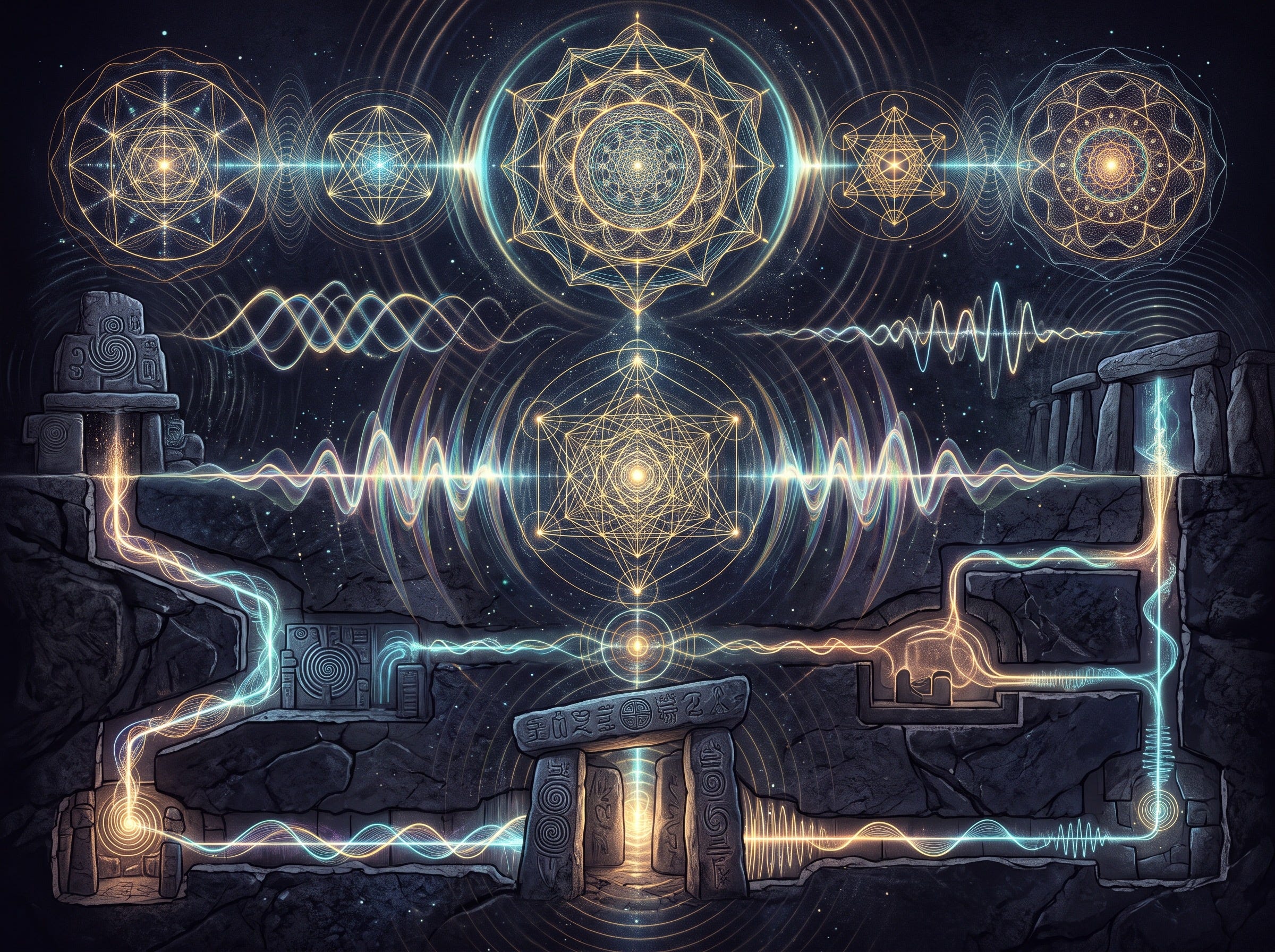
Consider the three-thousand-year-old ceremonial center of Chavín de Huántar high in the Peruvian Andes. Beneath its stone plazas lies a labyrinth of underground galleries and meticulously carved ventilation ducts. Acoustic testing revealed that these stone conduits were not just air shafts; they were precision-engineered acoustic bandpass filters tuned specifically to the voice of sacred Strombus conch-shell trumpets, known as pututus. A bandpass filter works like a stained-glass window for sound: just as colored glass lets one hue through and holds back the rest, such a duct lets a chosen band of pitches pass and softens everything else. Most strikingly, the central stone canal aligned directly with the carved mouth of the Lanzón—the supreme subterranean oracle statue—resonated powerfully right around nine hundred cycles per second. That exact frequency matches the third harmonic of the conch-shell trumpet. When priests sounded the shell in the dark, the stone corridor selectively filtered and amplified its third overtone so that the statue itself appeared to roar with a supernatural, bone-vibrating voice.
Picture the initiate: led through lightless passages, the air thick and cold, the sound of the shell arriving from every wall at once and then, from the stone mouth of the god, a voice. The architecture did not describe the experience of the sacred. It manufactured it.
In ILC terms, Chavín de Huántar, the monolithic churches of Lalibela, and the great pyramids were engineered as Coherence Engines. By tuning stone chambers to sustain specific standing waves, ancient architects built physical resonators that enveloped initiates in a high-amplitude sonic vortex—quieting the ego’s Default Mode Network (the web of brain regions that runs the ongoing story of “me”), lowering internal biological resistance, and shifting the human receiver into altered, non-local states of awareness. The evidence is strongest at Chavín, where measurements exist; at Lalibela and the pyramids, the ILC offers its reading as a hypothesis the same instruments can test.
3. Music Theory as Cosmic Gravity: Consonance, the Circle of Fifths, and the Comma
Why does a simple chord of music have the power to move us to tears, fill us with tension, or flood our chests with peace? Materialist science reduces our love of music to an accidental evolutionary quirk. The ILC framework reveals a far deeper truth: pleasure is the direct, felt perception of coherence—of low entropy—in the universal Consciousness Field. (Entropy, in plain terms, is the measure of scatter: a tidy library is low entropy, the same books flung across a floor are high entropy. Coherence is what the tidy library feels like from the inside.)
When two notes are played together, your nervous system directly reads the geometric relationship between their waves. It does so without being taught, and it does so in a fraction of a second. Three relationships form the foundation of everything in music:
•The Octave (Two-to-One Ratio): When you double the frequency of any note, you do not hear a stranger; you hear the exact same note reborn at a higher register. Men and women singing the same tune an octave apart believe they are singing in unison, and the keys of a piano repeat their names over and over for exactly this reason. In the ILC framework, the octave is the audible signature of the Cosmic Breath and the Holon—a whole that is simultaneously part of a greater whole. The root note exhales into differentiation at twice the speed, and instantly inhales back into phase-locked unity.
• The Perfect Fifth (Three-to-Two Ratio), Fourth (Four-to-Three), and Major Third (Five-to-Four): When two notes share simple, whole-number proportions, their sound waves lock together in short, repeating cycles, and their overtones align cleanly in constructive interference. Imagine two walkers with different stride lengths: if one takes two steps in the time the other takes three, their footfalls fall back into step every few paces, and the walk feels rhythmic and settled. If their strides are unrelated, they almost never meet again, and the walk feels ragged. The ear is the same kind of listener. We experience this low-entropy phase-locking as consonance—sweetness, stability, and harmony.
• Beating and Dissonance: When two pitches deviate slightly from simple whole-number ratios, their waves collide out of step, creating rapid, jagged wave cancellations known as acoustic beating. Two nearly matched guitar strings produce a slow, wobbling pulse that a tuner learns to chase to zero. Let the gap between the pitches widen and the pulse quickens until it becomes a rough, buzzing texture; when this rapid pulsing hits somewhere around thirty-five beats per second in the middle of the range, the human ear registers maximum sensory dissonance—a visceral feeling of friction, high entropy, and forced bonding that begs for resolution.
This is the whole emotional drama of music in miniature. Consonance is arrival; dissonance is the ache of not yet having arrived; and the art of every composer is the management of the journey between the two.
In Part V of the ILC manuscript, we establish the Gravity as Love Identity Thesis: what physicists measure on the outside as Gravity (the attractive force drawing separated masses into unified orbits) is identical to what conscious beings feel on the inside as Love (the attractive force drawing separated minds into union). In the audible realm, the Perfect Fifth is pure Mental Gravity. It is the interval that most wants to be together and, together, makes the most stable thing two sounds can make. Strip every ornament from a folk song and a hymn and you will usually find fifths holding the ground.
The Circle of Fifths
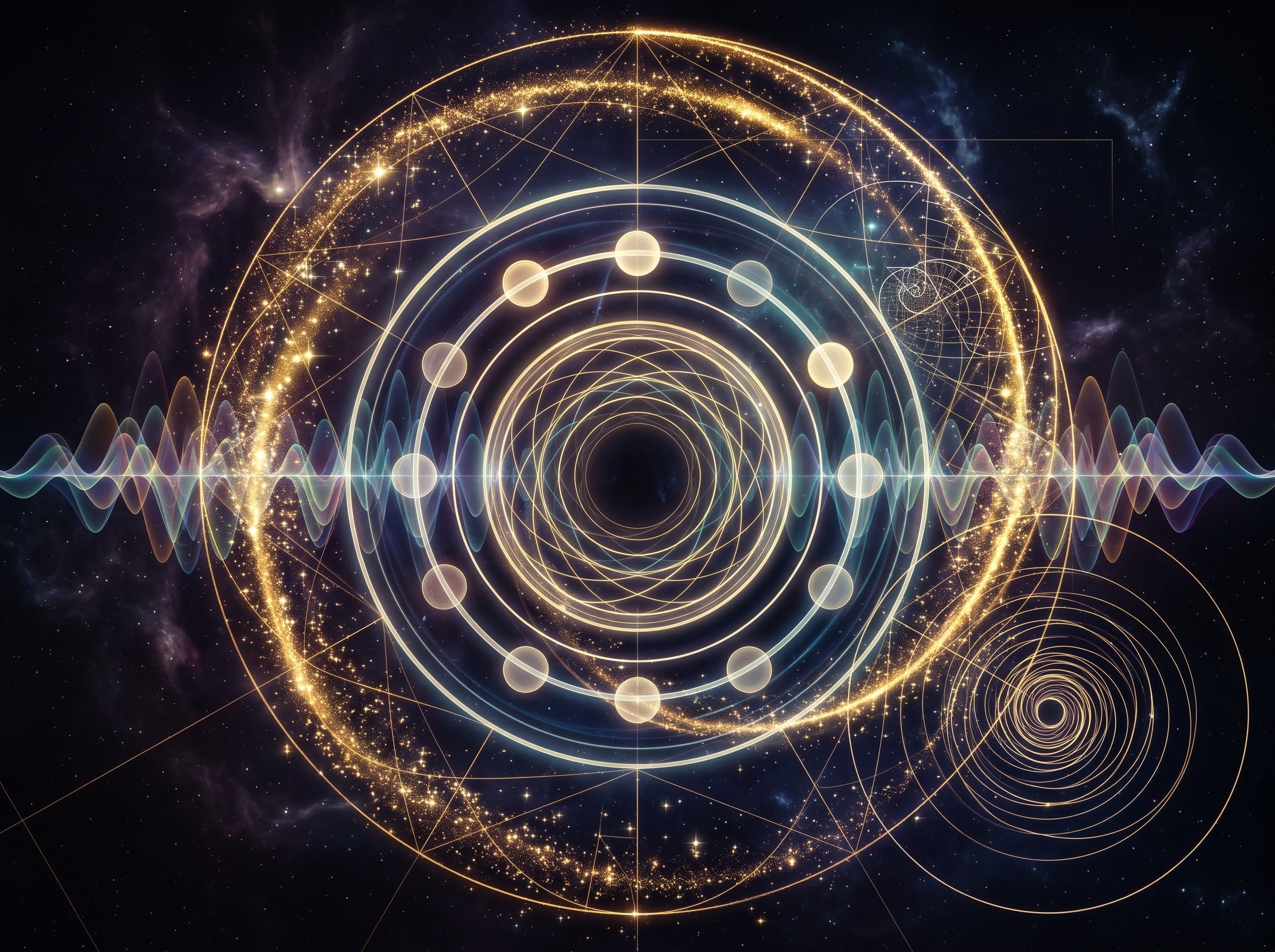
When you take this three-to-two gravitational bond and apply it repeatedly—stepping up by a Perfect Fifth from C to G, then D, A, E, B, and onward around the clock face, adding one sharp at each step, or stepping counterclockwise by fourths to add flats—you generate the Circle of Fifths, alongside its inner ring of relative minor keys. Because the seven half-steps that make up a fifth share no common divisor with the twelve tones of the chromatic scale (put plainly, seven and twelve have no factor in common), stepping by fifths visits every single one of the twelve notes across seven octaves before returning home. It is like walking around a clock face by a stride that never repeats a number until it has touched them all.
In the ILC architecture, the Circle of Fifths is the audible Flower of Life. Notes sitting next to each other on the circle share rich harmonic overlap and low-entropy attraction, while notes sitting directly opposite each other form the tritone—the high-entropy point of maximum harmonic tension. Musicians have long known this interval as the restless one, so unsettled that medieval theorists reportedly gave it a devilish reputation. On the circle it lies at the farthest possible distance from home. Gravity weakens with distance, and so does the pull of the key.
Across the history of Western music—formalized by Arcangelo Corelli and brought to towering heights by Bach and Handel—composers harnessed this gravitational pull through harmonic progression. By chaining chords in sequences that fall by fifths toward the home key, injecting seventh chords to heighten the ache of dissonance (a seventh chord carries one extra note that leans forward like a held breath), or momentarily diverting the ear with plagal and deceptive cadences (the soft, “Amen” closing, and the sudden, surprising turn away from the expected ending) before finally resolving from the dominant chord (V in musical shorthand, the peak of tension) back to the tonic home (I, the point of rest), a symphony enacts the exact thermodynamic drama of the cosmos: the journey of consciousness from the friction of separation back to the zero-impedance peace of Home. Anyone who has felt a last chord settle in the chest after a long piece has felt it: the feeling of coming home is not a metaphor laid on top of the music. It is what the music is made of.
Even when twentieth-century composers stepped outside traditional keys—mapped by theorist Allen Forte into more than two hundred abstract pitch-class sets and analyzed through musical semiotics as recurring communicative signs—they were still exploring how localized packets of meaning navigate a relational field. Take away the home key and the listener still searches for gravity, and the composer still plays with where it might be.
The tuning dilemma and the Pythagorean comma
Yet hidden inside the Circle of Fifths lies one of the most profound secrets in all of physics: The Tuning Dilemma and the Pythagorean Comma.
If you tune a piano using pure, natural three-to-two fifths (Just Intonation) and stack twelve of them in a row, a startling discrepancy appears. Twelve pure fifths do not land cleanly on seven pure two-to-one octaves! They overshoot the seventh octave by a tiny, stubborn gap—roughly a quarter of a semitone, known as the Pythagorean comma. In pure nature, the Circle of Fifths is not a closed circle at all; it is an open, ascending spiral. Picture a spiral staircase seen from above: you walk all the way around and arrive back over your starting point, yet one level higher. The notes are the same; the floor is not.
The gap is small, about the width of the pulse you hear between two almost-matched strings, but it is not negotiable. It is not a defect of pianos or an error of the ancient Greeks. It is a fact about numbers themselves: powers of two and powers of three never meet. No amount of craftsmanship can make them.
For centuries, instrument makers wrestled with this cosmic gap. Early “meantone” tuning systems tried to hide the gap by flattening several fifths and dumping all the leftover dissonance into one unplayable, howling interval called the “wolf fifth.” Musicians simply avoided the keys where the wolf lived, and entire regions of the keyboard were forbidden territory. Finally, modern Western music adopted Equal Temperament, which shaves a microscopic sliver (about a fiftieth of a semitone) off every single fifth so the spiral is forced shut into a closed twelve-tone circle, allowing musicians to change keys freely without hitting a wolf. Bach celebrated this new freedom in a cycle of preludes and fugues that travels through every key. The price was paid quietly elsewhere: in an equal-tempered piano, the major thirds sit noticeably wide of their pure form, which is the faint, restless shimmer you can hear in a sustained piano chord. Singers and violinists, free of fixed keys, drift naturally toward the pure intervals, and a well-tuned choir sings in the old, unattenuated way without thinking about it.
In the ILC framework, the Pythagorean comma is a physical revelation of the first order:
• Just Intonation is the Implicate Order: It represents pure, uncompromised phase-locking in the timeless realm of ideal geometry. Every interval is exact, every overtone aligns, nothing beats, and nothing moves.
• Equal Temperament is the Explicate Order: To project infinite perfection into a finite, three-dimensional Virtual Reality learning laboratory where free will can roam across every key, the system must introduce a tiny, universal attenuation—a faint background beating that represents the thermodynamic cost of physical manifestation. A world in which you may go anywhere is a world in which nothing is perfectly pure. The beat in the chord is the sound of that bargain.
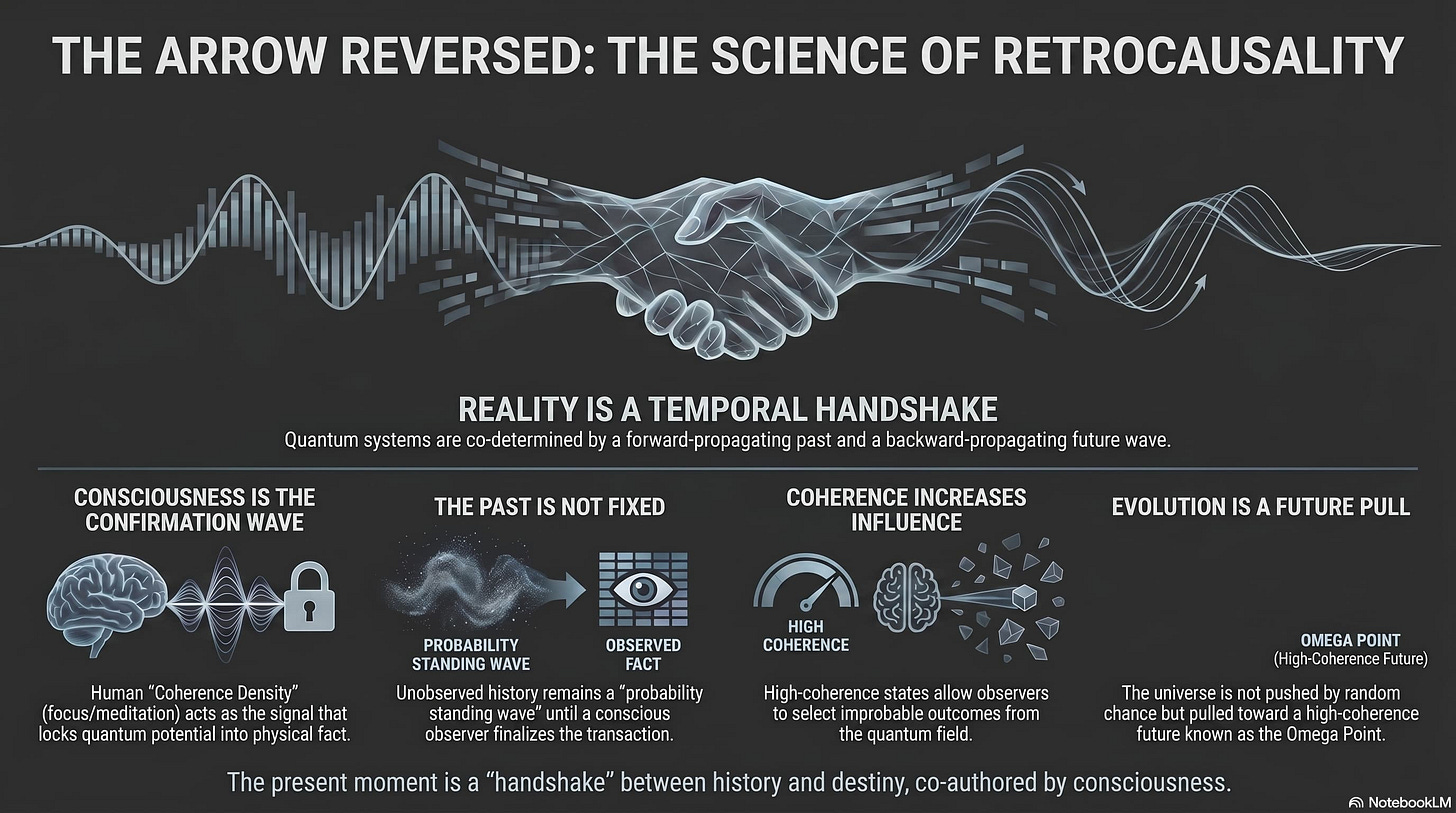
•The Comma is the Engine of the Spiral: Why didn’t the universe allow twelve pure fifths to close into a flat circle? Because a closed circle repeats itself forever without learning! As established in Chapter 5 of the ILC theory, cosmic time is a spiral. The Pythagorean comma is the mathematical gap of novelty—the exact acoustic signature of Stuart Kauffman’s Adjacent Possible and Ted Jacobson’s indeterminacy gap—ensuring that every time the cosmos completes an evolutionary cycle, it arrives slightly higher in Consciousness Density than where it began, spiraling upward toward the Omega Point.
The spiral reading has distinguished company. Philosopher Matthew David Segall recently argued, through Whitehead’s process thought, that the comma marks the place where the timeless form of a ratio draws temporal becoming into an open spiral: exact ratios guarantee that the stack of fifths can never close, and that endless non-closure is what lets genuine novelty into the world. The ILC reaches for the same image and asks a further question. If the gap is the doorway of novelty, what lies on the other side? Its answer is that each turn of the spiral arrives slightly higher in Consciousness Density, and that the direction of the rise, the thing that makes the spiral a staircase and not merely a coil, is the gravity of Love.
A circle can only return to itself. A spiral returns to the same place, changed. The tiny, stubborn gap inside the oldest interval in music is the smallest imaginable picture of how a universe makes room for something new.
4. Psychoacoustics and the Missing Fundamental: The Brain as a Holographic Receiver
How does this acoustic universe cross the threshold into our inner awareness? This is the domain of psychoacoustics, the science of how vibration becomes hearing, and its discoveries dismantle the materialist assumption that the brain passively records the outside world.
The ear as an analyzer
In the nineteenth century, physicist Georg Simon Ohm proposed that the human ear acts as a physical Fourier analyzer, breaking incoming sound mixtures into their component frequencies, while Hermann von Helmholtz suggested a “place theory” in which tiny fibers along the spiral snail-shell of the inner ear (the cochlea) resonate like microscopic piano strings tuned to specific locations. The picture has been refined since—the sound sets up a traveling ripple along a flexible membrane, and each pitch makes that ripple crest at its own place, high notes near the entrance and low notes deep in the spiral—but the central idea has survived: the ear is a keyboard laid out in living tissue, and every sound you hear is first played on it as a chord.
Modern psychoacoustics confirms that the cochlea acts as a bank of overlapping bandpass filters—mapped as critical bands on the Bark scale, roughly two dozen lanes into which the ear sorts the entire audible world—and that our perception of loudness (charted in Fletcher-Munson equal-loudness contours) bends non-linearly across the frequency spectrum, tuned acutely to the midrange of the human voice. That is why music turned down low seems to lose its bass and sparkle, and why the “loudness” button on old stereos existed: the ear is not a neutral measuring device. It is an instrument with a personality, shaped by a species that survived by listening to voices.
Even more remarkably, when two loud tones enter the ear, the nonlinear mechanics of the inner ear generate combination tones—phantom difference pitches that do not exist in the air of the room at all, but are actively synthesized inside the listener’s own biology. Violinists discovered them centuries ago when double-stopped fifths seemed to summon a third, lower voice from nowhere. Two instruments play; a third sound is born in the listener.
The note that is not there
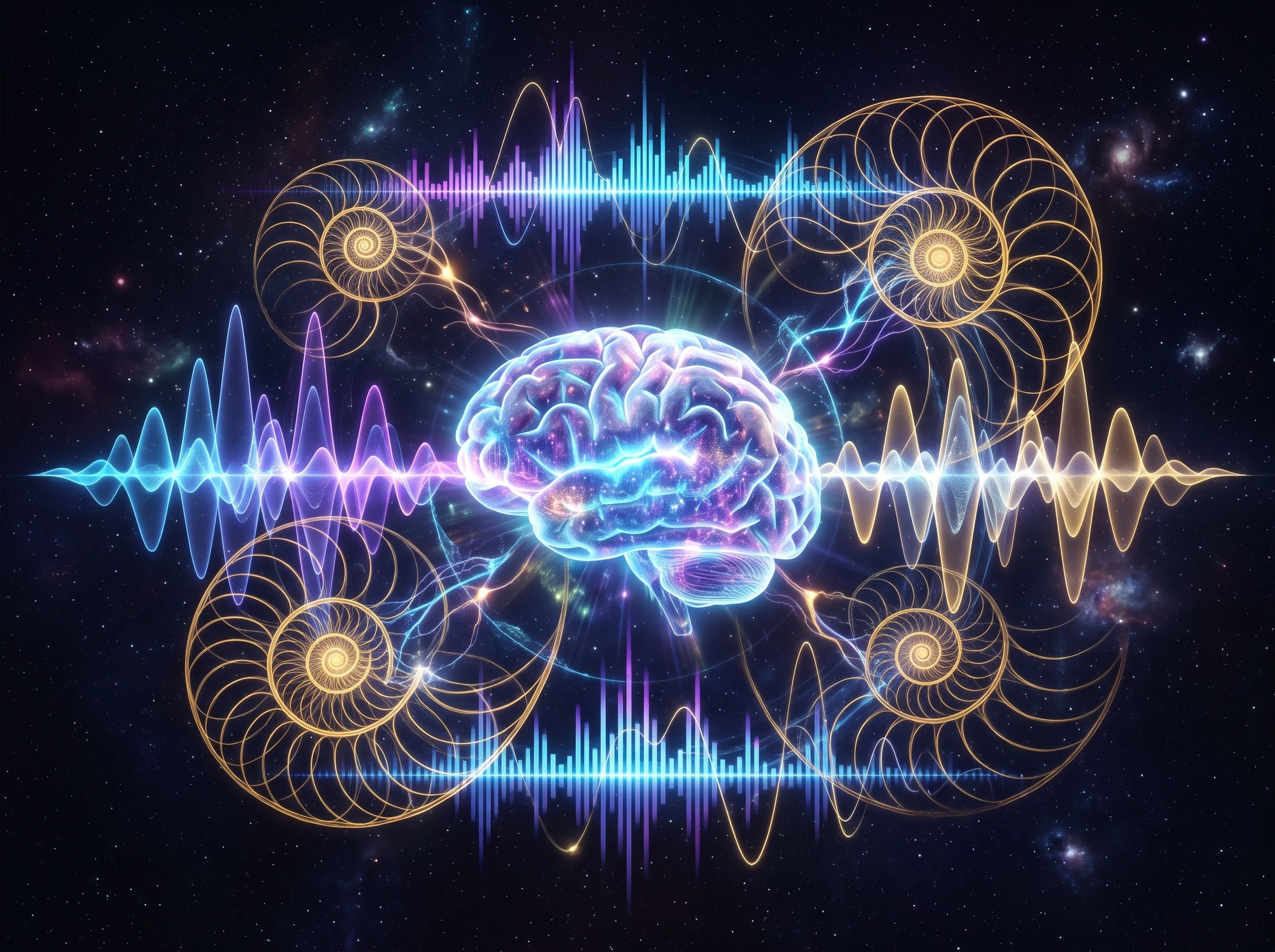
The ultimate challenge to naive materialism, however, arrived with August Seebeck’s acoustic siren and the phenomenon of the “missing fundamental.” If you play a note’s higher overtones—say, two hundred, three hundred, and four hundred cycles per second—while completely deleting the one-hundred-cycle fundamental root note from the physical audio signal, the human brain still hears the one-hundred-cycle root note as clear as day! Even though there is zero physical energy vibrating at that root frequency in the air, your awareness perceives the missing foundation by reading the harmonic spacing of the upper waves.
You have heard this today. A telephone or a small laptop speaker cannot physically reproduce deep bass, yet a man’s voice on the phone still sounds deep, and a bass line still sounds like a bass line through tiny earbuds. The speaker supplies the upper rungs of the ladder; the listener supplies the floor. When Ohm first heard of Seebeck’s result, he argued that the low pitch was an illusion, since there was nothing physical at that frequency to hear. Later experimenters tried to explain it away as a difference tone made by the ear, but when they drowned the missing frequency in noise so that no phantom could survive there, listeners still heard the root. The pitch is built in the brain, from the pattern.
In the ILC framework, the missing fundamental is the definitive acoustic demonstration of the Biological Transducer and Predictive Processing (as modeled by Anil Seth and Karl Friston’s Free Energy Principle). Predictive processing is the contemporary view that perception is less like a camera and more like an informed guess: the brain constantly forecasts what the world should be sending, and the senses mostly report where the forecast was wrong. Your visual blind spot, silently painted over so that you never see the hole, is the same trick in another sense; Anil Seth likes to call perception a “controlled hallucination.” The missing fundamental is that principle made audible.
Your brain is not a passive microphone waiting to be struck by physical matter. It is a Bayesian holographic receiver that reads interference patterns and actively reconstructs the unseen root. (Bayesian simply means it weighs new evidence against what it already expects; holographic points to the way a hologram stores the whole picture in the pattern of interference, so that the pattern, not any single point, carries the image.)
Here is the bridge to an older tradition. For more than a century, thinkers from William James to Aldous Huxley have suggested that the brain works like a filter, or a reducing valve, narrowing a vast awareness down to what a living animal needs. The missing fundamental adds something that a pure filter cannot do. A filter can only take away, yet the ear adds: it supplies a note that was never delivered. Perception, on this evidence, is neither a window that lets the world in nor a valve that holds a flood back. It is closer to a musician who hears the first few bars and plays the tune that must come next.
This is the note we started with, the bass line in the tiny speaker. The speaker delivered only the upper tones, your brain supplied the foundation, and nothing in the experience told you anything was missing.
The crisis in a single chord
This is the exact metaphor for our entire three-dimensional scientific crisis. Materialist science looks out at the physical universe—the Explicate Order—and sees only the upper harmonics: scattered particles, galaxies, and biological cells. Because materialism cannot detect the “missing fundamental” with a ruler or a scale, it declares that the vacuum of space is empty and dead. Cosmology itself has begun to sound the same note: the visible matter of the universe accounts for only a small fraction of what the motions of galaxies demand, and astronomers infer the unseen remainder from the spacing of the visible pattern, exactly as the ear infers the missing root. The practice of reasoning from the visible overtones to the invisible foundation is not mysticism. It is how hearing works, and increasingly how physics works.
A high-coherence mind, however, recognizes the spacing of the harmonics. Through what the ILC calls Synoptic Transduction—and what ancient practitioners of Nada Yoga cultivated by listening to the anahata nada, the unstruck primordial sound—the human transducer perceives the Missing Fundamental of the cosmos: the unified Consciousness Field that binds every overtone of matter into a single song. The sound the yogis describe is called “unstruck” because nothing strikes it: no string is plucked and no air is moved. It is the fundamental that is heard in the absence of any physical source, which is the nearest thing the laboratory offers to the experience the yogis describe.
5. Vocal BioAcoustics and Entrainment: Tuning the Zero-Impedance Human
Once we recognize that the human organism is a liquid-crystalline acoustic transducer, the boundary between music, physics, and medicine vanishes. Sound is no longer passive entertainment; it is a bi-directional physiological driver capable of rewriting our cellular coherence in real time. (A word of honesty belongs at the threshold of this section: the experiments below range from well established to early and exploratory, and the ILC reading of them is a framework to be tested, not a replacement for medical care. Where the evidence is young, we say so.)
The singing cell
At UCLA, researcher Jim Gimzewski founded the field of sonocytology by placing an ultra-sensitive atomic-force microscope against living cells and amplifying their vibrations. The instrument works like a record player’s needle so fine that it can feel the trembling of a single cell; its signal, sped into the range of human hearing, becomes sound. In his experiments, yeast cells proved to carry distinct, steady vibrational signatures, which changed when the cells were stressed or altered. Gimzewski and others have suggested that stressed or cancerous cells may lose their steady pitch and emit something closer to acoustic static. That idea is an intriguing and still-developing line of research, not an established diagnostic, but it captures a principle the ILC finds beautiful: a living thing is a vibrating thing, and its health may be audible.
As biologist Michael Levin has demonstrated, cells communicate through bioelectric signals, and when cells lose their shared electrical and vibrational conversation across their gap junctions—the tiny channels that let neighboring cells share currents and messages—they close themselves off from the collective blueprint of the body and revert to unicellular selfishness. Levin’s research frames cancer, in part, as a collapse of the cell collective’s shared story. In the ILC’s reading, disease at its root is a loss of musical pitch—a spike in internal dielectric resistance and Psychological Entropy—a hypothesis in which the body’s health is the coherence of a very large choir, and sickness begins as the choir losing the key.
Resonant Entrainment
How do we clear that static and return the biological instrument to its optimal, zero-impedance superconducting state? Through Resonant Entrainment, a phenomenon so basic that physics knew it in the seventeenth century. Christiaan Huygens noticed that two pendulum clocks hung on the same wall drifted, over a night, into perfect step with each other, each nudging the other through the wood. Fireflies flash in unison across a riverbank; a crowd on a footbridge falls unconsciously into one gait. Oscillators that can touch one another tend to synchronize, and the stronger, steadier oscillator pulls the weaker toward its own rhythm. The three practices below apply that principle to the body.
• Harmonic Interval Therapy: When sound therapists strike calibrated tuning forks tuned to C (256 Hz) and G (384 Hz), they project a pure three-to-two Perfect Fifth directly into the body’s biofield. (This C belongs to the “scientific” tuning used in the older acoustic literature, a clean power-of-two number, rather than the concert tuning on modern pianos.) Because this ratio embodies low-entropy Coherent Attraction, the disordered oscillations of stressed tissue passively entrain to the pure interval, dropping internal friction. The ILC proposes the mechanism; the controlled evidence for it is still to be gathered, and a fair experiment would be among the first the theory should welcome.
• Autonomic Reset and the Cardiac Node: Clinical measurements of singing bowl and gong sound baths report that rich, sustained harmonic overtones shift the nervous system out of sympathetic “fight-or-flight” static, elevating Heart Rate Variability (HRV / RMSSD)—the healthy, flexible variation in the gaps between heartbeats—and lowering the Baevsky Stress Index. The studies so far are small and early, but their direction is consistent with a long human intuition that a sustained bell or a lullaby calms the body. In Chapter 10 of the ILC framework, the heart is identified as the Magnetic Node—the primary oscillator whose magnetic field, according to HeartMath researchers, is some five thousand times stronger than the brain’s. By entraining the vagus nerve and smoothing the heart’s rhythm, acoustic resonance eliminates internal pressure echoes, allowing the heart-aorta system to resonate as a standing wave around seven cycles per second—phase-locking the human body directly to the Schumann Resonance of the Earth. That last figure is the ILC’s proposal, and it is a lovely one: the Schumann Resonance is the planet’s own standing wave, a faint pulse near the same frequency produced as lightning rings the hollow between the ground and the upper atmosphere, so that the whole Earth is, quite literally, a resonating room.
• Human BioAcoustics and the Holographic Voice: Because resonance is a closed-loop, two-way circuit, your body does not merely receive sound; it broadcasts its entire internal status through your voice. Developed by Sharry Edwards at the Institute of BioAcoustic Biology, Vocal Profiling captures a thirty-to-sixty-second voice sample and uses a Fast Fourier Transform—the same unbundling of a sound into its pure tones that Joseph Fourier made possible—to map the voice’s hidden frequency spectrum. Because the laryngeal nerves connect directly to the vagus nerve and the body’s neuro-endocrine highway, the human voice acts as a real-time holographic readout of biochemical, structural, and emotional coherence. By identifying over-stressed frequencies (“risers”) and depleted or missing frequencies (“stringers”) across the twelve musical pitch classes—where each note correlates, in Edwards’ system, with specific physiological pathways, nutrients, and neurotransmitters—and feeding calibrated corrective tones back through headphones, the body is prompted to remember its own healthy standing wave and restore homeostasis. Edwards’ specific claims have yet to receive independent validation, and the field should be approached with that in mind. The broader premise, however, has quietly entered mainstream research: medical scientists are now studying the voice as a biomarker, finding that subtle changes in pitch, tremor and texture can accompany stress, depression and neurological conditions such as Parkinson’s disease.
Resonant Engineering
Combined with emerging brain-computer music interfaces (BCMIs) that translate neural waves directly into audible harmony, we are witnessing the dawn of Resonant Engineering. Instead of attacking the physical body strictly with blunt chemical force, we are learning to tune the underlying geometric cause. This is a vision, not a verdict: a complement to medicine, to be earned by experiment, and never a reason to set aside the care of a physician. But the direction of travel is clear. The body was always an instrument, and for the first time we have the tools to listen to it with the care we give a concert hall.
6. The Grand Synthesis: Remembering the Song You Are
Step back and behold the unified tapestry that emerges across all five axes of our investigation. Each began as a humble question about sound; each ended at the same door.
• The Physics of Boundaries shows that whenever an infinite wave is constrained, it naturally quantizes into whole-number harmonics and standing waves—the exact mechanism by which the Implicate Order precipitates into the particles and rooms of our Explicate world. Limit is not the enemy of the infinite; it is the way the infinite becomes a note.
•Music Theory and the Circle of Fifths reveal that harmony is the audible expression of Love-Gravity, while the Pythagorean comma ensures that the cosmos never traps itself in a flat, dead circle, propelling existence upward along an evolutionary spiral. Home is real, the pull toward it is real, and the road to it is a staircase that never returns to the same floor.
• Cymatics and Archaeoacoustics demonstrate that frequency is the unseen architect of matter—sculpting liquid and dust into ancient cultural archetypes and transforming stone temples like Chavín de Huántar into mind-altering Coherence Engines. Form is what vibration looks like when it holds still.
•Psychoacoustics and the Missing Fundamental confirm that the human brain is an active Biological Transducer designed to extract wholeness and meaning from harmonic patterns, even when the fundamental source is hidden from our physical eyes. The listener is not an audience. The listener is part of the instrument.
• Sound Healing and Vocal BioAcoustics point toward the possibility that we are living, liquid-crystalline symphonies whose cellular health, cardiac coherence, and emotional peace can be read and restored through pure resonant entrainment—a possibility the ILC puts forward as an experimental program, and invites the world to test.
The materialist mythos told us that we were accidental spectators in a mute, indifferent universe. The Integrated Light-Consciousness Theory restores us to our true station. The cosmos is neither dark nor silent; it is a grand, holofractographic orchestra, and you are both a localized note in its chord and the conscious transducer built to hear the performance. Every time you choose empathy over fear, stillness over static, or harmony over division, you lower the internal resistance of your antenna and help smooth out the dissonant beats of a world in transition.
Notice, finally, how little of this asks you to take anything on faith. Every step began with something you can check with your own ears: a string pinned at both ends, a bathroom that flatters a voice, a bell that goes on ringing after you cannot hear it, a chord that leans toward home, a bass line that your earbuds cannot play and you hear anyway. The universe has left its operating manual lying in the open, written in the one language every living creature is built to read.
Listening for yourself
• Sing in a stairwell or a bathroom. Glide slowly up from a low note and notice the pitches where the room suddenly swells. You have just found its standing waves, and you have played a room like an instrument.
• Listen to a single struck note until it vanishes. A piano, a bowl, a bell: follow the sound out to the edge of silence and notice that you keep hearing after the physical sound is gone. Ask what is doing the listening.
• Sing a fifth with a friend. One of you hums a steady note; the other finds the note that feels like it belongs, and then the one that feels like home. Feel the beating fade as the two of you lock in. That small, wordless settling is the whole theory, felt from the inside.
• Hear the missing bass. Play a song with a deep bass line through the smallest speaker you own. Notice that you hear the bass anyway, though the speaker cannot make it. That low note is being built in you.
One more thing before the last word. Return, for a moment, to the note that isn’t there. When you heard that bass through the tiny speaker, you were not deceived. You were right: the foundation was real, and you perceived it by reading the pattern of everything built upon it. The only thing you could not do was point to it. The ILC’s wager is that the same is true on the largest scale. The Consciousness Field is the fundamental that cannot be pointed at, because everything you can point at is already built upon it, including the finger. And the evidence that it is there is available to anyone willing to learn to listen to the spacing.
The fire does not need to be lit; the static simply needs to be cleared so the native frequency of the universe can ring through you unimpeded.
Afterword: What Is Measured, What Is Proposed
A framework that calls itself falsifiable owes its readers a clear line between what the instruments have shown and what the theory adds. This essay mixes the two on purpose, because the meaning lives in their meeting; here they are separated so that anyone can test the join.
• Established physics and perception science. Standing waves, the harmonic series, superposition, Fourier decomposition, room modes, reverberation, Chladni and Faraday patterns, the Pythagorean comma and its tuning history, critical bands, combination tones, the missing fundamental, and the predictive-processing account of perception.
• Measured, with interpretation still open. The acoustic properties of Chavín de Huántar and its resonance near nine hundred cycles per second; the reading of those chambers as engines of altered awareness, and of Lalibela and the pyramids by analogy.
• Reported, early or awaiting replication. The Ghanaian Chladni-plate findings with Adowa music; sound-bath effects on heart rate variability; sonocytology as a window on cell health; vocal profiling.
•ILC proposals to be tested. Sound as the causal engine ahead of light; the electron as frozen sound; Gravity and Love as one force seen from outside and inside; the comma as the signature of novelty; fork-based fifth entrainment; a heart-aorta standing wave locked to the Schumann Resonance.
Nothing in the last row is weakened by being placed there. A hypothesis that can be named, measured and possibly refuted is the kind of claim that moves a conversation forward, and the acoustic domain is unusually generous to experimenters: its instruments are cheap, its phenomena repeatable, and its questions can be asked on a kitchen table.
How to Prove Us Wrong
A theory that cannot lose is not worth hearing. Here are four experiments that could count against the ILC’s acoustic claims, offered as sketches for researchers to sharpen and not as finished protocols.
•The expectation test (the transducer claim). Play listeners tones with the fundamental removed, and vary what they have been led to expect: a hint of the melody, a priming pattern, or nothing at all. Record the pitch they report and, with brain recordings, the signature of surprise when an expected root fails to arrive. If perception is constructive prediction, the reconstructed note should bend with expectation. If it never does, the case for an actively predicting transducer weakens.
•The sound-bath test. Run a preregistered, randomized trial comparing sustained, harmonic-rich sound against loudness-matched inharmonic sound and against silence, measuring heart rate variability and self-reported calm, plus how much each participant expected to benefit. The ILC predicts that harmonic purity matters beyond loudness and expectation. If pure and inharmonic sounds do equally well, the entrainment-by-purity claim fails.
• The fifth-versus-comma test. Compare a pair of tuning forks in the pure three-to-two ratio with the same pair mistuned by about a quarter of a semitone, one comma. The ILC predicts the exact ratio entrains where the mistuned one does not. If neither bodies nor instruments can tell them apart, Mental Gravity as a measurable effect fails. Designers will need to handle the fact that the mistuned pair beats audibly.
• The Coherence Engine survey. Apply the same sine-sweep measurements used at Chavín to a sample of ritual chambers and a matched sample of ordinary ones, and test whether the ritual spaces cluster near the harmonics of their associated instruments more than chance allows. If they do not, Chavín is a curiosity and not a pattern.
Notes and Lineage
Sources opened while revising this essay, for readers who want to follow the trail:
• Matthew David Segall, How Eternity Falls in Love with Time: The Pythagorean Comma and the Spiral of Fifths (July 11, 2026), on the open spiral of fifths and Whitehead’s process thought.
• Ilia Delio, a discussion of Teilhard de Chardin on love as a cosmic force (2014).
• Joachim-Ernst Berendt, The World Is Sound: Nada Brahma (Destiny Books).
• Ethan Hein, Music theory and quantum mechanics, on atomic orbitals as the harmonics of a confined wave, with his own caveats about the analogy.
• The Unfinishable Map, Filter Theory of Consciousness, on William James, Henri Bergson and Aldous Huxley.
• Scott Sowersby, The Arrow of Time and Harmonic Consciousness (2025), an independent and untested proposal that treats the comma as a physical constant.
The histories of Plato, Kepler, Hans Jenny, and the Ohm and Seebeck dispute come from standard references and should be cited to primary sources before the book goes to print.
Where These Threads Live in the Book
The acoustic domains in this essay are not an appendix to the ILC Theory; they are load-bearing. Each one locks into specific chapters of the manuscript and advances its overarching cosmological thesis: that consciousness is the fundamental carrier wave of existence, and physical matter is a localized standing wave of “frozen sound.” Here is where each strand joins the whole.
• Boundaries, standing waves and cymatics: the Magneto-Electric Hierarchy (Chapters 1, 10 and 19). Standard physics treats light and electromagnetism as primary, but the ILC posits a strict causal signal chain in which Resonance (Sound) is the generative engine that precedes and shapes Light (Electromagnetism). Primordial vibration generates toroidal geometry, moving toroidal fields generate magnetism, and moving magnetic fields generate the electric code of physical matter. Physical acoustics, boundary constraints and cymatics give the tangible, human-scale picture of this hierarchy: invisible frequency dictates visible form.
•The Pythagorean comma: the engine of the evolutionary spiral (Chapters 4 and 5). Chapter 4 identifies Just Intonation (pure, whole-number harmonic ratios) as the unattenuated Sacred Geometry of the Implicate Order, and Equal Temperament as the pragmatic compromise required to render a navigable three-dimensional Explicate Order. The acoustic dilemma of the comma, the physical fact that twelve pure fifths refuse to close into a flat circle and instead overshoot seven octaves to form an open spiral, supplies the exact acoustic mechanics for Chapter 5’s assertion that cosmic time is a learning spiral rather than a closed, repetitive loop.
• Psychoacoustics: the Active Inference Transducer (Chapters 3, 4 and 6). The Pribram-Bohm synthesis in Chapter 4 models the brain as a Fourier Transform frequency analyzer that converts spectral wave interference from the Implicate Order into solid perceptions. Georg Simon Ohm’s acoustic law, cochlear critical bands, phantom combination tones and August Seebeck’s missing fundamental show that the Biological Transducer is not a passive microphone. Instead, it operates via Predictive Processing and Active Inference, actively reconstructing the unified Implicate root even when the physical fundamental has been stripped from the environment.
• Archaeoacoustics and cymatics: Coherence Engines (Chapters 4, 8 and 16). Room modes, Chladni nodal geometries, the Ghanaian finding that traditional Adowa music generates ancient Ashanti cultural symbols, and the 900 Hz stone acoustic filters of Chavín de Huántar provide Tier 1 archaeological and physical support for Passive Coherence Engines and Morphic Resonance. They suggest that sacred symbols and megalithic temples are not arbitrary cultural artifacts, but engineered standing-wave resonators designed to lower internal biological resistance and shift awareness.
•Vocal BioAcoustics: the Zero-Impedance Superconductor (Chapters 10, 13, 14 and 29). Clinical findings showing singing bowls and tuning forks elevating Heart Rate Variability (HRV) are consistent with Chapter 10’s integration of HeartMath and Polyvagal Theory, where coherent acoustic resonance activates the ventral vagal pathway to purge Psychological Entropy. Sharry Edwards’ Vocal BioAcoustics pairs with Jim Gimzewski’s sonocytology and the twelve harmonic phase states of liquid-crystalline Exclusion Zone (EZ) water in a single picture: the human body as a programmable, bi-directional acoustic instrument.
Continue the Exploration
To dive deeper into the formal physics, the Coherence Collapse Model, the Gravity as Love identity, and the experimental protocols of the post-materialist paradigm, explore the complete ecosystem at jaxnabarro.com and download your copy of The Integrated Light-Consciousness (ILC) Theory: The Luminous Resonance Principle — A Falsifiable Framework for a Conscious Universe by Jax Nabarro.