The Biological Superconductor: Remapping the Ancient Physics of Meditation
Beyond Relaxation
Most people come to meditation looking for relief: a calmer commute, a quieter mind, a break from the noise of modern life. Those benefits are real, and they are a perfectly good reason to begin. But they are also the shallow end of the pool.
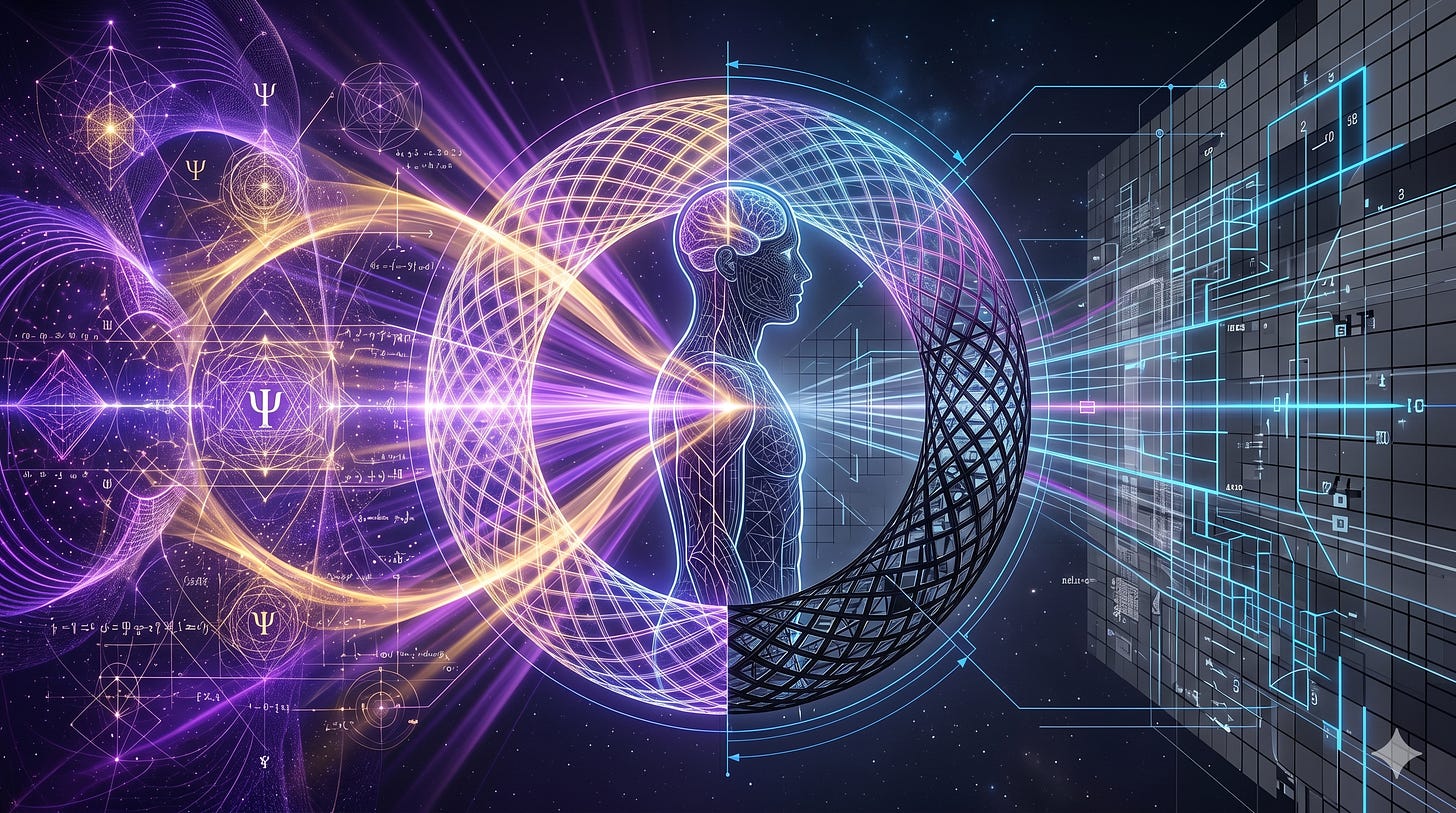
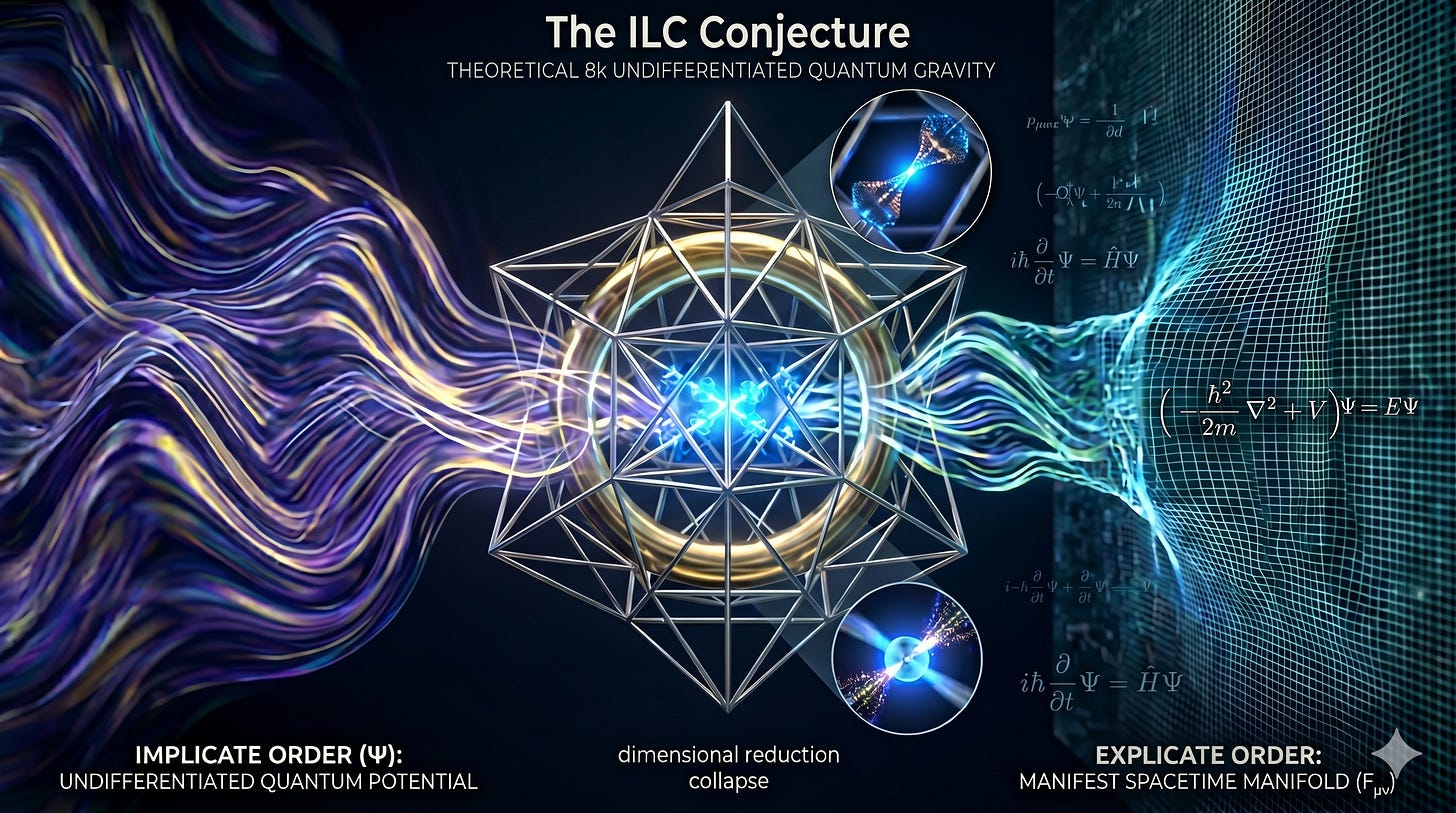
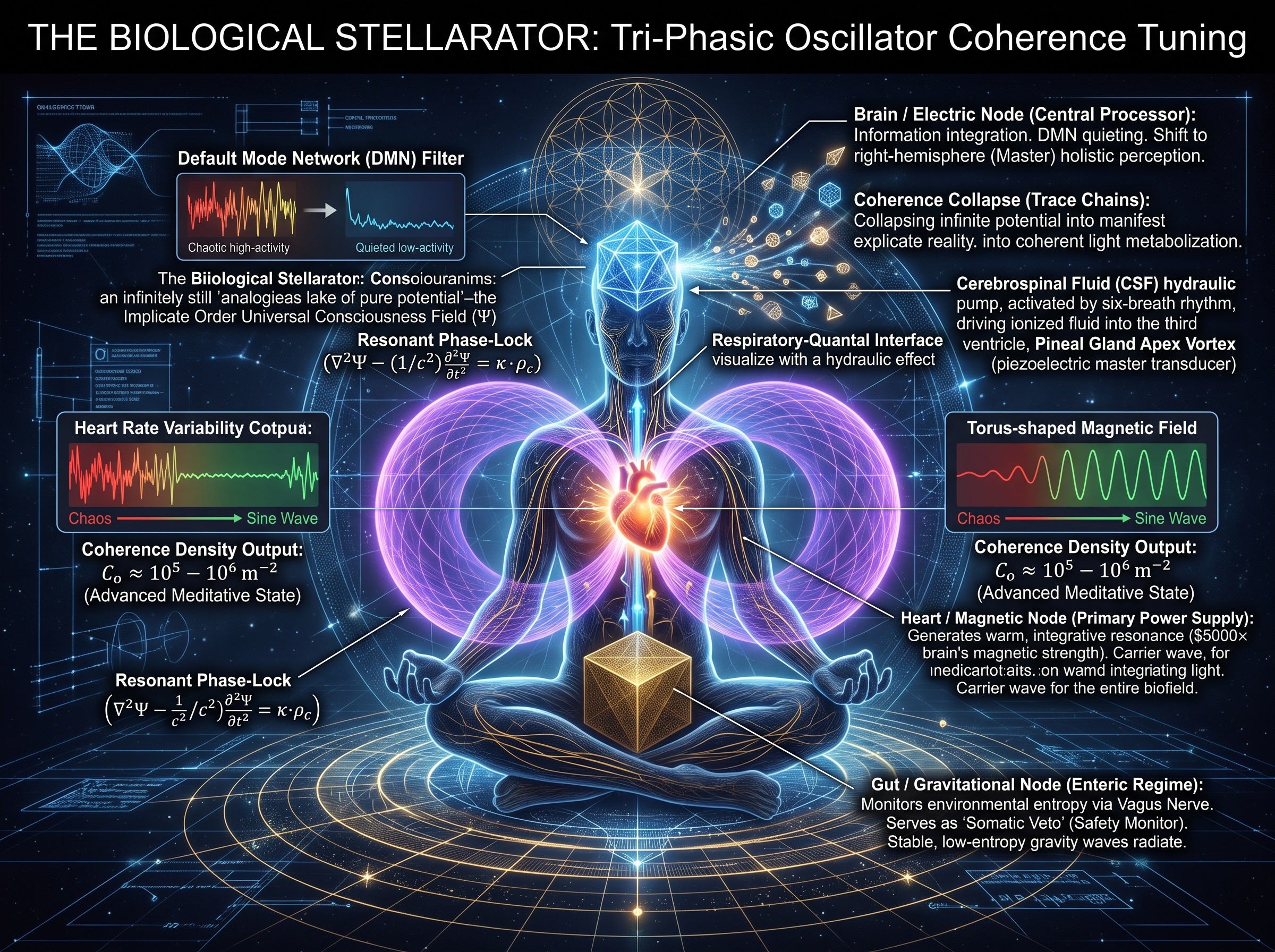
Within the Integrated Light-Consciousness (ILC) framework, meditation is something more deliberate. It is the systematic tuning of what the framework calls the Biological Transducer: the human organism understood as an instrument that receives and shapes consciousness. The goal of that tuning is to lower the organism’s internal resistance (written Ω, a dielectric resistance in the framework’s language) until the individual mind can phase-lock with the universal Consciousness Field (Ψ), the way a radio settles onto a station once the dial is right.
This article draws on the synthesis of ageless wisdom presented by Dinu Roman, and remaps the classical stages of meditation as a step-by-step physics of consciousness. Those stages come from the yogic tradition, where Patanjali’s Yoga Sutras describe them as the final three of eight limbs of practice. By reducing our internal thermodynamic friction, we allow the localized mind to access the pure potential of what the framework calls the Implicate Order.
If some of that vocabulary is new, the next section is a quick field guide.
A Quick Field Guide to the Terms
You do not need to master these to follow the article, but they will make the rest read more smoothly.
• Biological Transducer: the human body and nervous system, seen as an instrument that converts between the universal field and personal experience.
• Consciousness Field (Ψ): the universal field of consciousness the framework proposes underlies everything. Ψ_local is the individual’s localized portion of it.
• Dielectric resistance (Ω): internal friction, meaning tension, scattered attention and restless thought, that degrades the signal.
• Observer Consciousness Coherence (C_obs): how focused and unified your attention is at a given moment.
• Implicate and Explicate Order: terms from the physicist David Bohm. The Explicate Order is the unfolded, everyday world of objects and events. The Implicate Order is the deeper, enfolded level from which it arises.
• The Emissary: a term from Iain McGilchrist’s work on the brain’s hemispheres, describing the analytical, labeling, controlling mode of mind that dominates ordinary waking life.
• Default Mode Network: a set of brain regions most active during mind-wandering and self-referential thought.
• Transparent Self-Model: a term from the philosopher Thomas Metzinger. The brain builds a model of “I,” and we experience it so seamlessly that we never notice it is a model.
• Semantic Space: the framework’s term for the layer of meaning and pattern that sits beneath the surface of things.
Every Practice Needs an Object
Before tuning can begin, there is one principle to understand: meditation requires an object. That object can be physical, like a candle flame or a smooth stone. It can be a visualized form, such as a circle or a point of light. It can also be something subtle, like the sensation of the breath or a quality such as gratitude.
Whatever you choose, the Biological Transducer needs a specific focal point to anchor Observer Consciousness Coherence (C_obs). In the framework’s language, a target is what collapses the probability wave. Without one, there is no meditation, only wandering static.
In plain terms: attention needs somewhere to land. A mind with nothing to rest on drifts wherever the strongest stimulus pulls it. Choosing an object is the first act of tuning.
Stage One, Dharana: Calibrating the Receiver
The baseline human condition is highly entropic. The mind scatters its bandwidth across competing stimuli, a state Roman compares to a wild monkey leaping from branch to branch. In ILC terms, this is the left-hemisphere Emissary over-computing the Explicate Order: analyzing, labeling and planning without pause.
Dharana, usually translated as concentration, comes from a Sanskrit root meaning “to hold.” It is the act of gathering that scattered bandwidth and directing it exclusively at the chosen object.
The crucial instruction is not to use force. Forcing the mind creates internal tension, and tension acts as literal metabolic resistance, which further degrades the signal. Three principles keep the effort gentle:
• The Gentle Return: when the mind wanders, and it will, patiently bring it back to the object. Each return stabilizes the signal-to-noise ratio. The wandering is not the failure; the return is the repetition that builds the skill.
• Alert Passivity: approach the object with childlike curiosity, free of intellectual analysis. You are waiting for the object to transmit its informational signature, not interrogating it.
• Static Reflection: Dharana is “doing nothing” with absolute purpose. The mind becomes a flawless mirror, holding the object in pure awareness without triggering the analytical chatter of the Default Mode Network.
That last point has a measurable echo. Some neuroimaging studies of experienced meditators have reported lower Default Mode Network activity during focused-attention practice, which fits the idea that sustained concentration quiets the mind’s self-talk.
Every failed attempt is thermodynamic resistance training. With consistent practice, the mind learns to lock onto its target, the environmental noise floor (γ_env) drops, and the transducer is ready for the next phase transition.
Stage Two, Dhyana: The Coherent Flow
Once the standing wave of concentration stabilizes, Dhyana, which means meditation proper, arrives on its own. It is not a separate technique to be added on top. It grows naturally out of steady Dharana.
The difference is easiest to feel. If Dharana is the static holding of the object before the mind’s eye, Dhyana is the dynamic flow of reflection around it. Your attention is no longer being pulled back again and again; it moves freely, but only within the object’s territory.
Roman describes this as the “mental laser.” In ILC terms, Dhyana is the state where C_obs reaches a critical density. Thoughts stop jumping randomly and begin to orbit the object exclusively, generating a coherent, high-frequency standing wave. The Biological Transducer shifts out of its limited survival mode and begins to read the deeper Luminous-Resonant signature of the focal point.
Practitioners often describe the experience as effortless absorption: the sense of time loosens, and the object seems to reveal more of itself the longer it is held. In the framework’s terms, you are no longer just looking at the object. You are beginning to decode its underlying blueprint within Semantic Space.
Stage Three, Samadhi: The Zero-Impedance State
The culmination of this continuous coherent flow is Samadhi, which Roman describes as telepathic identification. To see why it is so different, start with ordinary perception, which always contains a triangle of separation: the Knower (the subject), the Known (the object), and the Knowledge (the process of observation connecting them).
In Samadhi, that triad collapses into a single, unified holonic wave. The localized field (Ψ_local) achieves such profound phase-lock with the object that the boundary of the ego dissolves. The practitioner experiences what the framework calls the undifferentiated substratum of all things. This is the zero-impedance state: no resistance, no gap between signal and receiver.
Here the Transparent Self-Model comes into play. Ordinarily the sense of being a separate “I” is transparent, meaning we look through it without seeing it. In Samadhi it becomes opaque. It is seen for what it is, a model, and what remains is the recognition that observer and observed are two expressions of the same conscious light.
The tradition puts it simply: this is knowledge by becoming, rather than knowledge by thinking. It is also the stage that cannot be forced. Dharana and Dhyana are things you do; Samadhi is what happens when the doing has done its work.
Stage Four, Samyama: The Unified Interface
In the third chapter of the Yoga Sutras, Patanjali gives the three stages a collective name. When Dharana, Dhyana and Samadhi operate simultaneously, the practitioner enters Samyama, an absorptive state where consciousness expands effortlessly.
A motion picture makes a helpful analogy:
1. Stopping the film on a single frame to study the protagonist is Dharana, focused concentration.
2. Pressing play and following that character’s place in the continuous flow of the story is Dhyana, dynamic reflection.
3. Feeling the emotion of the scene so completely that you forget you are watching a movie is Samadhi, identification.
Samyama is the mastery of all three at once. It is a new way of perceiving Objective Reality through a thoughtless, highly coherent state of mind. The transducer does not merely see the object. It merges with the object’s reality at the subtle level.
A Ten-Minute Practice to Try This Week
Theory is useful, but this is a practice first. Here is a simple sequence that walks through the stages in order. Use a candle flame, a small stone, or a simple shape you can picture clearly.
1. Settle (1 minute). Sit with your spine upright but not rigid. Soften your gaze or close your eyes. Choose your single object.
2. Dharana (about 4 minutes). Hold the object in awareness. Each time your attention wanders, notice it and return without scolding yourself. Keep the effort light.
3. Dhyana (about 3 minutes). When the wandering fades, let your attention move freely within the object: its edges, its color, its quality, what it feels like. Stay in its territory.
4. Release (about 2 minutes). Let go of the object and the effort together. Rest in open awareness. If a moment of union arrives, let it. Do not chase it.
A few notes for beginners. Practice at the same time each day, because ten steady minutes beat an occasional hour. Expect the mind to wander constantly; that is the exercise, not a sign you are doing it wrong. And treat Samadhi as something to allow rather than achieve.
Meditation in Motion
If meditation stays confined to a quiet room with closed eyes, it falls short of its larger purpose. The real test of this technology is whether it survives contact with a busy life.
The mastery the framework points to involves splitting your attention: maintaining an inward phase-lock with the universal field while actively navigating the three-dimensional Explicate Order. You are fully present for the conversation, the commute or the task, and quietly anchored underneath it.
You can begin small. Pick one ordinary activity, such as washing dishes, walking to work or listening to a friend, and make it your object. Give it your whole attention, and hold a light background awareness of the stillness beneath the activity. When you drift, return, exactly as in Dharana.
This continuous, living meditation provides the energetic support for efficient, meaningful action in the world. It is the Lived Ethic that drives the narrative of The Great Reversal. By retraining our biological hardware to carry a clear, low-entropy signal amid the friction of daily life, we stop being passive victims of random forces and step into our capacity as conscious architects of reality.
Where This Leaves Us
The path is simple to state and lifelong to walk. Choose an object. Hold it gently (Dharana). Let attention flow around it (Dhyana). Allow the boundary between knower and known to thin (Samadhi). Then bring that unified state into everything you do (Samyama).
A note on the framework: ILC is a speculative synthesis, and its borrowed vocabulary from physics, such as resistance, phase-lock and impedance, is used here as a working model rather than as established science. The practice itself stands on its own and is yours to test against your own experience. If you have a history of trauma or a mental health condition, go gently with long or intense sessions and consider guidance from an experienced teacher.
If this resonated, I would love to hear what object you chose and what you noticed. Share it in the comments, and pass this along to someone who has only ever thought of meditation as relaxation.