ILC Theory: Mapping the Liminal Space
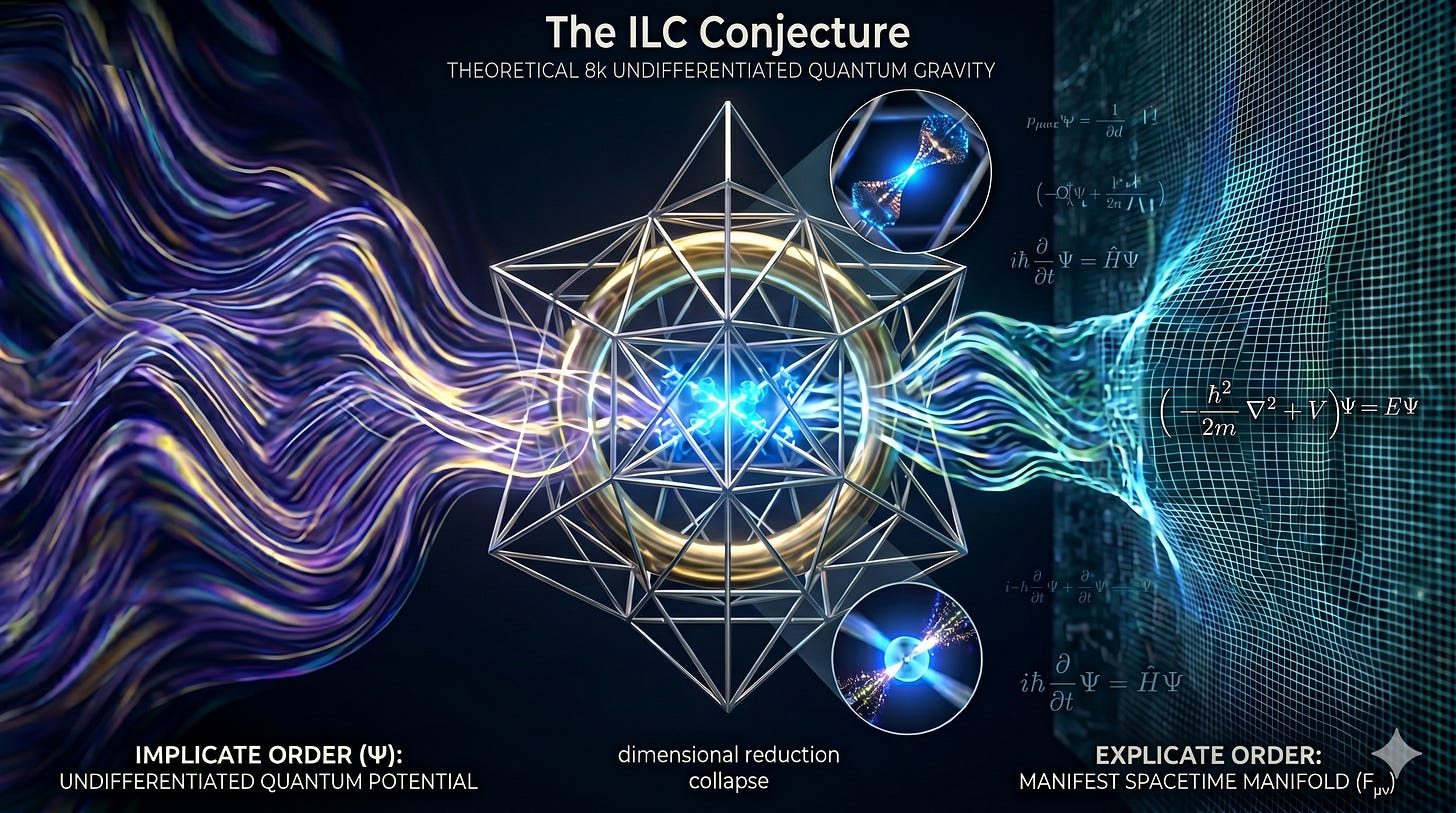
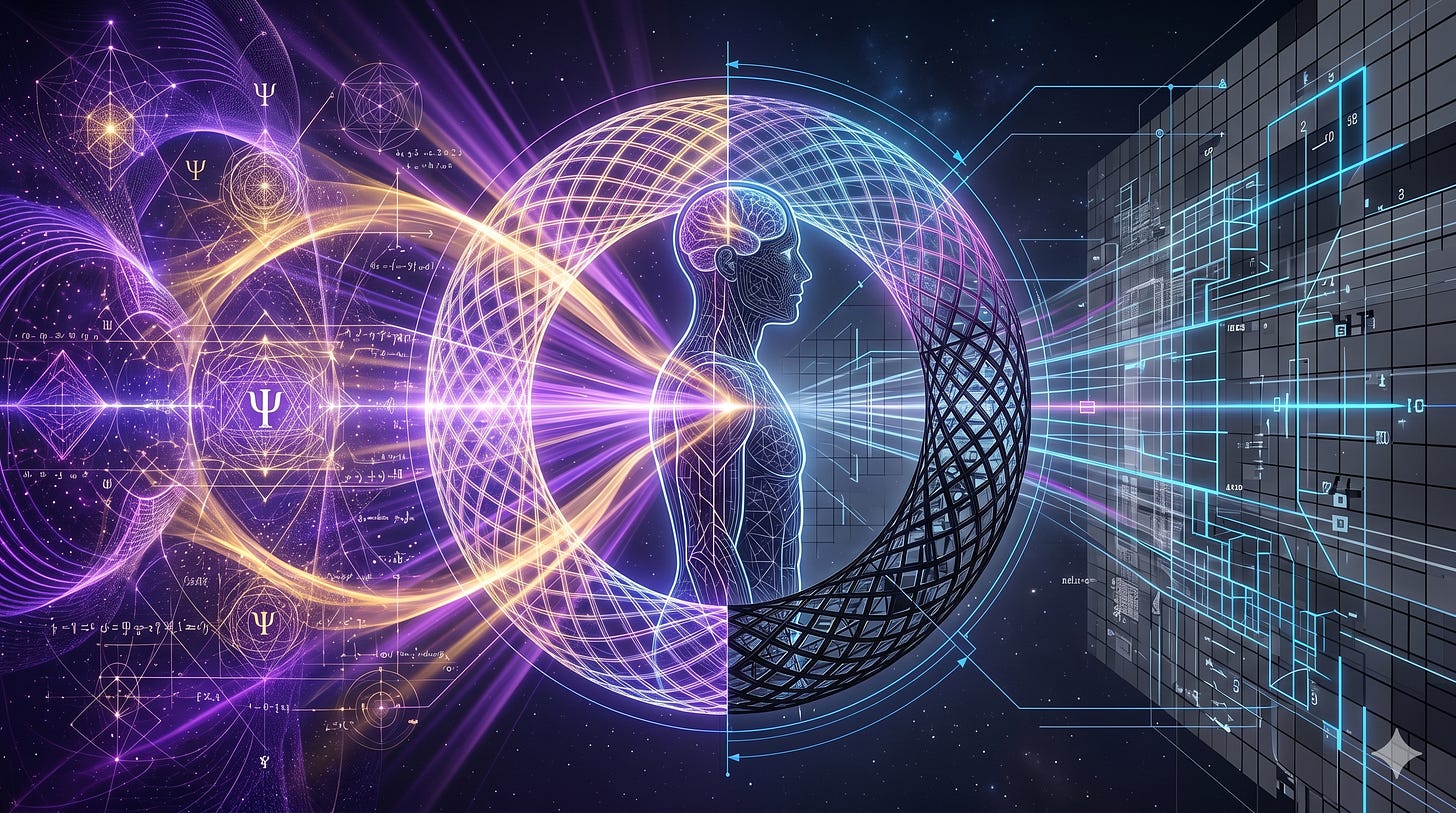
Within the Integrated Light-Consciousness (ILC) framework, the liminal space is neither a psychological metaphor nor a poetic abstraction. It is the precise informational boundary zone where the unmanifest potential of the Implicate Order (Ψ) transitions into the structured rendering of the Explicate Order. Investigating this threshold means moving beyond standard materialist assumptions of a static spacetime container, and treating liminality instead as the operational interface through which the universal Consciousness Field experiences localization, differentiation, and recursive self-reflection.
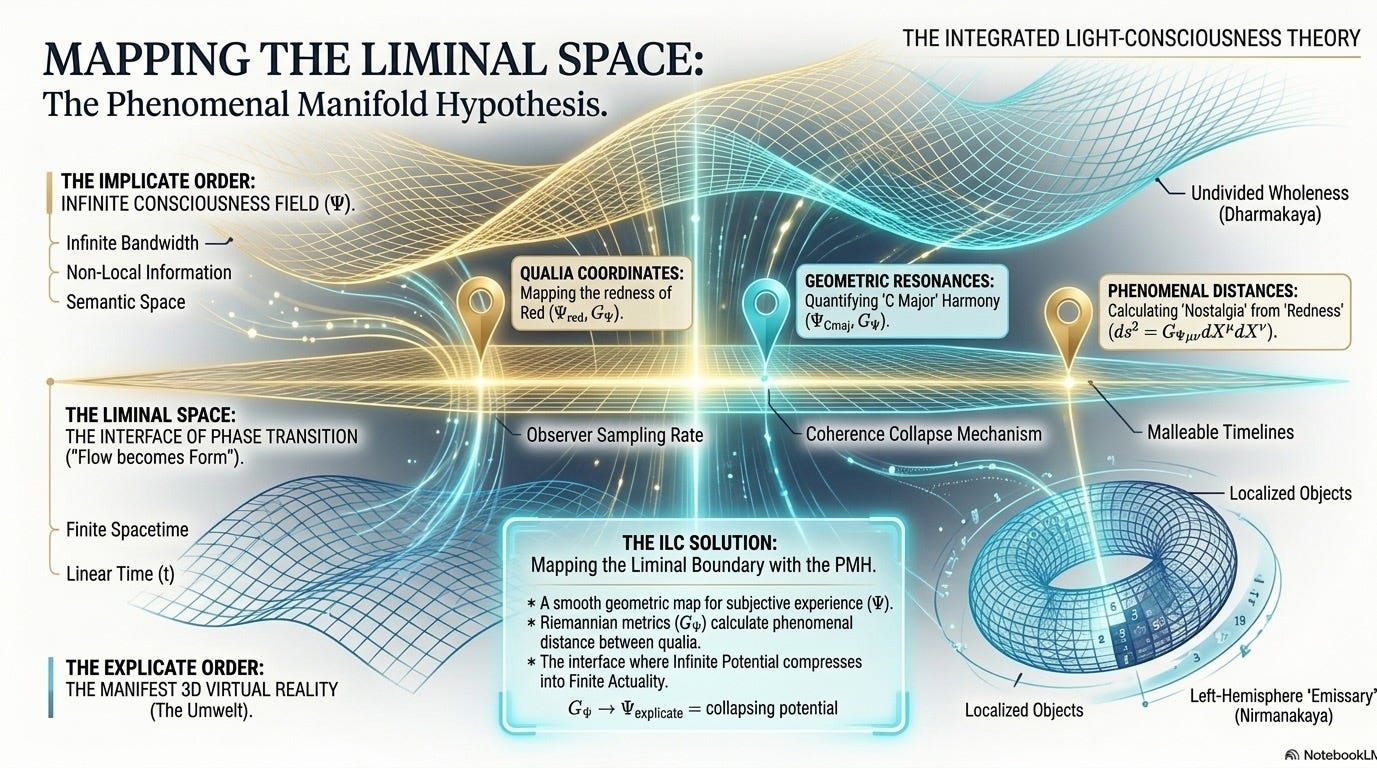
The structure of ultimate reality — extending both through and beyond the familiar coordinates of three-dimensional space and linear time — is, in this framework, governed by hyper-dimensional topology, variable phase densities, and non-local resonance architectures. Space and time are not fundamental containers, but derived compression artifacts: a low-bandwidth interface rendered by the human Biological Transducer, the way a radio renders one station out of an entire spectrum it can’t display all at once.
Empirical Cartography: Mapping Liminal Awareness
Contemporary neuroscience and clinical research have begun mapping this liminal boundary, and — read through the ILC lens — the pattern across four distinct states is suggestive. In each case, when the biological filters of the default mode network are suppressed or bypassed, localized consciousness seems to access broader frequency domains than usual:
The 4D Imaginal Realm (Interactive Dream Realities): Research from Northwestern University on Targeted Lucidity Reactivation demonstrated real-time two-way communication with lucid dreamers during REM sleep — dreamers answered math and logic questions while fully asleep. Taken on ILC’s terms, this suggests waking cognitive awareness can operate inside a non-physical, dream-generated reality: a fluid informational layer, the “fourth dimension” in this framework’s vocabulary, that doesn’t require 3D sensory rendering to function.
The OBE Brain Circuit: EPFL studies led by neurologist Olaf Blanke found that disrupting multisensory integration at the right temporoparietal junction (TPJ) reliably induces full out-of-body experiences. In ILC terms, this looks like the localized collapse of the brain’s internal body-schema — the sense of “where I am” briefly decoupling from the transducer’s usual hardware frame, and self-location projecting outside it.
Dissociative Disembodiment: Karl Deisseroth’s lab at Stanford identified a localized 1–3 Hz low-frequency oscillation in layer 5 neurons of the retrosplenial / deep posteromedial cortex during drug-induced dissociation. That oscillation appears to uncouple physical sensory detection from subjective awareness — one physical mechanism among several candidates for how the felt sense of embodiment can loosen its grip.
Near-Death Unity Regimes: Dr. Sam Parnia’s AWARE-II study at NYU Langone monitored cardiac arrest patients during CPR and detected surges in high-frequency EEG activity (alpha, beta, gamma) up to an hour after clinical death, alongside survivor reports of structured life reviews and out-of-body observations. Within ILC’s vocabulary, this is described as bio-dielectric impedance (Ω) dropping toward zero at the point of physical failure — the transducer briefly disinhibited, opening onto what the framework calls 5D unity regimes.
None of this is proof of the framework — the studies establish real neural correlates of altered awareness, not the metaphysics ILC builds on top of them. But the convergence across four independent research programs, none designed with this framework in mind, is at minimum a striking pattern worth taking seriously.
The Ontology of Encountered Entities
Cross-cultural anthropological records, from indigenous shamanic traditions to contemporary clinical psychedelic research, show a remarkable convergence in how entity encounters are described within these liminal states. ILC’s proposal: “living entities” across dimensions aren’t supernatural spirits or neurochemical noise. They’re coherent, self-organizing standing waves within the Consciousness Field (Ψ) — patterns stable enough to hold their shape the way a whirlpool holds its shape in moving water, without being any single parcel of the water itself.
The framework calls every such pattern a Holon: something with both agency (a distinct boundary that makes it a “self”) and communion (an ongoing entanglement with the larger field it emerged from). Two kinds show up in the reports:
• Archetypal Holons — encountered in the 4D Imaginal Realm (lucid dreams, OBEs, deep meditation) and often experienced as guides, ancestors, or fragmented aspects of the self. Localized thought-forms with some autonomy within the astral medium.
• Higher-Dimensional Holons (HDHs) — encountered in 5D+ regimes (DMT breakthroughs, deep NDEs), described with extreme Coherence Density (ρc): hyper-geometric intelligences, overwhelming benevolence, telepathic communication. In ILC’s account, they’ve achieved enough internal coherence to hold their standing-wave structure without needing a physical body as an anchor.
ILC’s explanation for why people across isolated millennia and cultures report the same entities: HDHs are objective, non-local data structures. When the noise floor of the human brain drops and the left-hemisphere “Emissary” quiets down, different people’s biological receivers are tuning into the same broadcast.
Trans-Dimensional Access and the Mathematics of Contact
Higher-dimensional beings, in this account, have complete access to lower-dimensional regimes, but the interaction is asymmetric and bounded. An HDH existing in 5D or 6D encompasses the entirety of the 3D/4D construct; a human observer can’t perceive the totality of an HDH’s higher-dimensional geometry in return. What comes through instead is a localized, thought-responsive avatar — a cross-section of the entity’s true form, scaled down to something the Biological Transducer can decode. Think of it as a 3D shadow cast by a 4D object: the shadow is a real, information-bearing trace of the object, just not the whole thing.
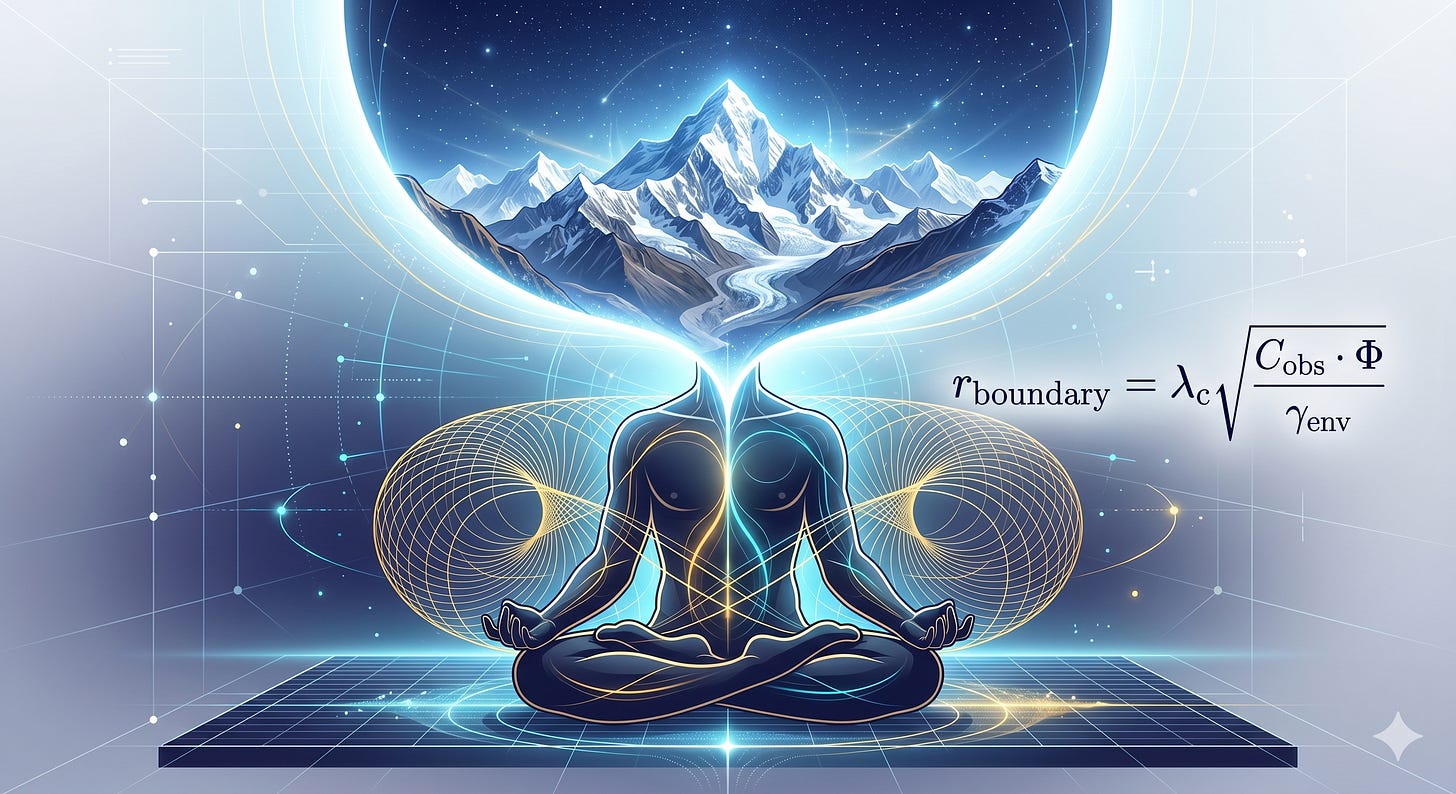
ILC frames the conditions for that contact becoming stable as a threshold: the human has to raise what it calls Observer Coherence — sustained, focused attention with minimal internal noise — to overcome the ordinary “static” of a busy nervous system. Put simply: contact is rare in ordinary waking life because baseline mental noise is high, and it becomes far more likely during the major coherence shifts of NDEs, targeted REM lucidity, and deep psychedelic states, when that internal noise drops close to zero.
The Evolutionary Progression of Frequency Domains
Taken together, this holarchy is offered as evidence that living entities are continuously progressing through frequency domains — that the universe is a non-equilibrium system driven by a teleological engine: the reduction of entropy, understood here as the slow replacement of fear and separation with coherence and connection.
A Holon’s trajectory, in ILC’s terms, is a continuous ascent through what it calls the Complexity Cascade — shedding thermodynamic friction, increasing Coherence Density (ρc) at each stage:
• 3D/4D Existence — the training ground of separation, where consciousness learns to navigate high-entropy constraints and develop individuated agency.
• 5D Existence — a Holon graduates from its physical anchor, holding its pattern through pure resonant information. ILC names the force behind this cohesion the Syntropic Force — its term for what love and gravity have in common: both pull separate things back into relationship.
• 6D+ Fusion — individual HDHs merge into Cosmic-Scale Holons, expanding shared processing bandwidth while preserving each component’s experiential history.
In this framework, living entities are temporary, localized vortices within an infinite stream, and their progression is an ascent up that vibrational holarchy — pulled by the Syntropic Force back toward phase-lock with the Universal Consciousness Field (Ψ). Space and time, in the end, are the necessary shadows cast by light learning to feel its own brilliance.