A curated collection of documentaries, scientific insights, and philosophical perspectives on quantum physics, non-duality, and the mysteries of existence.
This vault archives YouTube transmissions and corresponding literature across meditation, neuroscience, ontology, ecology, AI, spirituality, and cosmology.
Latest Explorations
500 Transmissions
Documentaries
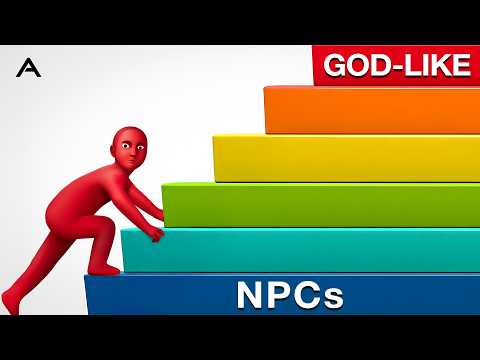
The Highest Levels of Thinking | Why Society is Stuck at the bottom
Human civilization is built on pyramids. Not just the stone ones baked under the Egyptian sun, but invisible structures, hierarchies of thought, layers of meaning, and levels of thinking that range from the most basic impulses to the heights of true revelation. And yet, despite...
Human civilization is built on pyramids. Not just the stone ones baked under the Egyptian sun, but invisible structures, hierarchies of thought, layers of meaning, and levels of thinking that range from the most basic impulses to the heights of true revelation. And yet, despite the astonishing tools, knowledge, and information available to us today, most people never climb past the very first steps. In school, in politics, in culture, and especially online, the majority of society still operates at the lowest layers of thinking: remembering , or more accurately, simply regurgitating everything they’ve been told.
Health
You’re Out of Tune (And It’s Making You Miserable)
What's the difference between changing yourself and changing the world? Only one of them actually works. In this wide-ranging conversation, Keith Martin-Smith and David Arrell diagnose the core pathology of contemporary life: we're living in an attainment culture that measures worth through accumulation—more status, more...
What's the difference between changing yourself and changing the world? Only one of them actually works. In this wide-ranging conversation, Keith Martin-Smith and David Arrell diagnose the core pathology of contemporary life: we're living in an attainment culture that measures worth through accumulation—more status, more recognition, more stuff—while starving the qualities that actually make life worth living. The result? Epidemic levels of anxiety, polarization, narcissism, and a quiet desperation that no amount of productivity hacks or self-optimization can touch. The alternative isn't another framework to add to your collection. It's a fundamental reorientation toward attunement culture—a shift from quantity to quality, from getting to becoming, from conquest to meaning. David lays out the architecture of this shift across three temporal dimensions: HEALTH (The Past): Most of us are operating from developmental anchors—unconscious wounds and reactive patterns that keep us stuck at earlier stages of maturity. When you criticize, control, or comply automatically, you're not responding to what's in front of you; you're responding from an old script. The work is to turn toward these patterns with curiosity, reclaim the energy locked there, and stop letting the past hijack your present. DEPTH (The Present): Your attention is under siege. Billions of dollars have been spent engineering super-normal stimuli to keep you distracted, metabolically aroused, and scrolling. But presence—the capacity to remain grounded when life gets turbulent—is the foundation of wisdom. Character and virtue aren't abstractions; they're your ability to tolerate weather without capsizing. The fruits of the spirit (love, joy, peace, patience, kindness, goodness, faithfulness, gentleness, self-control) emerge spontaneously when you create the conditions, like apples from a healthy tree. GROWTH (The Future): Beyond your current capacities are your leading edges—the places where you're stretching into new territory. Growth means tolerating the unknown, throwing aspirational grappling hooks into territory you can't yet see clearly, and expanding your container of authenticity. It's not about becoming someone else; it's about becoming more fully who you already are. Throughout the conversation, Keith and David return to a revolutionary foundation: dignity culture. Unlike respect (which must be earned), dignity simply is—every human being has equal claim to worth by virtue of being human. This creates common ground from which we can build toward higher ground. It dissolves the false choice between dominator hierarchies and victim narratives, between attainment Olympics and oppression Olympics. The examples are visceral: Martin Luther King Jr. didn't change America by attacking his enemies—he changed it by cultivating such depth of character that he could march from Selma without taking opposition personally. Lama Tsering Everest changed a room simply by walking into it. The power of alignment—when your intrapersonal, interpersonal, and cultural dimensions move in the same direction—is magnetic. The conversation offers practical wisdom for the current moment of cultural chaos: shift from grievance to gratitude, from entertainment to enrichment, from tribe of the chosen to tribe of the chosen ones you intentionally create. Track your attention. Practice humor. Grant dignity to yourself and others. Get your butterflies in formation. This isn't self-help. It's a blueprint for becoming the kind of person who can actually create change—not by trying to fix everyone else, but by doing the work that makes your very presence a form of influence.
Astronomy/ Cosmology
How Light Becomes Matter (and Back Again) | SLEEP SCIENCE STORIES
What if everything around you — every atom, every object, even you — once existed as pure light? In tonight’s Sleep Science Story, we explore one of the most mind-bending truths in physics: light can become matter, and matter can turn back into light. Relax...
What if everything around you — every atom, every object, even you — once existed as pure light? In tonight’s Sleep Science Story, we explore one of the most mind-bending truths in physics: light can become matter, and matter can turn back into light. Relax as we dive into the strange world of E=mc², particle creation, and the dance between energy and mass that shapes our universe. From the heart of stars to the vacuum of space, discover how the cosmos continuously transforms light into life.
Neuro-Science
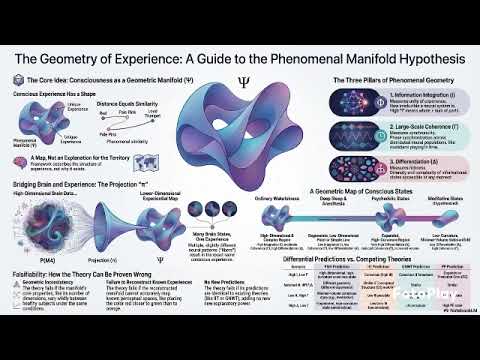
The Geometry of Consciousness: Understanding the Divine Pattern
This podcast explores a bold new theory proposing that every feeling, thought, or dream may have an actual shape. The Phenomenal Manifold Hypothesis by Éric Reis suggests that consciousness can be mapped as a geometric structure—a “phenomenal manifold” (Ψ). Instead of asking why experience exists,...
This podcast explores a bold new theory proposing that every feeling, thought, or dream may have an actual shape. The Phenomenal Manifold Hypothesis by Éric Reis suggests that consciousness can be mapped as a geometric structure—a “phenomenal manifold” (Ψ). Instead of asking why experience exists, it focuses on describing its structure, much like thermodynamics described heat before molecular theory. According to the model, each conscious experience corresponds to a point in a vast multidimensional landscape, and the distance between points reflects how similar two experiences are. The geometry of Ψ is determined by three measurable properties of brain dynamics: Integration (I), representing how unified and irreducible a conscious moment is; Coherence (Γ), measuring how synchronized neural regions are; and Differentiation (Δ), capturing the richness and variety of possible brain states. These three forces define the curvature, dimensionality, and shape of your inner world at each moment. The theory predicts that different states of consciousness correspond to distinct geometries. Wakefulness forms a high-dimensional space with moderate curvature. Deep sleep or anesthesia collapses the manifold into a low-dimensional, nearly flat structure. Psychedelic states expand the geometry dramatically into a highly complex, high-dimensional manifold with high Differentiation but often lower Coherence. Certain meditative states contract the manifold into a unified, low-volume geometry that may shrink to less than 20% of its waking size. Crucially, the model is testable and falsifiable. It must accurately reconstruct known phenomenological structures—such as color relationships—or it fails. It also predicts that the intrinsic dimension of consciousness should remain relatively stable across healthy individuals; large variations would falsify the theory. The hypothesis also offers a framework for evaluating machine consciousness. By analyzing an AI system’s informational dynamics, researchers could compute Integration, Coherence, and Differentiation. The theory proposes minimal thresholds—such as Imin ≈ 0.15 bits and dimensionality n ≥ 3—for a system to be considered a potential candidate for consciousness. If an AI meets these criteria, the precautionary principle suggests treating it as potentially phenomenal. Ultimately, this podcast discusses how the Phenomenal Manifold Hypothesis proposes that consciousness may have a discoverable geometry. By translating neural information dynamics into geometric structure, it offers a scientific bridge between objective brain activity and subjective experience, opening new ways to map the hidden landscapes of the mind.
Advaita Vedanta
Francis Lucille: A Masterclass In Non-Duality
Francis Lucille, originally trained in mathematics and physics, is a contemporary spiritual teacher in the Advaita Vedanta tradition, highly regarded for his clear and experiential articulation of non-duality. In this conversation with Natalia Vorontsova, Lucille explains that Advaita Vedanta is grounded in a single axiom:...
Francis Lucille, originally trained in mathematics and physics, is a contemporary spiritual teacher in the Advaita Vedanta tradition, highly regarded for his clear and experiential articulation of non-duality. In this conversation with Natalia Vorontsova, Lucille explains that Advaita Vedanta is grounded in a single axiom: there is only one reality, which he equates with consciousness. The apparent multiplicity of selves, worlds, bodies, and minds is an appearance arising within this one consciousness. An important value of Advaita Vedanta, in the myriad of idealist spiritual traditions, is that it focuses not so much on achieving altered states of consciousness, but rather offers a method to recognize that consciousness is the single, universal reality.
Scientists Reveal a Theory Suggesting Another Reality Has Been Intersecting Ours
Right now, while you watch this, another version of you made a different choice. In a lab in California, a particle just passed through two separate slits at the exact same time. Scientists have discovered that reality itself might be splitting into countless copies every...
Right now, while you watch this, another version of you made a different choice. In a lab in California, a particle just passed through two separate slits at the exact same time. Scientists have discovered that reality itself might be splitting into countless copies every single second. We are talking about the Many-Worlds Interpretation, a theory suggesting that infinite parallel universes exist right here, overlapping with ours. If you enjoy exploring these mind-bending ideas, subscribe and hit that like button. Prepare yourselves. We begin.
What does it truly mean to be alive? Nobel Prize-winning geneticist Paul Nurse answers biology’s most fundamental (and elusive) question in his full interview with Big Think. Drawing from decades of research, Nurse explores how five core ideas redefine life, from the hidden power of...
What does it truly mean to be alive? Nobel Prize-winning geneticist Paul Nurse answers biology’s most fundamental (and elusive) question in his full interview with Big Think. Drawing from decades of research, Nurse explores how five core ideas redefine life, from the hidden power of the cell to the bizarre machinery inside us all.
This Forgotten Code Shows EXACTLY How Language Controls Reality
Everything is energy - and language is the code that collapses reality. You were never taught this, but every word you speak is a quantum measurement. You are not describing your life - you are fixing it into place. In this 1 hour 19 minute...
Everything is energy - and language is the code that collapses reality. You were never taught this, but every word you speak is a quantum measurement. You are not describing your life - you are fixing it into place. In this 1 hour 19 minute master-class, we expose the hidden mechanism behind manifestation, language, and reality creation through the work of John Archibald Wheeler, quantum physics, and ancient esoteric traditions that understood this thousands of years ago. This video reveals why: • Your subconscious treats words as commands • Observation doesn’t reveal reality — it creates it • Speech collapses probability into lived experience • Silence preserves infinite potential • Repetition stabilizes destiny You’ll learn: • The Participatory Universe explained simply • Why “I am” statements lock identities permanently • How language entangles you with money, health, and relationships • Neville Goddard’s revision method explained through quantum mechanics • The 7 exact protocols to reprogram your reality starting tonight This is not motivation. This is instruction. Once you see this, you can never speak unconsciously again.
Documentaries
The 6 Civilizations Before Us Were Erased on Purpose… We’re the 7th, and This Explains Everything
Everything is energy. This documentary explores why so many people feel that something about the world doesn’t quite add up, drawing on psychology, history, and philosophy to examine how human perception, memory, and behavior are shaped over time. By looking at recurring patterns in past...
Everything is energy. This documentary explores why so many people feel that something about the world doesn’t quite add up, drawing on psychology, history, and philosophy to examine how human perception, memory, and behavior are shaped over time. By looking at recurring patterns in past civilizations, modern research on inherited behavior, and the way attention and awareness influence experience, the video offers a calm, grounded perspective on how humans adapt to change and uncertainty. This is not a belief system or a prediction, but an exploration of how patterns repeat, how meaning is formed, and how understanding these dynamics can bring clarity to how we live in the present.
Astronomy/ Cosmology
Dan Winter’s Golden Theory of Everything, Animated FractalGUT.com animated by Nikolene Ahha & Andy
Dan Winter's Golden Theory of Everything explores a unifying principle behind physics, using the golden ratio. This animated explanation details "charge collapse," a wave compression mechanism, and its potential impact on gravity and consciousness. The theory proposes a mathematical framework scaling from Planck length to...
Dan Winter's Golden Theory of Everything explores a unifying principle behind physics, using the golden ratio. This animated explanation details "charge collapse," a wave compression mechanism, and its potential impact on gravity and consciousness. The theory proposes a mathematical framework scaling from Planck length to protons, challenging mainstream science.
Analytic Idealism
Towards A New Physics Of Living Systems and Consciousness
Physicist and physician Dr. Anita Goel has designed the equivalent of the double slit experiment in a living system, to test if the nanomachines that read and write DNA could operate quantum mechanically. In this interview with Hans Busstra, Goel talks about her experiment and...
Physicist and physician Dr. Anita Goel has designed the equivalent of the double slit experiment in a living system, to test if the nanomachines that read and write DNA could operate quantum mechanically. In this interview with Hans Busstra, Goel talks about her experiment and explores the new theoretical framework it could lead to: a new physics to understand life, living systems and consciousness. Hans Busstra interviewed Dr. Goel after her presentation at the Science of Consciousness Conference in Barcelona (7 October 2025), this full presentation in which she describes her experiment in detail can we watched here: • 2025 TSC - Barcelona Plenary 10 - Quantum... Dr. Anita Goel is a physicist, physician, and pioneering nanotechnology entrepreneur whose work bridges quantum physics, biomedicine, nanotech, and AI. She is the Founder, Chairman, and CEO of Nanobiosym Research Institute and Nanobiosym Diagnostics (https://www.nanobiosym.com), where she developed the Gene-RADAR, winner of the first XPRIZE in healthcare. Recognized by MIT Technology Review as one of the world’s top science and tech innovators and by Scientific American as a leading biotech visionary, she has also earned three DARPA Breakthrough Awards and consistently appears on global top-35 and top-100 lists in nanotech and engineering.
Biology/Ecology
This New Tech Revolutionizes Biology..
Dr. Michael Levin is on the verge of revolutionizing medicine by unlocking the bioelectric code that governs how cells communicate, heal, and build complex structures. His work reveals that intelligence exists at every level of biology—allowing us to reprogram tissues, regenerate limbs, and even suppress...
https://youtu.be/Exdz2HKP7u0
Dr. Michael Levin is on the verge of revolutionizing medicine by unlocking the bioelectric code that governs how cells communicate, heal, and build complex structures. His work reveals that intelligence exists at every level of biology—allowing us to reprogram tissues, regenerate limbs, and even suppress cancer by restoring cellular memory and connection.